


National University (NU) Vice-Chancellor Professor ASM Amanullah has said Artificial Intelligence (AI)-based “Applied ICT” will be a game changer in the future job market.
He emphasised that the primary goal of higher education is to develop skilled, creative, and responsible human resources capable of leading in a changing world.
Considering current technological realities, digital competence and the ability to solve practical problems using information technology are essential for every student.
To this end, National University has made “Applied ICT” course compulsory for all subjects in the second year of the Bachelor (Honours) programme.
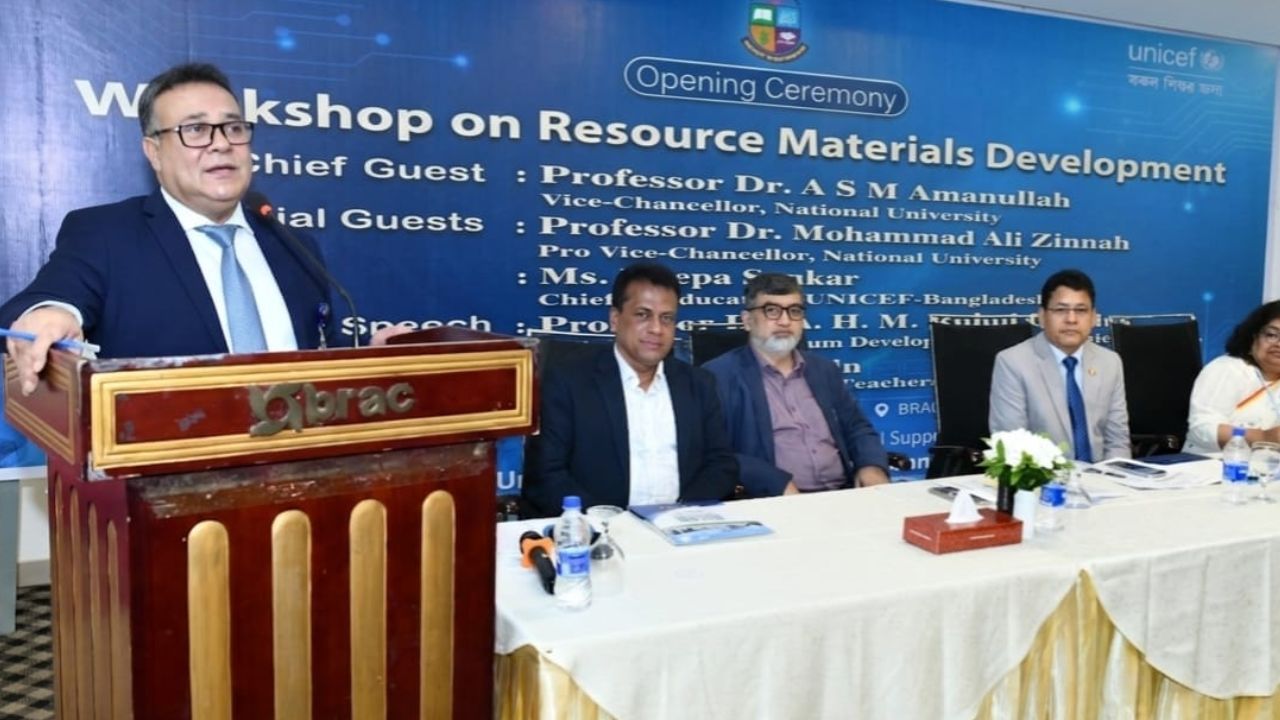
The vice-chancellor made these remarks as the chief guest at the inaugural ceremony of a four-day workshop titled “Resource Materials Development” held at BRAC CDM in Savar on Sunday.
The workshop was organised by National University with technical support from UNICEF Bangladesh.

Curriculum reforms, policy accountability
Amanullah noted that despite more than five decades of independence, the country has been unable to develop an advanced and timely curriculum.
While there are debates regarding the quality of education and certificates at National University, he pointed out that numerous graduates have established themselves in important positions at home and abroad through their own merit.
However, due to a lack of skills-based curricula, many students are being deprived of the skills required for the job market. He asserted that policymakers, rather than students or teachers, are responsible for this reality.
The vice-chancellor explained that the current reforms being implemented by National University aim to prepare students for their future careers.




By making ICT education practical and application-oriented, students will gain skills in cyber security, digital marketing, the gig economy, and freelancing, thereby making them ready for both higher education and the global job market.
Addressing regional challenges
Highlighting his recent visits to educational institutions in various regions, including Rajshahi, Bogra, and Naogaon, Amanullah shared that students in remote areas are persevering despite inadequate resources and teacher shortages.
In some instances, a single teacher is required to conduct an average of 16 to 17 classes. Even in the absence of ICT labs, teachers are conducting classes using projectors. These issues have been reported to the relevant departments, which have promised swift action.
He further announced that National University has undertaken significant investments and multi-faceted steps for the 2026–2027 academic year to enhance students’ ICT skills.
The content of the second-year ICT syllabus is highly applied, and mastering these modules will allow students to excel in the domestic and international job markets. Standardised “Resource Materials” and guidelines are being developed for every college to support this initiative.
Digital literacy, social values
Amanullah observed that modern students are not “digitally blind,” as almost everyone possesses a smartphone and is active on social media.
Students are increasingly interested in the digital economy and online businesses rather than just seeking traditional jobs. However, they require systematic knowledge and proper guidance.
Citing his research from a decade ago, Amanullah noted that digital literacy among university students was then only 19 per cent. While the situation has improved, there remains a significant gap in awareness regarding the use of digital platforms.
He expressed concern over the culture of “trolling” senior citizens online and stressed the need for extensive work on digital etiquette. He called for courage in addressing the challenges of socialisation to ensure the youth remain on the right track.
A collaborative effort
Amanullah said the success of the course depends on quality implementation, requiring modern training modules, learner-friendly materials, and skilled trainers. He described the workshop as a vital step towards making the university’s education system more efficient and innovation oriented.
The materials developed here will help make the learning experience more effective and of international standard for millions of students.
He added that academic knowledge alone is no longer sufficient for professional success; students also need digital literacy, data analysis capabilities, effective communication, teamwork, and the creative use of technology.
The technical partnership with UNICEF Bangladesh is an example of an effective collaboration in achieving these reforms. The workshop was moderated by Salma Parveen, director of the Teacher Training Department at National University.
Special guests included National University Pro-Vice-Chancellor Professor Mohammad Ali Jinnah and UNICEF Bangladesh Chief of Education Deepa Sankar. Professor AHM Ruhul Quddus, dean of the Curriculum Development and Evaluation Centre, delivered the welcome address.
Participants included subject specialists, curriculum and pedagogy experts, online course design specialists, and representatives from both National University and UNICEF Bangladesh.