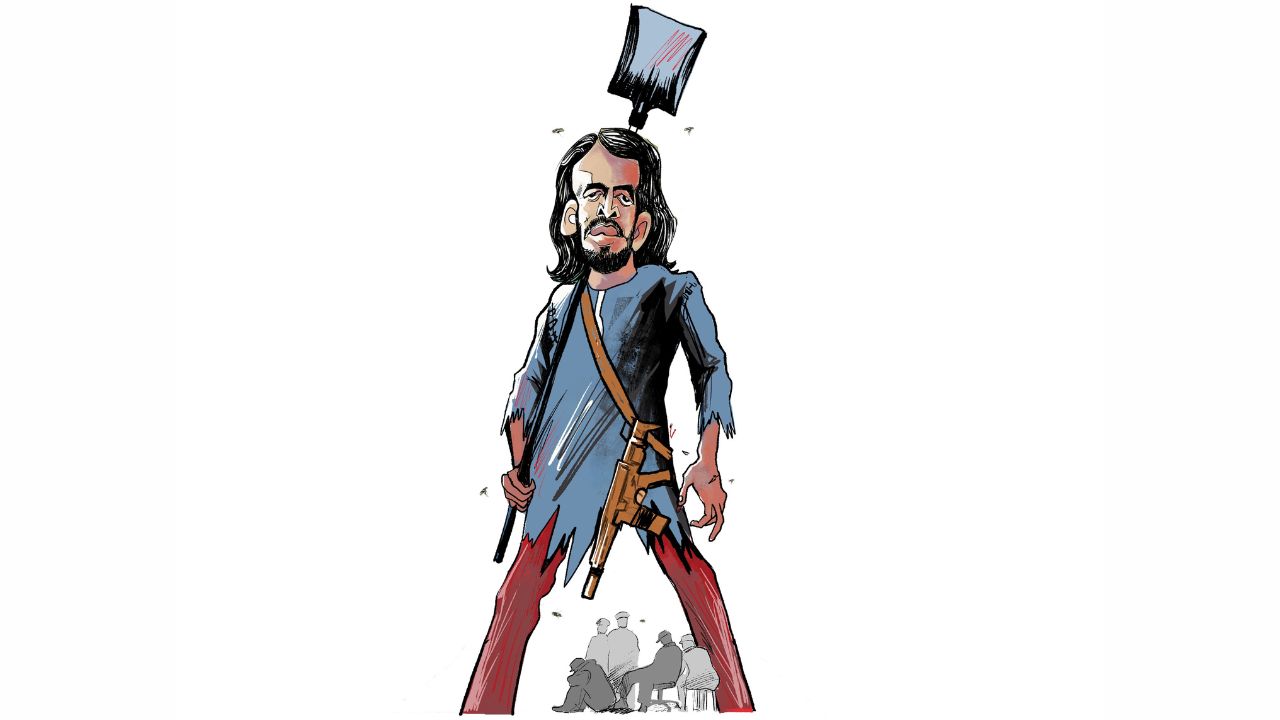

Self-styled as a “Living Gazi”, invoking the fierce spirit of Ottoman conquerors, Salahuddin Ammar’s rhetoric remains steeped in menace.
He shot to fame as a joint coordinator of the Anti-Discrimination Student Movement during the 2024 July uprising, winning over peers with fiery slogans before cementing his popularity by rallying against Rajshahi University’s controversial “ward quota”.
Yet, since taking office as general secretary of the Rajshahi University Central Students Union (Rucsu), his tenure has been overshadowed by mounting allegations of reckless aggression.
Ammar stands accused of intimidating the university’s teaching staff, instigating brawls, and delivering speeches laced with veiled threats of violence.
Former pro-vice-chancellor of the university Farid Uddin Khan admitted the campus was “embarrassed and alarmed by Ammar’s uncontrolled behaviour.”
The outrage reached boiling point recently after he allegedly orchestrated the brutal beatings of students branded as banned Chhatra League loyalists.
Campus leaders are now fighting back.
Sultan Ahmed Rahi, president of the university unit Jatiyatabadi Chhatra Dal, insisted Ammar’s antics are completely unacceptable for a student representative. “He should already be behind bars for the library attacks. We demand maximum punishment,” Ruhi told TIMES of Bangladesh.
Asked on whether his aggression would ever stop, Ammar delivered a chillingly ambiguous reply, “If Bangladesh’s justice system doesn’t function properly, I think it won’t be the last.”
Armed with a spade, threatening to bury students
On Monday, Ammar was spotted charging towards the RU central library brandishing a spade, threatening to bury a student alive.
By the time the dust settled, three students lay severely beaten before being handed over to the police, only to have a criminal case filed against the injured victims themselves.
Video footage capturing the violence quickly surfaced, showing Ammar inside the reading room repeatedly beating a person with a heavy stick.

According to the Proctor’s Office, the chaos originally stemmed from a dispute over a romantic relationship.
The confrontation escalated during a meeting convened by the Proctor’s Office.
Ammar and Rucsu Assistant General Secretary Salman Sabbir accused a student, Anas, of Chhatra League ties.
After searching his phone and discovering photographs with leaders of the banned organisation, Ammar and Sabbir slapped him in front of Proctor Mahbubur Rahman.
Dismissed from the proctorial office, tensions boiled over by 3pm.
A brick-throwing clash erupted outside the Rucsu building between Anas’s group and activists from Rucsu and Islami Chhatra Shibir.
When Anas and two companions, Mahmudul and Hasib, sought refuge in the library reading room, an enraged Ammar led a mob inside. Activists pummelled the trio and any onlookers attempting to intervene with bamboo poles, iron rods, belts, and sticks.
Amid obscene abuse, Ammar held up a spade, screaming, “I’ll kill you. I’ll bury you. I’ll bury you for good.”


As a critically injured Mahmudul Hasan was carried to an ambulance, mob members kicked him and tried dragging him away before chanting religious slogans outside the administration building.
Ammar remained unrepentant, “We weren’t beaten. We did the beating,” adding that trusting administration enforcement had yielded nothing.
Pro-Vice-Chancellor Professor Abdul Alim called the incident “highly condemnable,” promising a swift investigation and punishment.
When TIMES asked about the assault, Ammar retorted, “What should be done when you see someone from a banned organisation?” Told he could not assault anyone, Ammar replied, “Had they attacked me, you would have reported that the Rucsu general secretary had been attacked.”
A trail of unchecked aggression
The latest library assault is merely one entry in a long list of controversies surrounding the Rucsu leader.
On 14 July, Ammar presented Vice-Chancellor Faridul Islam with a list of “pro-Awami League” teachers, threatening to detain and hand them over to police if action was stalled. Last 20 December, he demanded six deans resign for being “collaborators of fascists.”
“The administration has failed to act for eighteen months, so we’re taking matters into our own hands,” Ammar announced. He then forced the deans’ resignations, personally locking their office doors once the letters were secured.
His physical outbursts span months. On 21 September 2025, during a ward quota dispute at Zubery Building, Ammar allegedly assaulted Pro-Vice-Chancellor Main Uddin and grabbed an assistant registrar by the beard; an investigation remains pending.
On 17 June, he was accused of collar-grabbing Nawab Abdul Latif Hall Students Union General Secretary Md Nurul Islam Shahid during a FIFA match screening, a claim Ammar calls baseless.
Political figures have frequently drawn his wrath. On 18 January, Ammar tore down a Paris Road banner welcoming Tarique Rahman, put up by Zia Parishad president Nesar Uddin, and posted video footage online, prompting Chhatra Dal and faculty to urge the VC to arrange mental health treatment for him.
In late February and March, he verbally abused Chhatra Adhikar Parishad leaders, including President Mehedi Maruf, over protests regarding Ammar’s objectionable remarks about State Minister Nurul Haque Nur.
Online, on 21 May, Ammar faced backlash for posting an objectionable comment under a Ducsu leader’s post featuring a Pakistani woman.
Chhatra Dal vice-president Sheikh Nur Uddin Abir condemned the widespread cyberbullying, noting “even their own female leaders are not safe.” Ammar deleted the comment without further response.
Furthermore, on 26 October 2025, Chhatra Shibir secretary Nowsajjaman publicly accused Ammar of stealing a laptop from Rajshahi City Corporation during the July movement, an allegation Ammar denies.
Tk76 lakh donation controversy
Ammar’s financial dealings have also drawn severe scrutiny.
In 2025, he faced extortion allegations after sending letters to 70 organisations demanding Tk76 lakh to fund the “July 36, Festival of Liberation” concert, marking the Mass Uprising’s anniversary.
Dismissing the accusations, Ammar promised full financial disclosure for the event, yet those accounts remain unpublished.
Questions over Masud murder
Darker questions surround his presence during the brutal murder of Abdullah Al Masud.
On 7 September 2024, Masud, a disabled former Chhatra League member who had long abandoned politics, was abducted while buying milk and medicine for his four-day-old daughter.
Attackers stuffed him into a jute sack, bound his mouth, and savagely beat him with iron rods.
Mutilated years earlier in a 2014 campus attack that cost him his lower right leg and hand tendons, Masud was dragged between Motihar and Boalia police stations before dying at Rajshahi Medical College Hospital.
Though a murder case was filed, no investigation has commenced.
Ammar was spotted at Boalia Police Station as the dying man was brought in.
Talking to TIMES, Ammar vehemently denied any role in the killing, claiming his presence was purely coincidental while attending to an unrelated rape case.
The ‘Living Gazi’
On his Facebook profile, Ammar proudly styles himself a “Living Gazi”.
Having studied at the Shibir-controlled Tamirul Millat Madrasa and grown up immersed in a Jamaat-Shibir household and educational bubble, he considers himself “environmentally Shibir”.
Yet, he insists he never fully embraced the organisation on moral grounds, claiming he never studied its literature or held an official post.
Describing himself as a filmmaker, he acknowledges a brief stint with Shibir’s cultural wing and admits to organising several campus events under its banner during his madrasa days.
‘A display of muscle power’
Critics argue this background fuels a toxic culture of intimidation.
Fuad Ratul, convener of the Rajshahi University unit of the Ganatantrik Chhatra Jote, warned that Ammar’s behaviour signals a bleak return to the violent student politics of the past, demanding strict disciplinary action from the university administration.
Meanwhile, Mehedi Maruf, president of the Chhatra Adhikar Parishad, argued that Ammar’s deep-rooted Shibir ties were obscured during the Rucsu elections.
“He is brought to the forefront in controversial incidents and university disputes that Shibir does not want to handle directly, allowing the organisation to protect its image,” Maruf told TIMES.