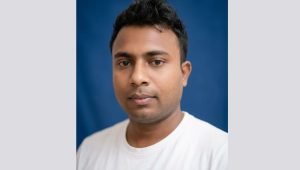
Like Shaheed Asad and Mohammad Shamsuzzoha in the mass upsurge of 1969, and Nur Hossain in the 1990 anti-authoritarian movement, Shaheed Abu Sayed emerged as one of the defining symbols of the 2024 July Uprising.
He was a student of Begum Rokeya University, Rangpur and a coordinator of the Students Against Discrimination movement there.
Born in Babanpur village in Pirganj upazila of Rangpur, in 2001, Abu Sayed came from a low-income family. He was the youngest of nine siblings. His father, Mokbul Hossain, worked as a day labourer, and the family had long struggled with poverty.
Yet Sayed continued his education with scholarships and support from relatives and villagers.
When the quota reform movement began on 6 June 2024, he joined it as a key organiser on his campus. He was a student of the 12th batch of the university’s English department, from the 2019-20 session.
On 16 July 2024, at about 2pm, Abu Sayed was shot in front of Begum Rokeya University at Park Mor during a protest. Witnesses and widely shared video footage showed him standing with both arms outstretched in front of armed police moments before he was hit by gunfire and collapsed. He was taken to hospital by fellow students, where doctors declared him dead.

The video of the shooting quickly spread on social media and triggered outrage across the country. Protests intensified in Dhaka, Chattogram, Rajshahi, Khulna, Barishal and Sylhet.
What had begun as a movement for quota reform soon widened into a broader anti-government uprising. The image of Abu Sayed standing unflinching in front of police fire became one of the most enduring frames of the movement.
Even the use of lethal force by state agencies failed to stop the momentum. People came onto the streets despite curfews, and the unrest went on to reshape the country’s political landscape, culminating in the fall of the Awami League’s more than 15-year rule.

The image of Abu Sayed standing unflinching in front of police gunfire quickly became a turning point in the movement, said Dhaka University Political Science Department Professor Mamun Al Mostafa.
“After the footage spread, it triggered a strong reaction across the country and accelerated the protests,” he told TIMES of Bangladesh.
“It marked one of the defining moments of the 2024 movement.”
Drawing parallels with earlier uprisings, he said figures such as Asad, who was shot during the 1969 mass movement, and Nur Hossain, a key figure in the 1990 anti-authoritarian protests, had come to occupy central places in the country’s political history.
“In the same way, how Abu Sayed’s death will be remembered in the history of the 2024 anti-government movement is something that is best left to time,” he added.
Those who knew Abu Sayed say his story also carried the weight of social mobility. He first won a talent pool scholarship in primary school, studied at Khalashpir Dimukhi High School, where he achieved GPA-5 in his Secondary School Certificate examination. Later, he secured the highest GPA again in Higher Secondary studies at Rangpur Government College.
His death turned him from a campus organiser into a national symbol. For many Bangladeshis, Abu Sayed came to embody both the anger that drove the 2024 uprising and the personal sacrifice that gave it force.
Abu Sayed began university in 2020. After completing his fourth-year examinations, he had started preparing for job recruitment tests as the movement demanding the abolition of quotas in government jobs gathered pace.
Three months after his death, on 20 October, his undergraduate results were published.
The result brought a fresh wave of grief for his classmates. Sayed had secured a CGPA of 3.30 and ranked 14th in the combined merit list. By then, however, he was beyond the reach of all earthly calculations.
A day before he was killed, on 15 July, Abu Sayed wrote a Facebook post about Mohammad Shamsuzzoha, the Rajshahi University chemistry teacher who was shot dead by the Pakistani authorities in 1969.
In it, he wrote addressing Samsuzzoha, “Sir, we need you deeply at this moment. All those who lived in your time are gone, but you remain immortal even in death. Your grave is our inspiration. We are illuminated by your spirit.”
“At least to die as a Shamsuzzoha is a far greater joy, honour and pride.”
After Abu Sayed’s death, the post spread widely on social media, prompting protesters to take to the streets in defiance of the oppressive government.