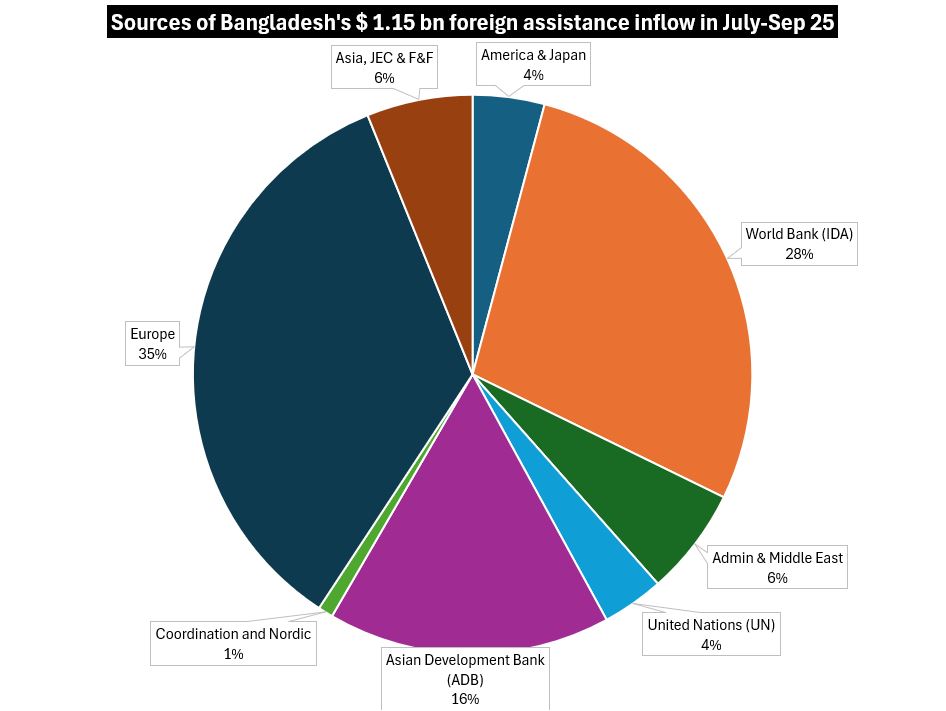
Foreign loans and grants to Bangladesh rose 35.7% year-on-year to $1.15 bn in the first quarter (July–September) of FY2025–26, showing a notable rebound after last year’s slowdown, provisional data from the Economic Relations Division (ERD) show.
Foreign-aid commitments also surged more than 32 times to $910.67 mn in the quarter, compared to just $27.41 mn in the same period a year earlier.
Europe led disbursements with 35% of the total, followed by the World Bank Group’s 28% and the Asian Development Bank’s 16% share of the total funds given to Bangladesh in the three months.
Of the total inflow, $1.04 bn came as loans and $100.47 mn as grants. Commitments this year included $821.7 mn in loans and $88.97 mn in grants, indicating renewed interest from development partners.

The Asian Development Bank accounted for 53% of total commitments, after having made none in the same quarter last year. The World Bank Group’s commitment rose slightly to $12.44 mn, while Europe’s increased to $77.1 mn from $21.56 mn.
However, without stronger commitments in the remaining three quarters, Bangladesh may end the fiscal year with barely half of its $9.23 bn foreign-assistance target.




Amid political uncertainty, slower project implementation and a weaker global financing climate, the country saw a 16.6% drop in disbursements to $8.57 bn and a 22.5% fall in commitments to $8.32 bn in FY2024–25.
In FY2023–24, Bangladesh received $10.28 bn in foreign assistance — its second-highest ever — while commitments rose 18.4% to $10.74 bn.
Debt servicing continues to climb
Between July and September 2025, the government repaid $816.88 mn in principal and $462.96 mn in interest — a 13.6% year-on-year rise in foreign-debt repayments.
In local-currency terms, total repayments reached Tk 15,591.69 crore, up 16.2% from a year earlier.
During FY2024–25, foreign-debt servicing totalled $4.09 bn, an increase of 21% — with $2.6 bn in principal and $1.49 bn in interest.
ERD officials said large loans contracted between 2017 and 2021 have now entered their repayment phase, intensifying pressure on annual outflows.
They added that the recent rebound in inflows reflects resumed disbursements from development partners and improved project execution, but cautioned that without stronger commitments, annual assistance could remain far below FY2023–24 levels.
“The data show a short-term rebound in inflows, but debt repayments are rising even faster,” said a senior ERD official.
He added that maintaining a sustainable balance between new aid and repayments will be one of the key fiscal challenges this year.