


The Policy Research Institute of Bangladesh (PRI) has warned that Bangladesh’s economic recovery remains fragile amid persistent inflation, weak investment, and limited fiscal capacity, urging stronger coordination between monetary and fiscal authorities and genuine central bank independence to ensure long-term stability.
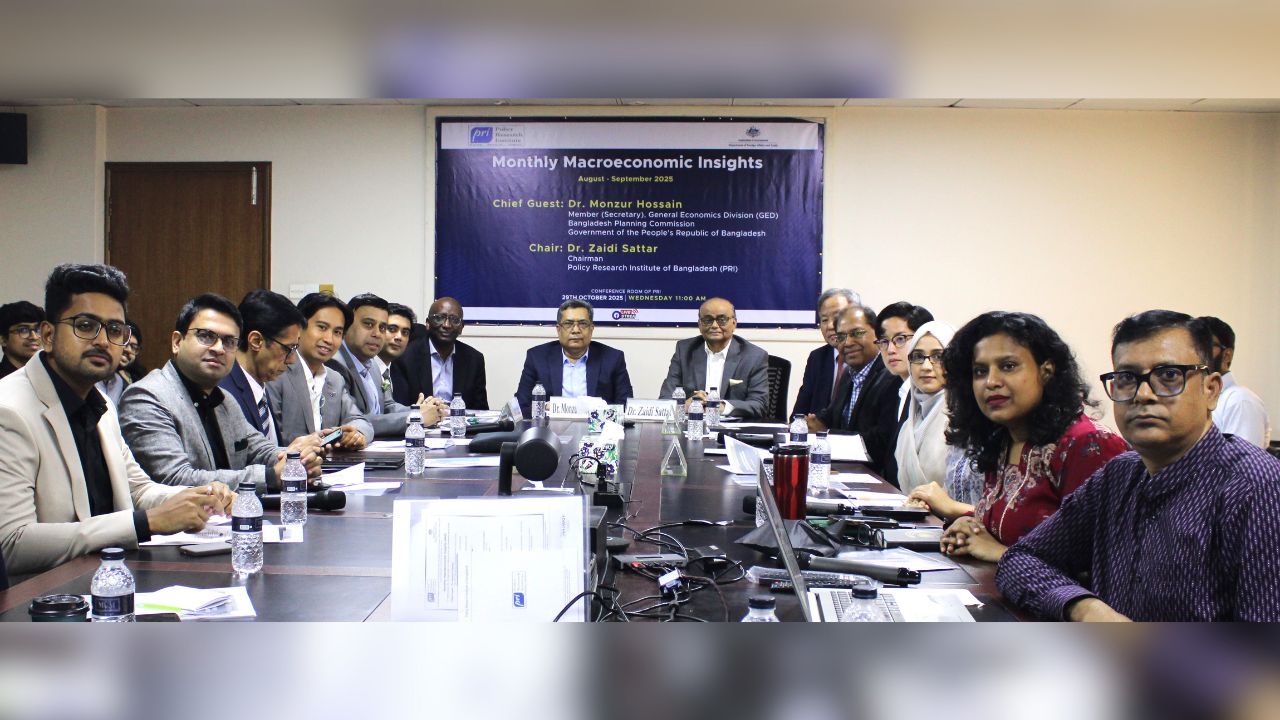
The observation came as the Centre for Macroeconomic Analysis (CMEA) of PRI, in collaboration with the Australian Government’s Department of Foreign Affairs and Trade (DFAT), released the August–September edition of its Monthly Macroeconomic Insights (MMI) on Wednesday at the institute’s conference room in Dhaka.
The report said the recovery from poverty and inequality is slow, with inflation staying above 8 percent and wage growth failing to keep pace with rising prices. Although import growth shows signs of renewed momentum, PRI described the overall recovery as uneven.
Bank deposit growth has finally reached double digits after 17 months, which the report termed a “policy dividend.” However, PRI cautioned that this trend must continue for at least five years to offset losses from non-performing loans.
It also described the tax-to-GDP ratio as a “pyramid of shame,” noting that weak revenue mobilisation restricts the government’s ability to fund social protection and public investment.
Bangladesh Planning Commission Member of General Economics Division Monzur Hossain, attending as chief guest, said investment depends on a stable economic ecosystem and cannot be revived overnight.

“The tight monetary policy should be relaxed moderately to encourage investment. Central bank independence is crucial, but fiscal and monetary authorities must work in sync,” he said.
PRI Chairman Zaidi Sattar, who chaired the session, said that the previous US-Bangladesh trade relationship based on comparative advantage in labour-intensive exports has been undermined by a new reciprocal tariff regime.
Presenting the keynote paper, PRI Principal Economist Ashikur Rahman warned that entrenched “economic oligarchs” continue to distort policymaking. “They infiltrate political and state institutions to serve their interests.




If unchecked, they will weaken the economy that sustains them,” he said. He urged both the interim and next elected governments to protect the financial sector from political interference.
The panel discussion featured PRI Research Director Bazlul Haque Khondker, Policy Exchange Chairman Masrur Reaz, and Meghna Group Director Tanjima Mostafa. Khondker said growth alone cannot reduce inequality, with only about one percent of social safety allocations reaching the poor.
Reaz warned that without new greenfield investments, job creation will remain slow, while Mostafa highlighted that many Letters of Credit from local banks are being rejected abroad, increasing import costs.
Australian Deputy Head of Mission Joshua Gacutan lauded the PRI-DFAT partnership, while Korean Ambassador Park Young Sik emphasised the need for tax reform and central bank independence.

UNDP Country Economic Advisor Owais Perry said supply-side measures must complement monetary policy to control inflation.
Concluding the session, PRI Executive Director Khurshid Alam said economic stabilisation is underway but remains uncertain.
“True sustainability depends on balancing growth with structural resilience,” he said.