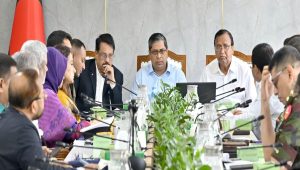
Ahead of the upcoming 13th National Parliament Election, the Election Commission led by AMM Nasir Uddin held a dialogue with representatives from civil society and teachers. Participating in Sunday’s dialogue, the representatives described the forthcoming election as the most significant challenge for the Commission.
They called for vigilance to prevent election-time violence, alongside adopting effective strategies to counter false information on social media, the misuse of AI, and issues concerning postal voting. Participants also advised against moving to a proportional representation (PR) system without a trial implementation.
In his welcome speech, Chief Election Commissioner AMM Nasir Uddin said, “I hope this dialogue will play a role in making the upcoming election fair and acceptable. We have completed much work. We have updated the voter list alongside legal reforms. We have progressed significantly towards holding the vote fairly.”
Mentioning the initiative for IT-supported postal voting for expatriates, he informed that arrangements will also be made for over one million personnel engaged in the election within the country. Government officials and people in legal custody will be able to vote, which will be a milestone this time
Speakers at the dialogue cautioned the current Commission by referencing the experiences of previous Election Commissions. In their view, bold, independent, and visible steps by the EC are crucial for a fair election. Some speakers raised the question of whether it is even possible to organise the “best” election while excluding any political party.
Journalist, columnist, and Editor of Charcha, Sohrab Hassan, said, “The bigger question is whether the current Election Commission itself believes that a fair election is possible under the present government. If it does believe so, then it must take responsibility for the next election. And if it does not believe so, then it must publicly state within the next five months what the government ought to do. Only then will public trust in the EC grow.”

He said, “You must have the mindset to hold an election, but you must also have the mindset not to hold an election. If you believe a fair election is not possible, you should step back from holding it; you should resign. I said the same to the previous EC.”
“Preparations are underway to hold an election by excluding some parties. There are also talks of excluding one side from the election. The Consensus Commission is talking to 30 parties. If anyone from there says they will participate in the election, you must consider what the situation will then be. The chief adviser has said it will be the best election. So, if you hold an election by excluding someone, how will it be the best election?” he added.
Rasheda K Choudhury, former advisor to the caretaker government, said, “The EC has done a lot of work. You must remember the expectations of the young generation and the voices of all – young and old, rich and poor – so that we do not forget. A crisis of confidence has become rampant. There remains intense anger regarding women’s issues. Women are 51%, yet seat representation is only 5-7%. We are aggrieved. Our minimum demand is to ensure 33% representation for women.”




She said, “There must be an environment for women to vote without hindrance. I hope the EC will ensure this. The voting rights of persons with disabilities and a conducive environment for them to vote must be ensured.”
Professor Robayet Ferdous of Dhaka University said, “Despite many achievements, we are very sad and unfortunate because we still have not been able to fix the election process. Why does a nation and state fail? The nation that fails to build its institutions, fails.”
“You have seen the fate of Bangladesh’s three former chief justices. One chief justice was shoved out of Bangladesh before the 5 August. Another was mobbed out on the 5 August. Another Chief Justice, ABM Khairul Haque, is now in jail. You have also seen the fate of former Election Commissioners,” he added.
He said, “Human Rights Commission, Information Commission, Parliament – Bangladesh essentially has no institutions. People have no trust in the police. In such a situation, no one trusts anyone. My request to the Election Commission is: only if you have a backbone, only if you have courage, can you be independent.”
He said, “Over the last 20 years, every profession – teaching, journalism, politics – has been tarnished. The dignity of every profession has been destroyed. Everything is broken. No one has any trust or faith in anyone. I said the same thing last time but the previous EC could not show that courage, that backbone.”
Former ambassador Humayun Kabir said the biggest challenge and achievement is to hold a successful election. For the country, this is a transition; which direction Bangladesh goes will depend on its success. Just as the 1970 election was a turning point, this election will also be a turning point.
He said, “People will want to see the EC on a high moral standard. An exemplary election is people’s expectation. You must think about what people want, the heights you need to reach; you must also consider perception. Holding a fair election is necessary in the current complex context.”
Humayun Kabir said, “My understanding is that in this election, 80 percent of the campaign will be on social media, online. How prepared is the EC for this? False information, misinformation, AI-generated information will come. Social media will create much excitement even before the election.”
Vice-Chancellor of Chittagong University Professor Muhammad Yahiyea Akhter said, “You are going to hold an election in what one must say is a terrible situation. On the verge of institutional destruction over the last 15-20 years. If you can deliver a fair election in such a terrible situation, the EC’s name will be written in the pages of history.”
He said, “Postal voting is a new challenge. It has many opportunities to become controversial. You must be cautious about this. If exemplary measures are taken in enforcing the code of conduct, the election could be somewhat peaceful.” Noting that while the government changed, the bureaucracy did not, he mentioned that the EC has many trained people under its wing. He advised appointing its own officials as Returning and Assistant Returning Officers, keeping bureaucrats aside.
TIB Director Baduzzaman said, “There are weaknesses in the effective mechanism for verifying affidavit information and in applying the code of conduct.” Advising to have measures for monitoring and disclosing election expenses, he said, “Giving loan defaulters time until the day before nomination submission (for repayment/rescheduling) will encourage them. With the new proposal, we are moving backwards; it will essentially encourage loan defaulters.” He stated that provisions for a ‘No’ vote are essential not only in single-candidate constituencies but in all constituencies.
Senior Fellow at the Power and Participatory Research Centre Abdul Wazed said, “For the EC officials to command and control the field administration is very important for conducting the election.” He believes that instead of field administration officers handling complaints during voting, EC officials themselves will struggle to cope.
In his concluding speech, Nasir Uddin said, “We want to make the election transparent. We want to make arrangements so that everyone can see it. We will try to implement your suggestions.”
The CEC said, “I don’t answer many phone calls. I don’t talk on the phone for fear of call leaks. But our doors are open. We will accept your recommendations at any time.”