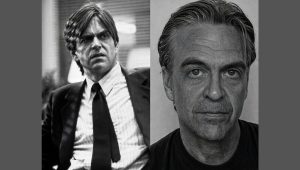
Paul Thomas Anderson’s ‘One Battle After Another’ (2025) is a bold, ambitious film that redefines what a blockbuster can be. Nearly three hours long and made with a $130 million budget, it is Anderson’s largest project to date, yet it still carries his unmistakable stamp as an auteur. The film proves that a director can retain personal style and thematic depth, even within the high-stakes, spectacle-driven world of modern action cinema.
At its heart, the film explores the cost of political struggle across generations. The story begins with the rise and fall of the French 75, a radical left-wing group. Leonardo DiCaprio plays Ghetto Pat Calhoun, an explosives expert, alongside Teyana Taylor as Perfidia Beverly Hills, his daring and complex partner. Their revolution ends in betrayal and humiliation at the hands of Colonel Lockjaw, played by Sean Penn, whose personal grudges now drive a larger campaign of state-sanctioned violence. Sixteen years later, Pat, now living under the name Bob Ferguson with his daughter Willa (Chase Infiniti), must confront the past when Lockjaw resurfaces. This time gap allows Anderson to show how the consequences of radical actions ripple forward, affecting not just those who take part, but the next generation as well.
The film’s tone is adventurous and unpredictable. It shifts between comedy, action, and intimate family drama, yet never feels disjointed. The humor is often dark, highlighting the absurdity of institutional cruelty. For example, Lockjaw, a military officer using immigration raids to settle a personal score, is both terrifying and ridiculous—a perfect illustration of the film’s view of power as irrational and petty. These tonal shifts give audiences space to absorb the weight of the story, keeping them engaged without overwhelming them.
The performances are a major strength. DiCaprio is both fiery and weary, capturing a man torn between his revolutionary past and his desire for a quiet life. Taylor’s Perfidia is fierce, unpredictable, and morally complex, driving much of the film’s energy. Penn’s Lockjaw is menacing yet humanly flawed, showing that the worst systems of power are often run by ordinary people with extraordinary pride. Chase Infiniti shines as Willa, embodying the cost of her parents’ past choices, while the supporting cast—including Benicio del Toro and Regina Hall—adds depth, showing that resistance can take many forms beyond explosive action.
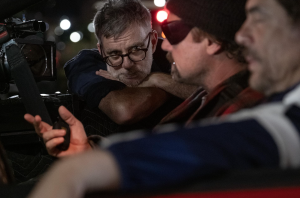
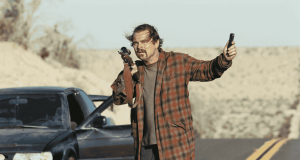
Visually, the film is stunning. Cinematographer Michael Bauman uses VistaVision, 70mm, and IMAX to capture the landscapes of California in breathtaking detail. Wide, painterly shots of deserts and hills create a sense of scale, while tighter, grainier shots bring immediacy to the action. Practical stunts, including a thrilling car chase across Borrego Springs, give the film a tactile, physical realism that CGI often cannot match. Every frame feels carefully composed, balancing beauty with danger.
Jonny Greenwood’s score adds another layer of intensity. His music is jagged, unpredictable, and sometimes unsettling, reflecting the story’s tension and ideological conflict. The combination of orchestral swells, rock riffs, and dissonant percussion makes the soundtrack feel like a character in itself, amplifying the film’s sense of unease and urgency. Needle-drop moments and pop-culture references link the film’s past and present, emphasizing how history continues to shape the story’s events.
What sets One Battle After Another apart is its ability to merge blockbuster spectacle with a deeply personal, political story. Anderson uses the trappings of high-budget action—the car chases, explosions, and dramatic confrontations—not as entertainment alone, but to reinforce the stakes of the narrative. The film does not allow viewers to escape into simple thrills; instead, it demands engagement with themes of systemic corruption, racial injustice, and the inherited costs of ideology.
While some may find the film long or occasionally uneven in pacing, these fluctuations mirror the unpredictability of its world. Moments of quiet reflection are followed by bursts of adrenaline, echoing the chaos of revolutionary life and the persistent tensions of systemic oppression. In that sense, the film’s very rhythm reinforces its political and emotional messages.
One Battle After Another is an important statement in contemporary cinema. In a time when blockbuster films are often defined by franchises or brand recognition, Anderson shows that commercial cinema can also be deeply personal and thought-provoking. It is both accessible to a wide audience and layered enough to reward close attention, bridging the gap between spectacle and artistry.

Ultimately, the film is a testament to Anderson’s vision. It proves that an auteur can retain control over scale and style, using the resources of a blockbuster to tell a story that is intimate, urgent, and socially aware. One Battle After Another is not just an action film—it is a reflection on history, power, and responsibility, told with energy, intelligence, and emotional weight. In Anderson’s hands, the blockbuster becomes a vehicle for ideas, showing that cinema can thrill, challenge, and inspire all at once.
Credits:
Director: Paul Thomas Anderson; Writers: Paul Thomas Anderson (written by) and Thomas Pynchon (inspired by the novel Vineland); Producers: Paul Thomas Anderson, Sara Murphy, and Adam Somner; Cast : Leonardo DiCaprio, Sean Penn, Teyana Taylor, Chase Infiniti, Benicio del Toro, Regina Hall, and Alana Haim; Composer: Jonny Greenwood; Cinematographer: Michael Bauman; Editor: Andy Jurgensen; Casting Director: Cassandra Kulukundis; Production Designer: Florencia Martin.