
Former FIFA president Sepp Blatter once described India as a “sleeping giant” of football. But nearly two decades later, the sport finds itself in fresh turmoil, with problems running from grassroots to the very top.
The men’s national team are currently without a head coach, and the Indian Super League (ISL) – the country’s top-tier competition – faces an uncertain future due to a dispute between the All India Football Federation (AIFF) and its commercial partner, Football Sports Development Limited (FSDL).
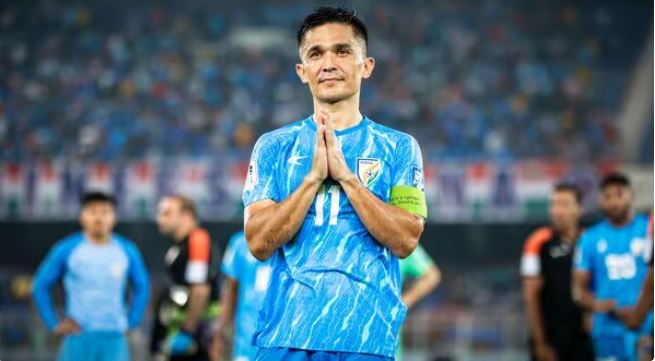
“Everybody in the Indian football ecosystem is worried, hurt, scared about the uncertainty we are faced with,” wrote Sunil Chhetri on X. The veteran forward’s message captured the anxiety within Indian football as doubts grow over the fate of the ISL.
Chhetri, 40, came out of international retirement in March. It was a move that underlined a deeper issue – the national side lacks capable successors. Despite being past his prime, the striker, with 95 international goals, remains indispensable. He trails only Cristiano Ronaldo, Lionel Messi and Ali Daei in the all-time men’s scoring chart.
India are currently ranked 133rd in the FIFA rankings, their lowest standing in nearly a decade. The men’s team have won only one of their last 16 matches and continue to miss out on World Cup qualification.

Spanish coach Manolo Marquez stepped down earlier in July after just a year in charge. His tenure ended with a 1-0 defeat to Hong Kong in Asian Cup qualifying – a result that starkly contrasts the population gap between the two countries.
The ISL, typically played between September and April, is facing disruption ahead of the 2025 season. The rights agreement between the AIFF and FSDL is set to expire on 8 December and no extension has been finalised.
This standoff has left the league paralysed, affecting more than 5,000 individuals including players, coaches and technical staff.




Still, some within the system remain hopeful. Former India goalkeeper Subrata Paul, now the national team director, told AFP, “Indian football, like any growing ecosystem, will face its share of challenges and transitions.”
He added, “Yes, the recent results and the uncertainty around the ISL are difficult for all of us who love the game, but I see a silver lining as well. It’s an opportunity to strengthen our foundation by investing in youth development, infrastructure and quality coaching.”
The ISL began in 2014 with ambition and star power, bringing global names like Alessandro Del Piero to India. But over time, the league has struggled with dwindling viewership and a drop in sponsor interest.
Although it was envisioned as a product that could rival cricket in popularity, football has remained third behind cricket and hockey. Its strongest followings remain limited to areas like Kolkata and Kerala.
FIFA has long sought to unlock India’s football potential, with Arsene Wenger visiting the country in 2023 to inaugurate a youth academy. The former Arsenal boss, now FIFA’s global head of football development, remains invested in India’s grassroots scene.
AIFF president Kalyan Chaubey met Wenger again in June. According to Chaubey, Wenger emphasised the need for early training – starting at age eight instead of the typical 13 in India.
India have never qualified for a World Cup, and their next chance will not come until at least 2030. But the past offered glimpses of hope: the country qualified for four Olympic Games between 1948 and 1960, finishing fourth in Melbourne in 1956.
Yet the giant remains asleep.
According to journalist Jaydeep Basu, poor leadership is at the heart of the crisis. “The fact that the team which was ranked 99 in September 2023 has come down to 133 basically shows poor management,” he said.
“There is a caucus working in the AIFF of two or three people who are running the show for their own benefit.”
Basu, who recently authored Who stole my football?, believes meaningful change will only come with accountability and a clear vision for the future – something the current system sorely lacks.