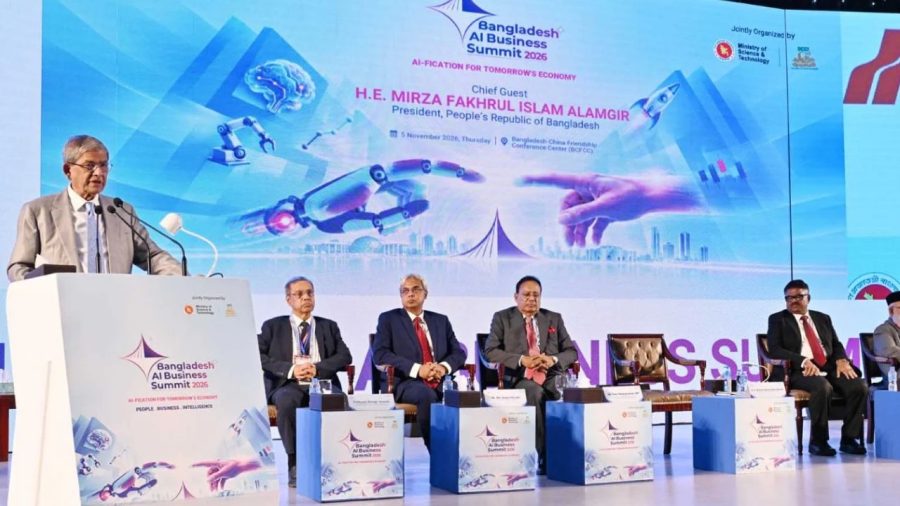



President Mirza Fakhrul Islam Alamgir has called for transforming Bangladesh from a user of artificial intelligence (AI) into a nation capable of developing, applying and innovating the technology.
Speaking as the chief guest at the inaugural ceremony of the Bangladesh AI Business Summit 2026 at the Bangladesh-China Friendship Conference Centre in Dhaka on Thursday.
The President said collective efforts were essential to build a country that could lead in both AI innovation and its responsible application.
Bangladesh must become an active partner in technological transformation rather than a passive participant, working towards an AI-enabled, innovation-driven and human welfare-oriented society instead of becoming dependent on the technology, he said.
The president observed that Bangladesh was approaching a major transformation in which AI would play a central role. Its impact would largely determine the country’s future in agriculture, education, healthcare, industry, commerce, employment and the wider economy over the next decade, as well as its position in the global arena.
AI is not merely a technology for future generations but could become a major driver of Bangladesh’s development, he added.
Highlighting its potential to increase productivity, modernise industries, expand exports, attract investment and create decent jobs for millions of young people, Mirza Fakhrul identified the country’s large youth population as its greatest strength.
If equipped with technology skills and appropriate training, young people could become the driving force of the Fourth Industrial Revolution, he said.
Citing international research showing that AI could add trillions of dollars in value to the global economy in the coming years, the president urged Bangladesh to seize the opportunity.

He called on businesses not to view AI merely as a cost-cutting tool but as a means of developing new products and services, entering new markets and creating employment.
He also urged universities and young people to work together to address the challenges of graduating from least developed country (LDC) status and realise the ambition of building a trillion-dollar economy by 2034.
The president said the readymade garment sector had given Bangladesh international recognition, while a new generation of young people equipped with AI capabilities could help establish a new global identity for the country.
Outlining government initiatives, he said work was under way to formulate a values-based National AI Policy focusing on ethics, human rights, risk-based regulation and responsible use of the technology. Efforts were also being made to develop national AI capabilities based on the Bangla language.
Achieving these goals would require joint efforts from businesses, researchers, universities and young entrepreneurs, he said.
However, the president warned that the expansion of AI also raised concerns about unemployment, particularly as a significant section of the country’s population was educated but unemployed.
He said the technology offered immense opportunities but also posed serious risks and uncertainties, making caution necessary at every level to prevent it from taking control of human activities.




Emphasising the need for safe AI applications and effective regulation, he warned that uncontrolled technological development could pose an existential threat to human civilisation.
Technology could be considered truly beneficial only when it served human welfare and the advancement of civilisation, he said, stressing that AI applications must reflect Bangladesh’s political, economic and social realities.
Before his address, the president was presented with an honorary memento. He later visited various exhibition stalls at the venue alongside other guests.
Speaking as a special guest, Science and Technology Minister Fakir Mahbub Anam said AI was no longer merely a technological issue in the era of the Fourth Industrial Revolution but a key determinant of productivity, competitiveness and the future of the economy.
Citing World Economic Forum data, he said AI’s contribution to the global economy was projected to reach nearly $16 trillion by 2030, making its strategic adoption essential across Bangladesh’s agriculture, industry and services sectors.
The minister said the Ministry of Science and Technology and the Ministry of Posts, Telecommunications and Information Technology were jointly working under Prime Minister Tarique Rahman’s leadership to develop an AI-friendly ecosystem.
The government was formulating a National AI Policy to ensure safe and responsible use of the technology, protect data privacy and accelerate innovation, he said.
He also outlined initiatives to provide special research grants, expand incubation facilities for local startups and researchers, and offer technical support to micro, small and medium-sized enterprises (MSMEs).
Work was also under way to develop a robust Bangla natural language processing system to bring citizens under voice-command-based digital services, he added.
The minister said the government was providing training in AI, machine learning and other emerging technologies under the prime minister’s direction, with the aim of creating 10 lakh jobs.
Calling for technology to be used for human welfare and its misuse prevented, he urged businesses in sectors such as garments, banking, logistics and healthcare to adopt AI.
Public-private cooperation would be essential to establish Bangladesh as a global hub for AI and technological innovation, he said.

Government Whip and Chairman of the Parliamentary Standing Committee on the Ministry of Science and Technology M Ruhul Quddus Talukder Dulu also stressed the need for responsible AI adoption in line with government policies to modernise the economy and improve productivity.
He highlighted the importance of equipping young people, entrepreneurs and researchers with skills in AI, data science, cybersecurity and machine learning.
Referring to the broader economic environment, Dulu said Bangladesh was moving towards new opportunities despite economic and political challenges. He urged the business community to help create an enabling business environment free from unnecessary obstacles and harassment.
Speaking at the event, Science and Technology Secretary Md Anwar Hossain emphasised the need for an integrated Science, Technology and Innovation (STI) framework.
He said the ministry was working to make advanced technologies, including AI, semiconductors, biotechnology and robotics, beneficial and accessible to citizens.
He outlined four key pillars of the framework: developing skilled human resources through science, technology, engineering and mathematics (STEM) education; strengthening research and its practical applications; commercialising innovations through startups and industries; and building national capabilities in frontier technologies.
The secretary also highlighted recent government initiatives to bring innovators, researchers and investors together, including the BEAR Summit in July, the Semiconductor Symposium and the Bangladesh Innovation Fair 2026 in September.
He called for establishing a National AI Platform to ensure ethical use of AI, data security and solutions tailored to domestic needs. An effective partnership among the government, academia and industry would be crucial to achieving these goals, he said.
International Chamber of Commerce (ICC) Bangladesh President Mahbubur Rahman also spoke as a special guest.
Alamgir Hossain, chief executive officer of UK-based Readiness and Intelligent Systems Limited and a former professor, delivered the keynote address, while Dhaka Chamber of Commerce and Industry (DCCI) President Taskin Ahmed gave the welcome address.
The summit was jointly organised by the Ministry of Science and Technology and the DCCI.
Government officials, researchers, innovators, corporate entrepreneurs and business leaders attended the event.
More than 150 organisations, including local and international companies, technology providers and innovators, showcased their products and innovations at exhibition stalls. Students and young innovators from 20 educational institutions also presented their AI projects.