


Extreme heat reduced Bangladesh’s potential labour earnings by an estimated $17.5b in 2025, as rising temperatures increasingly threatened workers’ ability to earn a living, according to the 2026 Lancet Countdown report on health and climate change.
Bangladesh lost an annual average of more than 26 billion potential working hours to heat exposure between 2016 and 2025, 71 per cent above the average in the 1990s. The $17.5b estimate covers earnings in 2025 alone, while the working-hours figure represents an annual average over a decade.
Separately, human-caused fine particulate air pollution was linked to an estimated 2,39,000 deaths in Bangladesh in 2023, highlighting the growing health and economic costs of environmental risks.
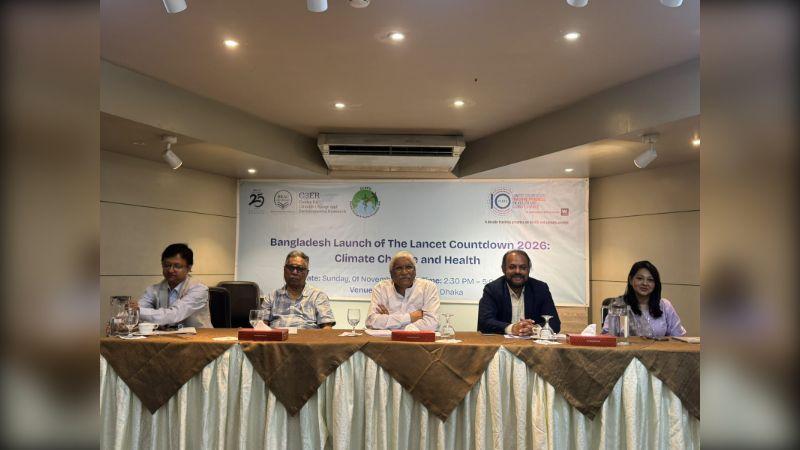
The findings were presented at the report’s national launch at BRAC Centre Inn in Dhaka on Sunday, organised by BRAC University’s Centre for Climate Change and Environmental Research (C3ER), with technical support from the Health Ministry’s Climate Change and Health Promotion Unit.
The report, titled “The Lancet Countdown on Health and Climate Change 2026: A Decade of Escalating Health Harms and a Decisive Moment for All”, found that infants and older people faced particularly sharp increases in heatwave exposure.
Between 2021 and 2025, infants experienced an annual average of 7.6 heatwave days, up 162 per cent from 1986–2005. People aged over 65 experienced 7.2 days, an increase of 136 per cent.
The estimated annual economic value of heat-related deaths among people over 65 reached $3.8b during 2021–2025, up 495 per cent from 2000–2004 and equivalent to approximately 2,16,000 average annual incomes. Unlike the labour earnings estimate, this figure represents a monetary valuation of premature mortality.

Environmental economist Shouro Dasgupta presented the findings at the event.
Air pollution’s economic toll
Deaths linked to human-caused fine particulate air pollution, known as PM2.5, rose 40 per cent between 2016 and 2023, reaching an estimated 2,39,000. Fossil fuels contributed to 37.5 per cent of those deaths in 2023.
Household air pollution was separately associated with 77,500 deaths that year, down from 90,700 in 2016.
The estimated monetary value of premature deaths attributable to air pollution reached $77.6b, equivalent to 16.4 per cent of Bangladesh’s gross domestic product. This represents an economic valuation of mortality, not direct expenditure or lost earnings.




Bangladesh’s energy system became 9.9 per cent more carbon-intensive between 2016 and 2023, while net fossil fuel subsidies reached $5.3b in 2024, equivalent to 52.9 per cent of the national health budget.
Department of Environment Additional Director General Md Ziaul Haque said the findings underscored the need to reduce pollution and fossil fuel use while implementing Bangladesh’s climate commitments.
He called for translating the country’s nationally determined contribution and National Adaptation Plan into action.
C3ER Director Md Golam Rabbani said Bangladesh had traditionally focused on cyclones, storm surges and salinity intrusion, often overlooking their health consequences.
“Heat stress is affecting farmers, outdoor workers and urban communities, while dengue has become a recurring public health concern,” he said.
Although climate policies recognise health as a priority, implementation has received insufficient resources and attention, he added.
Health adaptation funding falls short
Forty-eight developing countries estimated their combined health adaptation needs at a minimum of $3.3b annually, but funding commitments reached only $1.1b in 2024, covering one-third of their stated needs, the report found.
Funding and staffing shortages remain major barriers to implementing national health adaptation plans.
Bangladesh reported that its meteorological and hydrological services provide climate information to the health sector, but only two of five climate-related legislative documents assessed in 2025 contained health provisions. The country also raised climate-health concerns at the United Nations General Debate for the second consecutive year.

Centre for Advanced Studies Executive Director Atiq Rahman warned that rising temperatures were harming workers and increasing health risks for mothers and children.
“Had we acted earlier, we could have better protected people from these impacts,” he said.
BRAC University Emeritus Professor Ainun Nishat called for implementing the Health National Adaptation Plan, prioritising food security, nutrition and vector-borne diseases.
He stressed the need for region-specific health data and protection for outdoor workers, many of whom have little choice but to work during extreme heat.
Nishat also warned that global temperatures could rise by 3.5 degrees Celsius by the century’s end if current warming continued. He urged greater use of renewable energy and raised concerns about acid-rain risks from high-sulphur coal.
GSCC Global Climate and Health Lead Tahrim Ariba Chaudhury urged policymakers to address household healthcare costs at COP31 and make renewable energy investment commercially attractive.
Lancet Countdown Executive Director Marina Romanello said climate-related health damage was growing faster than the global response despite progress in clean energy and health-system preparedness.
The report, prepared by more than 300 researchers from over 100 institutions, found that several climate-related health risks intensified faster during 2016–2025 than in the preceding decade.
Its authors called for climate change to be recognised as a global health emergency, with health prioritised in emissions policies and climate financing.