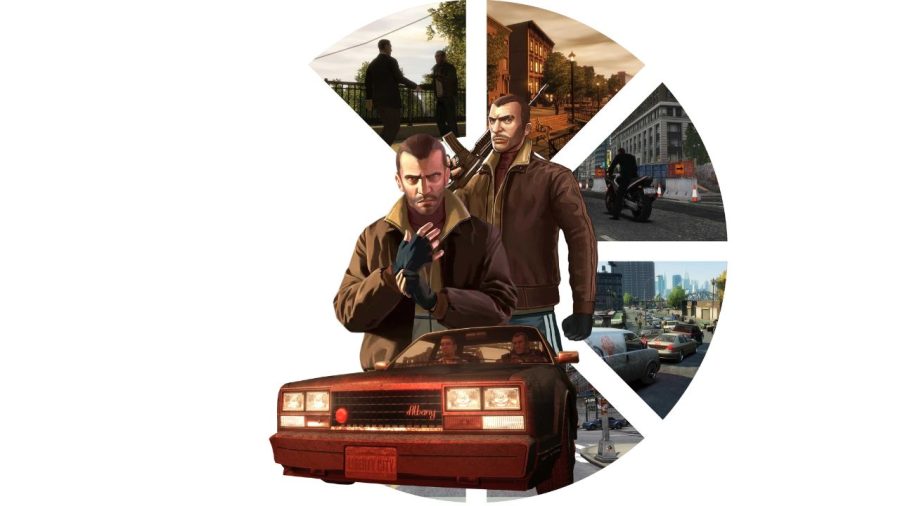



In 2008, Rockstar Games gave players a city to conquer, a fortune to chase and a dream to pursue. Then it asked a more uncomfortable question: what if the American Dream was never going to save you?
When Grand Theft Auto IV arrived in April that year, it felt like a deliberate rejection of everything that had made its predecessors so exhilarating. Gone was much of the sun-drenched absurdity of San Andreas, replaced by rain-slicked streets, grey skies and a city whose inhabitants seemed perpetually disappointed with their lives. Liberty City was not somewhere to become a legend. It was somewhere to discover how little a legend was worth.
At its centre stood Niko Bellic, an Eastern European war veteran who crossed the Atlantic in search of a better life. What he found was a cramped apartment, a cousin drowning in debt and a criminal underworld that offered him precisely the sort of violence he had hoped to leave behind. Beneath the guns, car chases and spectacular urban chaos, GTA IV was something unexpectedly intimate: a tragedy about immigration, disillusionment and the terrible difficulty of escaping oneself.
Niko arrives aboard the cargo ship Platypus, having been lured to America by the extravagant promises of his cousin, Roman Bellic. Roman’s letters describe mansions, sports cars and a life of improbable luxury. The reality is a struggling taxi business, gambling debts and a shabby Broker apartment.
It is one of Rockstar’s sharpest jokes, and one of its saddest. America has not betrayed Niko so much as exposed the distance between what he imagined and what he could reasonably expect. Roman’s lies were not simply attempts to impress his cousin; they were a defence against his own failure. The American Dream survives, in Liberty City, less as a promise than as a story people tell themselves to keep going.
Niko is hardly an innocent victim. His past is stained by the atrocities of war, including a massacre that left him the sole survivor of his military unit. He has come to America seeking both escape and revenge, pursuing Darko Brevic, the man who betrayed his comrades, while trying to evade Ray Bulgarin, a criminal associate from his earlier life.

The brilliance of Niko’s character lies in the contradiction. He can be tender towards Roman, generous towards friends and genuinely disturbed by the suffering around him. He can also kill without hesitation. Violence is his livelihood, his inheritance and, perhaps, the only language in which he knows how to survive.
Michael Hollick’s weary, understated performance gives Niko an extraordinary human presence. He is not a conventional action hero who discovers his conscience along the way. He is a damaged man who understands the cost of his actions but struggles to imagine an alternative.
Liberty City is the game’s other great protagonist. Inspired by New York, it is a place of recognisable neighbourhoods, crowded pavements, anonymous office towers and decaying industrial districts. Its scale is impressive, but its real achievement is atmosphere.
The city seems to carry its own exhaustion. Radio presenters peddle conspiracy theories and commercial nonsense; politicians promise renewal; strangers argue on street corners. Everywhere, somebody is selling a version of success that somebody else cannot afford.




This is satire with a distinctly bitter edge. Earlier entries in the series often invited players to revel in their own ridiculousness. GTA IV still contains absurd comedy, but its jokes more frequently expose the desperation beneath American consumer culture. The city is full of people trying to become richer, more important or more desirable, with little evidence that any of them are becoming happier.
Even the driving reinforces the shift in tone. Cars possess weight, lean through corners and react imperfectly to collisions. Characters stumble, grasp for support and respond to injuries with startling physicality. Rockstar’s RAGE engine, combined with NaturalMotion’s Euphoria animation technology, made Liberty City feel less like a stage for stunts and more like a place where actions had consequences.
The result could be frustrating. The handling was heavier, the pacing slower and the world less eager to indulge the player. But these were not merely technical novelties. They served a coherent artistic purpose: making violence feel physical rather than theatrical, and making the city feel inhabited rather than assembled.
The two expansions, The Lost and Damned and The Ballad of Gay Tony, deepened that vision by examining Liberty City from radically different social positions.
Johnny Klebitz’s story follows a motorcycle club struggling with loyalty, drugs and internal collapse. Luis Lopez’s takes place among nightclub owners, celebrities and wealthy clients whose glamorous lives conceal their own insecurities. One world reeks of petrol and betrayal; the other glitters beneath expensive lights. Both are governed by people who mistake power for control.
Their stories intersect with Niko’s through a stolen shipment of diamonds, turning a familiar crime plot into a small study of perspective. An event that appears significant to one protagonist becomes background noise to another. The city continues moving regardless of who believes themselves to be its main character.
Together, the three campaigns suggest that Liberty City’s corruption is not confined to a particular class or subculture. The biker, the immigrant and the nightclub fixer inhabit different worlds, but each is trapped by competing loyalties, compromised ambitions and the consequences of decisions made under pressure.
The game’s bleakest insight emerges in its final hours. Niko eventually confronts Darko, only to discover that the man responsible for his comrades’ deaths has become a broken addict. The revelation offers no satisfying resolution. Killing him cannot restore the dead; sparing him cannot undo the past.

The final choice between Deal and Revenge extends that logic. Neither path offers uncomplicated victory. In the Deal ending, Roman is killed at his wedding. In the Revenge ending, Kate McReary dies instead. The player can choose which relationship is sacrificed, but cannot escape the underlying tragedy.
This is where GTA IV distinguishes itself from the familiar fantasy of criminal ascent. Money, reputation and influence can be accumulated, but they cannot purchase absolution. Niko may survive Liberty City, yet survival is not the same as redemption.
Commercially, GTA IV was a phenomenon, generating approximately $310 million in its first 24 hours. Its success also brought controversy, from protests over drunk driving to renewed arguments about violence in video games and the compensation of performers. Yet its most enduring achievement was artistic rather than commercial.
Its 98 Metascore reflected the extraordinary critical reception, but numbers alone cannot explain its place in gaming history. Rockstar had demonstrated that an open world could be more than a playground for limitless possibility. It could be a setting in which freedom itself felt compromised by history, poverty, obligation and regret.
Nearly two decades later, GTA IV remains the series’ most uncomfortable masterpiece. It offers no triumphant vision of America, no clean break with the past and no guarantee that doing the right thing will save the people we love.
Instead, it gives us Niko Bellic, looking out across a city that promised everything and delivered so little.
Somewhere beneath Liberty City’s grey skies, the American Dream is still alive. It simply looks rather different from the advertisements.