


Chattogram Development Authority (CDA) has taken a strict stance to ease traffic congestion, identify risky buildings, prevent deviations from approved construction plans, and ensure fire safety across the port city.
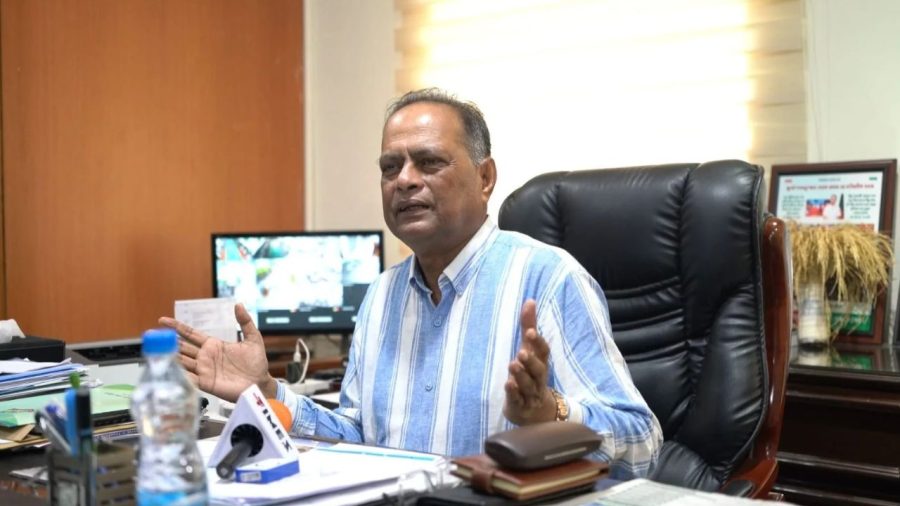
Belayet Hossain, engineer and chairman of CDA, told TIMES of Bangladesh in an interview on Tuesday that electricity and water connections will be denied to buildings constructed in violation of approved designs.
He warned that prolonged unplanned urbanisation and a lack of coordination among service agencies have put Chattogram at risk of becoming uninhabitable.
The interview was conducted by Jubair Uddin in Chattogram, in the presence of Shahadat Hossain Chowdhury, acting bureau chief of TIMES, Chattogram, and Zakir Hossain, photojournalist.
To address dilapidated and unsafe structures, CDA is coordinating with Chattogram City Corporation to demolish buildings that are completely unusable.
Hossain explained that demolition is not necessary for all non-compliant structures, as many were built with design deviations, such as erecting 11 storeys on an eight-storey approval or failing to maintain mandatory front, rear, and side setbacks.
Structural modifications are being initiated in such cases to rectify irregularities, while strict rules are being enforced for new constructions to ensure urban safety and restore pedestrian movement.
Drive against parking violations, traffic bottlenecks
Regarding traffic congestion, CDA has identified bottleneck-prone roads to execute priority interventions, particularly inspecting parking management at hospitals, schools, kindergartens, madrasas, shopping malls, and markets situated along main thoroughfares.

Many establishments allocated parking space during plan approval but restrict its actual use, such as denying entry to patient vehicles or imposing rigid terms at schools.
Hossain noted that hospital parking is an essential component of healthcare services, and the absence of proper parking inevitably creates traffic jams.
While initial persuasion led several hospitals and educational institutions to comply and ease traffic in certain areas, enforcement drives are being conducted against non-compliant entities.
The chairman emphasised that ongoing drives do not target any specific individual, institution, or group, but focus solely on rectifying irregularities that cause traffic jams, public suffering, and design violations.
Having faced numerous lawsuits and imprisonment in the past, Hossain expressed his readiness to go to jail again if required to serve the public interest and reduce citizen hardship.



Utility connection rules, fire safety standards
Highlighting utility connection rules, Hossain explained that withholding electricity and water connections is essential to establish discipline beyond routine drives.
New buildings must guarantee parking, fire safety, and emergency fire exits, especially in medical facilities, to ensure the safe evacuation of patients, doctors, and visitors during fires or earthquakes.
CDA has held joint meetings with officials from the fire service, police commissioner, and health department to strengthen overall building security.
Moreover, owing to the sharp decline in groundwater levels, deep tube-wells are becoming ineffective in many areas, prompting CDA to mandate the installation of rainwater retention tanks in buildings for rainwater harvesting.
Tracing the historical causes of urban degradation, Hossain pointed out that Chattogram’s natural environment of hills, plains, the Karnafuli river, and the Bay of Bengal estuary was damaged by hill cutting, canal filling, and unauthorised building construction.
Over the past 17 and a half years, designs approved by CDA were frequently altered during actual construction, leading to encroachments on canals and drains that normalised urban irregularities.
CDA is currently reviewing past approvals and construction activities to identify irregularities, while avoiding blame-game politics in favour of practical problem-solving.
Hossain noted that past political and administrative conditions compelled many individuals to make compromised decisions.
CDA is also prioritising solutions to housing shortages, including resolving long-standing obstacles in projects like Ananya Residential Area where plot owners were previously unable to build.
Inter-agency coordination, 2025-50 master plan
Public response to CDA drives has been positive, with citizens phoning and messaging the authority – at times as late as 2am or 3am – to report traffic bottlenecks and public suffering.

Traffic conditions near Chittagong Medical College Hospital and Mehedibag have already become more manageable, enabling pedestrians to walk comfortably on footpaths.
While infrastructure projects like the Outer Ring Road, Elevated Expressway, and feeder roads have reduced travel times, Hossain stressed that large infrastructure must be paired with strict regulations on road usage, parking, footpaths, and building construction.
He added that growing up, studying, and participating in political activities in Chattogram provided him with first-hand knowledge of local problems while navigating alleys on foot or by rickshaw.
Addressing inter-agency coordination, Hossain explained that uncoordinated work among service providers – where roads are repeatedly dug up for drains, water pipes by WASA, or poles by the electricity department – exacerbates public suffering.
CDA is bringing the city corporation, WASA, and other relevant bodies under a unified umbrella to work collaboratively as a team.
Looking ahead, CDA is formulating a long-term master plan for 2025 to 2050, proposing satellite towns in Patiya, Karnafuli, Anwara, Sitakunda, Hathazari, and Rauzan to reduce population pressure on the city core.
In line with the vision of Tarique Rahman, prime minister, to provide housing for 1,00,000 people, CDA is planning to construct and distribute flats ranging from 600 to 650 square feet and 1,200 to 1,500 square feet for low and middle-income groups.
To boost local employment, CDA plans to construct a low-cost market over the Karnafuli river and rehabilitate small businesses by building semi-pucca structures on recovered illegal encroachments at Bayezid, Moijjartek, and Kaptai Rasta Head under one-year renewable leases.
Concluding the interview, Hossain urged obstructionists to respect and obey the law, reiterating that CDA will assist compliant builders but will not tolerate irregularities that cause public distress.
He added that he holds no attachment to his office and will return to his original place once his tenure ends, but remains fully committed to leading the CDA team to make Chattogram a liveable city.