


Almost every Bengali knows Allah Megh De Pani De, the song that pleads with the clouds for rain. Farmers and schoolchildren alike can hum its familiar tune. Far fewer, however, can name the singer who helped make it famous: Abbasuddin Ahmed.
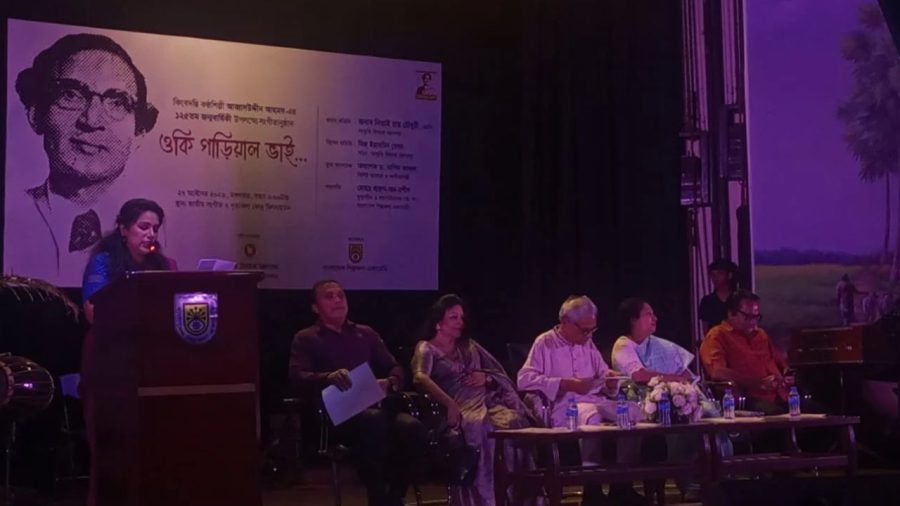
Bangladesh Shilpakala Academy marked the legendary singer’s 125th birth anniversary on Tuesday with an evening of songs and speeches titled Oki Gariyal Bhai. The programme took place at the National Music and Dance Centre Auditorium.
Yet the celebration also raised a question: how well do we remember the man behind the songs that remain part of our collective memory?
Born on 27 October 1901 in the Tufanganj subdivision of Cooch Behar, Abbasuddin came from a lawyer’s family. He went to Kolkata to pursue music and became a gramophone star at a time when many Muslim households considered singing improper.
He refused to hide his identity. While some Muslim singers recorded under assumed names, Abbasuddin insisted that his own name appear on record labels, despite the record company’s unease.

His partnership with Kazi Nazrul Islam helped bring Islamic devotional songs into homes where music had previously been unwelcome. He also took the sounds of rural life to gramophone records, recording Bhawaiya, Kshiral and Chatka from Rangpur and Cooch Behar, alongside Jari, Sari, Bhatiyali, Murshidi, Bichchhedi, Marsiya and Dehatatwa.
He sang Islamic-themed songs written by Nazrul, Jasimuddin and Golam Mostafa.
His rendition of the rain-calling Jari song became so popular that composer SD Burman adapted it for the 1965 Hindi film Guide. Abbasuddin died on 30 December 1959. He received the Pride of Performance posthumously in 1960, the Shilpakala Academy Award in 1979 and the Independence Day Award in 1981.




The anniversary programme brought together established performers Rezaul Karim Limon, Rahat Ara Giti, Noshin Laila and Salauddin Ahmad, as well as Abbasuddin’s granddaughter, Nashid Kamal. Cultural Affairs Minister Nitai Roy Chowdhury attended as chief guest.
Yasmin Begum, secretary of the Ministry of Cultural Affairs, was the special guest. Mohammad Harun-or-Rashid, the ministry’s joint secretary and director general (additional charge) of the academy, presided over the event. Nashid Kamal, a vocalist and researcher, discussed her grandfather’s life and the world he inhabited.
Chowdhury said Abbasuddin carried the soil, rivers and livelihoods of northern Bengal to the wider world through his voice. The rivers may have dried up, he said, but the singer’s voice and renditions continue to carry them.
The minister also announced plans for a large-scale, nationwide Bhawaiya festival. He said the government intended to bring about a new renaissance in Bangla culture.
Outside the academy gate, however, the evening offered a different perspective. An ice cream seller from Chandpur was working the crowd. He did not know who Abbasuddin Ahmed was, but he knew his songs, especially Allah Megh De Pani De.

He said such performances were meant for city people, not people like him. In his village, he explained, the same songs would be sung in an open field, with him dancing in the front row. He had spent about an hour inside the academy before leaving.
His experience brought the evening’s central contradiction into focus. Abbasuddin’s repertoire grew from fields, rivers and village gatherings. It carried the music of people who ploughed the land and sailed the waterways.
Yet a singer who spent his career bringing marginalised voices to the recording studio was being honoured in a seated auditorium where some of the people closest to his music did not feel welcome.
The songs already live in the mouths of millions. What they lack is a stage that reflects where they came from. An open-air programme in rural communities might do more to keep Abbasuddin’s legacy alive than any number of speeches in a hall.

The ice cream seller did not know the singer’s name. He knew the song. The gap between those two facts is where the work lies.