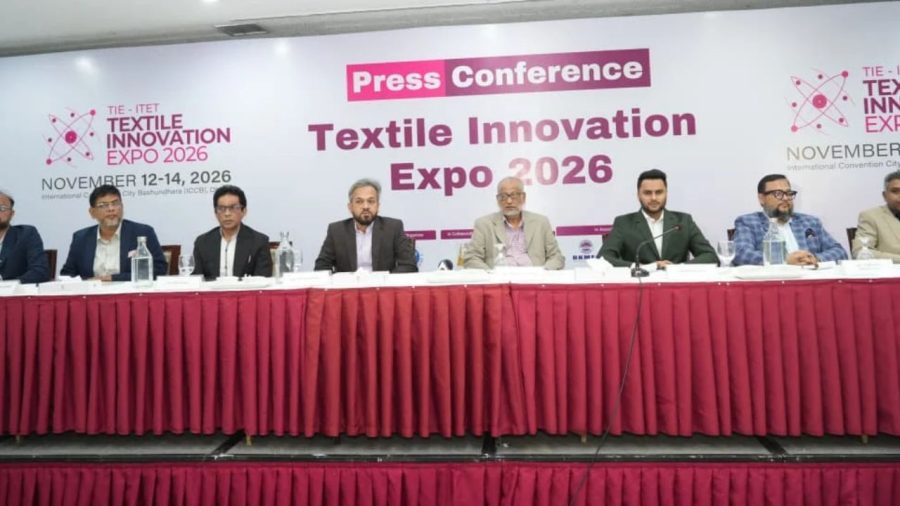



Industry stakeholders have urged Bangladesh’s apparel sector to shift away from sole reliance on low-cost labour and mass production towards value addition, technology integration, and productivity enhancement, amid falling average prices of Bangladeshi garments in the international market.
Speaking at a press conference in the capital on Monday organised on the upcoming Textile Innovation Expo 2026, organisers cited Eurostat data showing that between January and July 2026, the average price of Bangladeshi apparel per kilogram in the European Union market dropped by 8.47 per cent. In contrast, Vietnam’s average apparel price increased by 11.76 per cent during the same period.
Industry insiders noted that facing price pressures in international markets alongside escalating production costs, enhancing product quality and value is essential to maintain the competitiveness of Bangladesh’s garment industry.
The exposition is being organised by the Textile Innovation Exchange (TIE), co-hosted by the Textile Innovation Centre (TIC), supported by the Institution of Textile Engineers and Technologists (ITET), partnered by BKMEA and BGBA, and implemented by the Textile Today Innovation Hub (TTIH) to establish Bangladesh as an innovation-driven manufacturing destination.

The three-day “Textile Innovation Expo 2026” will take place from 12 to 14 November at the International Convention City Vasundhara (ICCB) in Dhaka, bringing together garment and textile factories, technology suppliers, brands, buyers, researchers, and industry professionals to showcase innovation-led products, manufacturing processes, and technologies.
The press conference was attended by ITET Bangladesh President Engr Md Enayet Hossain, BKMEA Director Engr Imran Kader Turjo, BGBA President Md Abdul Hamid, ITET Senior Vice-President Engr Sumael Muhammad Mallick, ITET Bangladesh General Secretary and, TIE Steering Board Member Engr ASM Hafizur Rahman Nixon, and Engr Ehsanul Karim Kaiser, TIE Chairman, and TTIH Executive Chairman.




The exposition will feature four thematic zones: Dyeing & Printing, Textile Materials, Automation Technology in Garment Manufacturing, and Eco-friendly & Sustainable Technology.
Additionally, local factories will highlight their innovative products and productivity-enhancing initiatives at a Factory Innovation Pavilion, while an Open Innovation Area will offer researchers, universities, startups, and factory engineers the opportunity to present innovative solutions.
The event will also host six technical seminars covering topics such as sustainable management, new fibres, digital product passports, supply chain traceability, textile recycling, productivity, and energy savings, alongside a plenary seminar on strategies for implementing innovation.
Organisers expect the expo to feature participation from around 50 textile, apparel, and accessories factories alongside 200 technology and solution provider companies, attracting approximately 5,000 visitors, 100 brands and buyers, and over 200 international delegates from more than 30 countries.
As part of the event, the Textile Innovation Award 2026 will be presented to recognise individuals and organisations for their contributions to factory-level innovation, technological advancement, product development, and sustainable management in the sector.
The awards will be conferred across eight categories: Process Innovation, Production Innovation, Technology, Product Development, Marketing & Market Expansion, Environmental Sustainability, Social Sustainability, and Human Resource & Organisational Development, with winners announced following an evaluation process.
It was highlighted that Commerce Minister Khandakar Abdul Muktadir inaugurated the Textile Innovation Exchange on May 16, and the implementing organisation, TTIH, has conducted over 270 innovation projects across more than 80 factories over the past seven years.
The overarching objective of the organisers is to foster an innovation-driven manufacturing system by strengthening collaboration between industry and research institutions, thereby assisting Bangladesh in increasing its global market share of high-value apparel products.