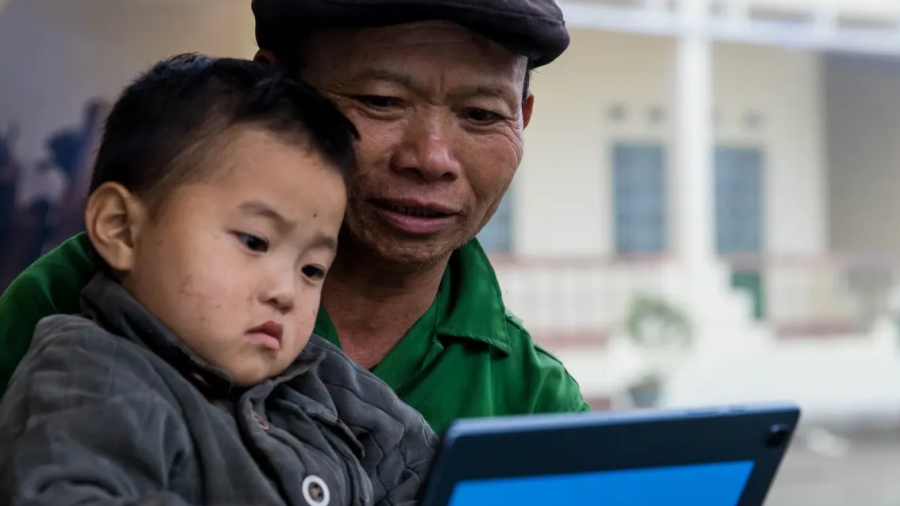



Once, a parent’s biggest worry was whether a child was spending too much time outside the home. Today, the worry is quite different: the child is sitting quietly at home, but the whole world is inside the phone. For parents, this creates a new kind of challenge. Their children can install applications, change privacy settings, find videos and navigate social media with remarkable ease. Parents sometimes feel that they have entered a world where their children are experts.
But parents do not need to become technology experts to guide their children. They need a parent who is willing to listen, ask questions, set reasonable boundaries and talk openly about both the opportunities and dangers of the digital world. The question, therefore, should not simply be how we can keep children away from screens. It should be how we can help children use technology wisely and become responsible digital citizens.
The latest Bangladesh Multiple Indicator Cluster Survey (MICS) 2025 reports that 72.1 percent of households have internet access at home. Digital connectivity is no longer limited to a small urban population. It is increasingly becoming part of children’s everyday environment. A UNICEF Bangladesh study of 1,281 internet-using schoolchildren found that about one-quarter started accessing the digital world before the age of 11. More worryingly, many children reported making online friendships with people they did not know in real life. These findings are not simply statistics. That is why digital parenting must begin with conversation.
Every family needs basic rules around technology. Parents and children can discuss when devices can be used, how long they should be used and what they should be used for. But rules are more effective when children understand why they exist. Explaining that excessive screen use can interfere with sleep, concentration, physical activity and family interaction helps children understand the reason behind the boundary.

The rules also need to grow with the child. Adolescents need increasing independence, but independence should come with responsibility. They need to understand that having a smartphone does not mean having unlimited freedom to share personal information, communicate with strangers or post whatever they want. Parents should also resist the temptation to turn every technology conversation into a lecture. Sometimes a simple question can open a much bigger conversation.
Another important lesson for parents: give children interesting things to do beyond screens. A child who comes home from school with no opportunity to play, read books, engage in creative activity, and interact with the family will naturally return to the phone. They need alternatives. This is important because children are naturally curious. We should not suppress that curiosity; we should widen it. A child who becomes fascinated by nature may still use the internet – but now the internet becomes a tool for exploring an interest rather than simply to pass the time. The goal should be to make children’s lives richer, not merely to make their screen time shorter.
Perhaps one of the simplest solutions is to create device-free moments for the whole family. It is difficult for parents to tell children to put their phones away while the adults themselves are constantly checking messages. If parents sometimes choose a book over a phone, go for a walk or simply sit and talk, children see that life does not have to revolve around a screen.




Children also need to know that they can come to their parents when something goes wrong online. They may receive an inappropriate message. Someone may bully them. A stranger may attempt to establish a relationship with them. Someone may pressure them to send a photograph. They may encounter violent or sexual content accidentally. They may also become victims of scams, misinformation or manipulation.
UNICEF has repeatedly highlighted these risks. In a 2025 Bangladesh youth poll involving almost 29,000 respondents, two in three young people identified excessive fake news and misinformation as the most significant source of stress on social media. Bullying, negative comments and harmful content were also identified as significant concerns. This shows that children are experiencing the consequences of the digital environment themselves. Parents therefore need to create an atmosphere where children can say, “Something happened online, and I don’t know what to do,” without immediately fearing punishment.
Digital citizenship means teaching children that their behaviour online has consequences. They need to understand that behind every profile is a real person. They also need to learn one of the most important skills of the digital age: how to question what they see. Not everything on social media platforms is true simply because it appears on a screen. Children need to learn to pause, verify and think.
There is a temptation to believe that the safest solution is to keep children away from the internet altogether. But that is neither realistic nor necessarily helpful. Digital technology provides children with opportunities to learn, communicate, create and participate. Bangladesh’s experience during the COVID-19 school closures also demonstrated how important digital access can be. At the same time, UNICEF and the Bangladesh Bureau of Statistics found major inequalities in children’s access to remote learning, with participation significantly lower among rural children than urban children. The lesson is clear: we cannot treat digital technology simply as a problem to be eliminated.
We need to teach children how to use it well. That responsibility belongs not only to parents. Schools, technology companies, policymakers and communities all have roles to play in creating a safer digital environment for children. UNICEF’s recent global guidance has also emphasised that age restrictions alone cannot address the full range of online risks; children need safer platforms, education, support and protection. For parents, however, the starting point is surprisingly simple.
We cannot raise a generation of children who never encounter the digital world. Nor should we try. Instead, we should raise children who can enter that world with curiosity but also caution; with confidence but also humility; with freedom but also responsibility.
The real success of digital parenting will not be measured by how rarely a child touches a smartphone. It will be measured by whether that child eventually learns when to use technology, when to question it, when to switch it off – and how to remain kind, respectful and responsible when no adult is watching. That is what it means to raise a responsible digital citizen, and that education begins not with a device, but with a conversation at home.
The views expressed in this article are solely those of the author
The writer is a Protection Specialist & CEO, Favor Consultancy. Email: [email protected]