


Behind the military flyovers, grand toasts, and clinking wine glasses at the White House state dinner lies a subtle yet critical instrument of global statecraft – the art of diplomatic gift-giving.
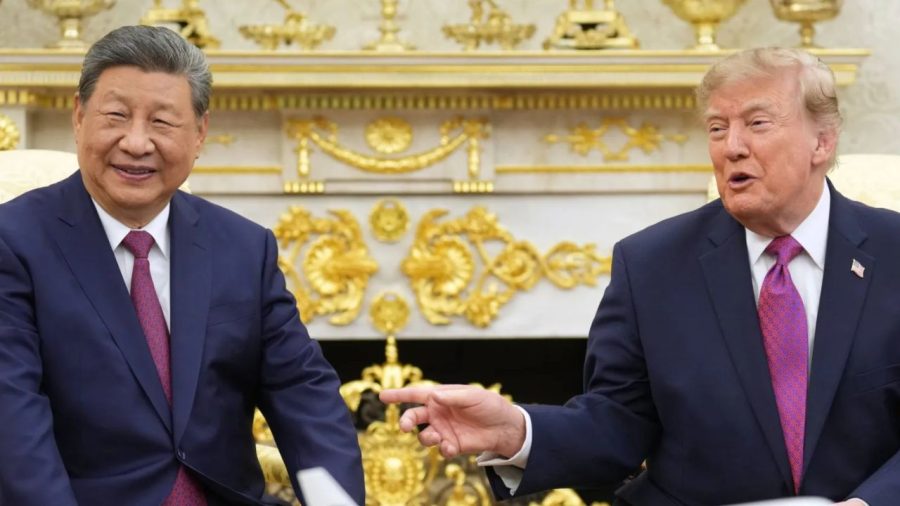
During a lavish Thursday evening dinner in Washington, US President Donald Trump presented Chinese President Xi Jinping with an ornate sculpture of a bald eagle, a North American bird and symbol of the United States.
Unveiled before VIP guests, the statue embodies “the free and soaring spirit of America”, according to Trump, who revealed that he and First Lady Melania Trump personally helped design the piece.
While a statue may appear to be a mere ceremonial ornament, experts emphasise that such exchanges play a small yet meaningful role in forging personal relationships between the heads of the world’s two global superpowers.
Daniel Kritenbrink, a partner at The Asia Group and former US diplomat with over 30 years of experience primarily in Asia, noted that while leaders must navigate complex geopolitical disputes, they remain human beings at the end of the day.

Kritenbrink highlighted that the direct bond between Trump and Xi acts as the essential glue holding together “the most complex and the most consequential relationship in the world,” reports BBC.
He added that Trump values “leader-level diplomacy”, where protocol, optics, and gift exchanges serve as “a means to an end, which is stable US-China relations.”
In response, Xi unveiled a diplomatic gesture of his own, announcing that China will send two giant pandas, Ping Ping and Fu Shuang, to Zoo Atlanta within days as an “envoy of friendship” between the Chinese and American peoples.
Xi also announced a new educational initiative – a student exchange programme designed to welcome 100,000 US students to study in China over a five-year period. It remains unclear whether the Chinese delegation presented any additional gifts.




The high-stakes exchange carries immense weight as the Washington summit marks the third face-to-face encounter between the two leaders since the start of Trump’s second presidential term.
The meeting unfolds amid growing global anxieties surrounding an artificial intelligence (AI)-led race for industry dominance and follows a bitter US-China trade war that has been temporarily paused by an extended truce.
Reflecting on the pragmatic nature of the summit, Kritenbrink remarked, “I’ll take a fragile truce over a white-hot trade war any day of the week.”
Gift-giving has long maintained a unique presence throughout the Trump presidency, during which he has received high-value items including a luxury jumbo jet, an engraved gold bar, and a diamond-and-jewel encrusted gold ring.
Ole Jacob Sending of the Norwegian Institute of International Affairs observed that gift-giving, broadly defined, is integral to how Trump operates.
Scholars point out that international gift traditions vary significantly across political systems. Morten Skumsrud Anderson, who co-authored a study on diplomatic gifts with Sending, explained that autocracies such as China and Gulf states tend to offer far more lavish presents.
Conversely, Western democracies operate under strict legal guardrails. In US, the constitutional emoluments clause restricts foreign gifts to a president to a value of $525 (£397).
Any item exceeding this threshold automatically becomes federal property unless the president buys it back with personal funds or receives congressional approval.
Far from being spontaneous gestures, diplomatic exchanges are meticulously scripted weeks in advance through lower-level negotiations covering timing, location, and protocol.
Anderson noted that a state gift is “not a last-minute purchase at the airport”, whilst Sending cautioned that an inappropriate present risks derailing broader strategic objectives.
Recent history offers contrasting examples of how gift diplomacy can succeed or misfire. During President Xi’s 2013 US visit, then US president Barack Obama presented him with an inscribed redwood bench in California, on which both leaders sat together and smiled for cameras.
In contrast, a 2009 exchange between former British prime minister Gordon Brown and Obama turned awkward when Brown gifted a desk pen holder made from historic anti-slave ship timbers, whilst Obama provided DVDs that were incompatible with UK DVD players, an exchange Sending described as embarrassing.