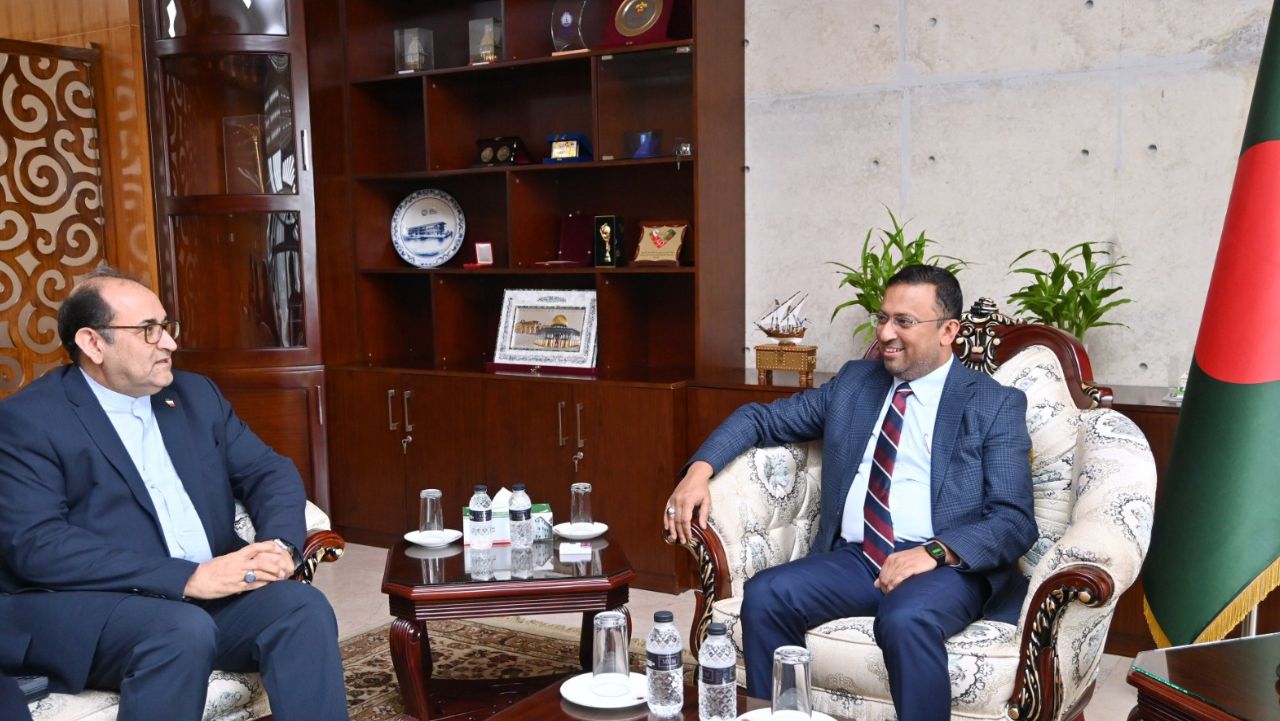

Dhaka has discussed the proposed Mecca Pact and other Middle East security issues with Tehran, whilst making clear that Bangladesh does not support or participate in any aggression against Iran, State Minister for Foreign Affairs Humaiun Kobir said on Wednesday.
He made the remarks after meeting Iranian Ambassador to Bangladesh Dr. Jalil Rahimi Jahanabadi at the foreign ministry.
“We exchanged views on Bangladesh’s involvement in certain security cooperation efforts and defence alliances in the Middle East – specifically, maritime cooperation to assist Saudi Arabia against the security challenges posed by the Houthis,” Kobir said. “Our position is explicit: we do not support, participate in, or call for any aggression or attacks against Iran. Our role is strictly limited to supporting Saudi Arabia in addressing the security challenges posed by the Houthis,” he said, adding that “Iran understands our position clearly in this regard.”
The state minister noted that the government was particularly concerned about the safety and well-being of Bangladeshi nationals living and working across the region. “A large Bangladeshi diaspora lives in the Middle East, approximately eight million people, working throughout the region. Their well-being and safety are of paramount importance to the government,” he said.

Dhaka calls for de-escalation
On the broader Middle East conflict, Kobir stated that Bangladesh’s position was to seek de-escalation and encourage all sides to resolve their differences through dialogue and diplomacy, adding that Dhaka wants the parties involved to reach a permanent, peaceful settlement.
When asked about maritime traffic through the Strait of Hormuz, Kobir noted that the situation was complex and could not be attributed to a single actor. “Keeping the Strait of Hormuz open is not dependent on just one party. There are a range of complex issues involved, and multiple actors are engaged in this conflict,” he said. “It is not a case where one party can be isolated as the sole authority deciding whether to keep it open or closed.”




Iran says pact not aimed at Tehran
Speaking to reporters after the meeting, Iranian Ambassador Jalil Rahimi said Tehran did not view the Mecca Pact as an initiative directed against Iran. “We consider this pact to be a clear sign of the weakness of United States security in the Middle East,” he said.
Rahimi emphasised that Tehran held no enmity towards Saudi Arabia and described Türkiye and Pakistan as close friends. “We maintain good relations with Saudi Arabia, a country with which we share positive bilateral ties. Therefore, we have no concerns regarding the ‘Mecca Peace Pact’,” he said.
On Bangladesh’s diplomatic stance, the ambassador expressed confidence in Dhaka’s balanced approach to foreign policy. “We are well aware that your government pursues a very balanced foreign policy. Therefore, any decision made by your government does not concern or worry us,” he said.
Iran questions us security guarantees
Rahimi argued that the United States was deeply concerned about its own security and that of its regional allies. He noted that Washington had for years conveyed a simple message to Middle Eastern nations: provide land for US military bases and purchase American weapons in exchange for security guarantees.
“In my view, the Mecca Pact is merely a supplementary component to the strategic defeat of the United States,” he said, arguing that regional Islamic countries have realised that stockpiling US weaponry cannot guarantee true security. “Thus, we do not regard the Mecca Pact as a threat to Iran, and we remain entirely unconcerned.”
Tehran open to invitation
Rahimi stated that Iran had not submitted any formal request to join the Mecca Pact, although it had previously proposed initiatives with similar security objectives. “We have not submitted any formal request or proposal to join. However, if an invitation or offer is extended to us by the member states of the Mecca Pact, we will consider it,” he said.
He recalled that Iran had proposed a “Nuclear-Weapon-Free Middle East” a decade ago, calling for all regional states to renounce nuclear weapons, alongside a proposal for a “Joint Defence Pact” among all Islamic nations in the Middle East. He noted that Arab states did not back the proposal at the time because they believed US backing was sufficient.
Questioning whether that assumption had held true, Rahimi asked: “Has the United States been able to provide you with the security you needed? Was the US able to intercept the Iranian missiles that flew over your airspace towards Tel Aviv?”