


The government has approved the National Pay Scale 2026 to make the salaries, allowances, and other financial benefits of public servants “more rational.”
The decision was made during a Cabinet meeting on Monday, which also approved the Joint Services Instructions 2026 for the armed forces to align with the new scale.Both measures will be effective retrospectively from 1 July 2026.
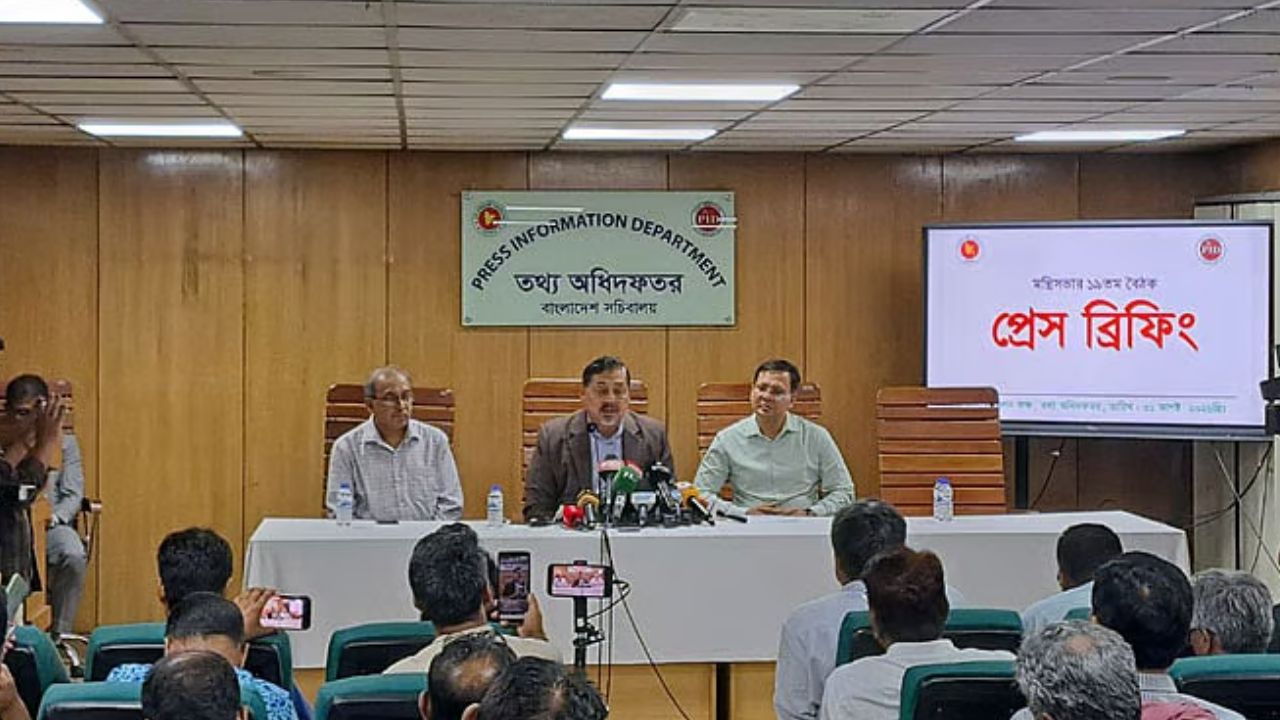
Cabinet Secretary Nasimul Ghani disclosed the details at a press briefing.
The Cabinet approved the new scale after reviewing a report submitted by a Secretaries’ Committee, which was formed to draft recommendations based on the earlier reports of the National Pay Commission-2025 and the Armed Forces Pay Committee 2025.
The decision took into account the government’s financial capacity, the overall economic situation, inflation, cost of living, living standards of employees, and the necessity of a balanced and rational salary structure.

Salary restructuring and equity
The approved pay scale retains the existing 20 salary grades for government employees while refixing basic salaries. The minimum starting basic salary has been set at Tk20,000 for the 20th grade, and the maximum fixed basic salary is Tk1,56,000 for the 1st grade.
In a bid to ensure fairness, the ratio between the lowest and highest-grade salaries has been narrowed from the existing 1:1.945 to 1:1.78. Consequently, the basic salary of the lowest grade will increase by 142 per cent, while the fixed salary of the highest grade will rise by 100 per cent.
Slab-based pension hikes and OROP timeline
In line with its election manifesto, the government remains committed to implementing the One Rank One Pension (OROP) system across both civilian and military sectors.
However, due to massive financial implications at present and a lack of historical data for civilian employees who retired before 2019, the government has decided to implement OROP in phases by 2030.


As an immediate alternative to secure the livelihoods and old-age security of retired public servants, the government has approved a significant, slab-based increase in net pensions. The hikes are structured as follows:
- Monthly net pension of Tk9,000 or below: 100 per cent increase.
- Tk9,001 to Tk20,000: 75 per cent increase.
- Tk20,001 to Tk30,000: 65 per cent increase.
- Tk30,001 to Tk40,000: 60 per cent increase.
- Tk40,001 or above: 55 per cent increase.
This tiered structure ensures that long-retired pensioners who receive lower net pensions receive a substantially higher percentage increase. Similar phased pension hikes will apply to all eligible pensioners.
New disability and expanded mobile allowances
For the first time, the government has introduced a disability allowance for the children with special needs of republic employees, providing Tk 3,000 per month for each eligible child.
Furthermore, to address rising internet and digital communication costs, the scope of the mobile allowance has been expanded. Previously restricted only to 5th-grade employees, the mobile allowance will now be extended to employees of all grades under the National Pay Scale 2026.
Phased implementation strategy
To manage the financial implications and control any potential impact on national inflation, the full pay scale will be implemented in phases over two fiscal years—the current 2026-27 and the next 2027-28 fiscal years.
The government will prioritise low-income employees in the 10th to 20th grades. Under this strategy, basic salaries will be implemented in three steps between 1 July 2026 and 1 July 2027, while all allowances will become effective simultaneously on 1 January 2028.
A separate committee has been formed for the judicial service. Based on its upcoming report, the Bangladesh Judicial Service Pay Scale will be approved and implemented step-by-step from 1 July 2026, mirroring the National Pay Scale 2026.
The government anticipates that this phased national rollout will help mitigate inflationary pressures.
Financial impact and beneficiaries
The implementation of the new scale will benefit approximately 24 lakh military and civilian employees, alongside 9.25 lakh retired employees and other eligible beneficiaries.
The initiative is estimated to require an additional annual expenditure of Tk 1,05,580 crore. The necessary funding has already been allocated in the respective fiscal budgets in accordance with the Medium-Term Budget Framework (MTBF).
The government expects the new pay scale to play a vital role in building an efficient, dynamic, and people-friendly public administration by enhancing financial security and boosting employee morale.
The Finance Division will issue the necessary gazettes, orders, and instructions detailing pay fixation methods, allowances, pensions, post-retirement benefits, and other related implementation guidelines.