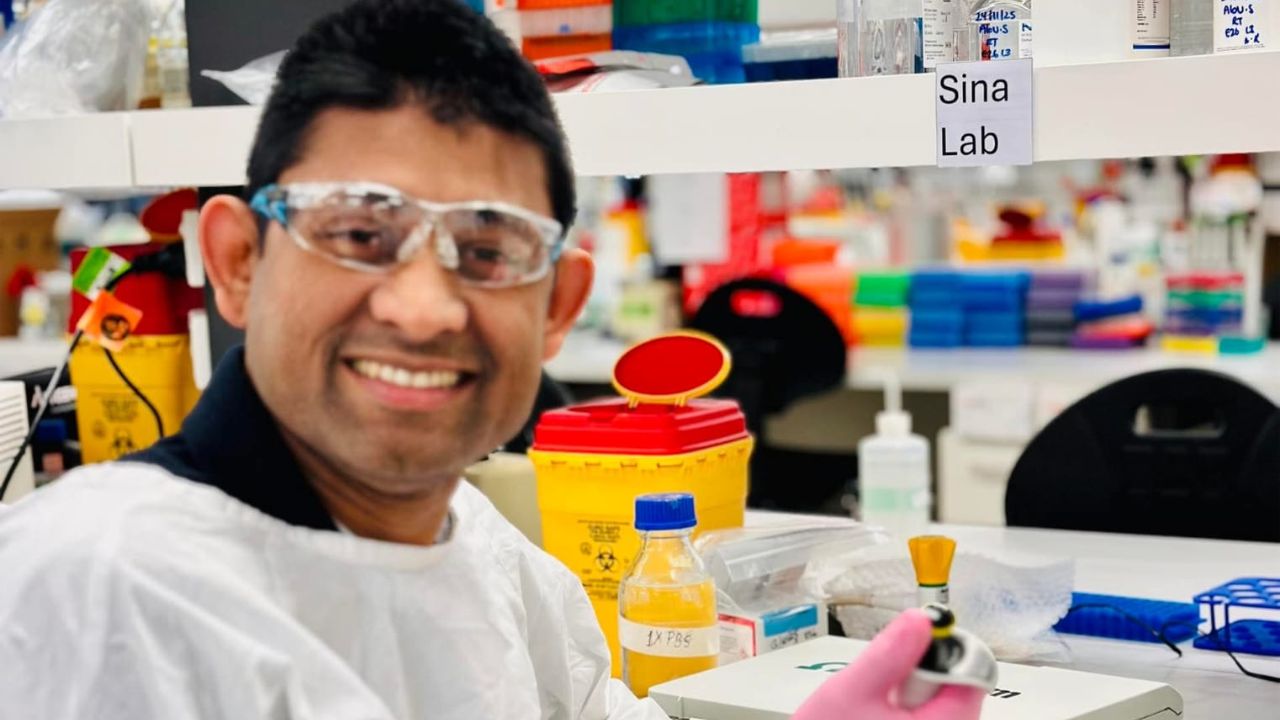



Abu Ali Sina, a researcher from Chandpur, has been awarded the National Health and Medical Research Council (NHMRC) Investigator Grant, one of Australia’s most prestigious and competitive honours in health and medical science.
The grant, worth about AUD 1.6 million (Tk 14 crore), will support cancer detection research at the Sina Lab under his leadership.
The NHMRC awards the grant in recognition of a researcher’s significant contributions, strong leadership and clear vision for future research.
According to the Sina Lab, the funding will support research into identifying next-generation blood-based biomarkers, developing nanotechnology-based diagnostic platforms and advancing technologies for the early detection of cancer. The aim is to develop technology that enables faster, more accurate and simpler cancer diagnosis.

The laboratory said the grant would expand the scope of its research and create opportunities for new students and researchers to participate in projects of international standard. It is also expected to accelerate the translation of laboratory findings into practical clinical technologies.
Sina is son of Shahidulla Master and Suraiya Begum of Baburhat of Chandpur town. He now lives in Brisbane, Australia, with his wife, Sabiha Sultana, and their son Jabir Ibn Hayyan.




He completed his Bachelor’s and Master’s degrees in Chemistry at Shahjalal University of Science and Technology (SUST). After a brief stint in the corporate sector, he joined the university’s Department of Biochemistry and Molecular Biology as a lecturer to pursue a career in research and higher education.
He later moved to Australia to undertake a PhD at the University of Queensland, where he began his cancer research. He currently heads the Sina Lab at the University of New South Wales (UNSW), Sydney.
Reacting to the recognition, Sina said the achievement was the result of long-term support and the collective efforts of his students, colleagues, mentors and family.
In a statement, the Sina Lab said the recognition belongs to both its current and former members. It also acknowledged the contribution of former PhD researcher Tanveer Ahmed, whose research it said played a vital role in establishing the scientific foundation for the newly funded project.
The laboratory added that the funding would advance efforts to make cancer detection technology more effective and accessible, potentially improving patient outcomes through early diagnosis.
Experts believe the international recognition of Sina highlights the global capability of Bangladeshi researchers and will inspire the country’s youth to pursue high-level international research.