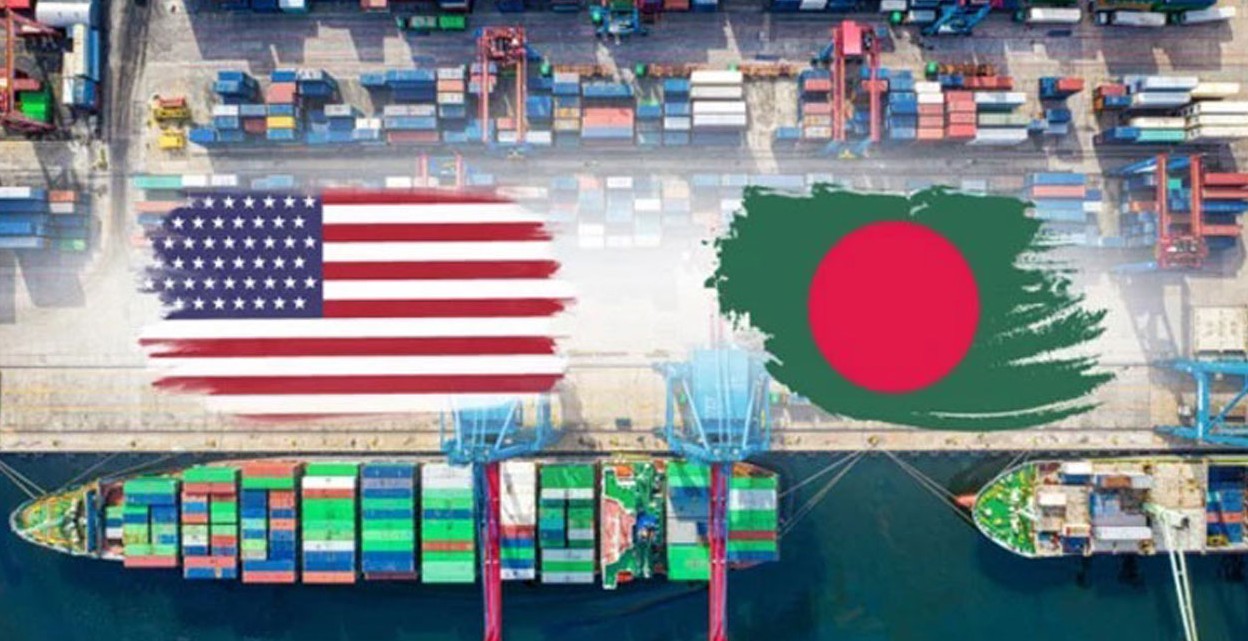
The country’s export sector is once again grappling with a challenging situation, as the United States has imposed new import taxes on Bangladeshi goods due to lax enforcement of measures intended to prevent goods allegedly made with forced labour. The new tariff regime officially came into force at midnight on Friday, but discussions about its economic impact are already underway. While the new tariff regime won’t have a downside impact on exports, according to the Bangladesh government, many economists have suggested that its long-term impacts should be studied. The latest development is also a clear sign that access to markets is now based not only on price competitiveness but also on labour standards, supply chain transparency, and international trade laws within the current international trading system.
The U.S. is one of Bangladesh’s top export markets, particularly in the apparel sector. More than four-fifths of Bangladesh’s export income comes from the RMG industry, which employs millions of people, most of whom are women. Any action likely to affect access to the American market will therefore always raise issues concerning export performance, employment, foreign exchange earnings, and overall economic growth. This is not the first time that Washington has tweaked its trade policy towards Bangladesh. Previous tariffs and trade restrictions were based on broader concerns about labour rights, workplace safety, and trade compliance. The new rule is not aimed at insufficient control over products ‘supposedly associated with forced labour’. However, such questions are gaining traction in international trade policy, as major economies strive to embed trade relations with human rights and responsible business practices into their agendas.
The government has sought to reassure the exporters, saying it has not impacted the country’s overall competitiveness. The main competitors of Bangladesh – China, Vietnam, and Thailand are not imposing higher tariffs, the Ministry of Foreign Affairs said. The officials are therefore confident that Bangladesh’s competitiveness in the U.S. market remains largely intact. The government has also said that the new tariff regime isn’t a punitive one, but rather a replacement for existing duties. In response, the Commerce Minister Khandakar Abdul Muqtadir said that the policy was not a new tariff but a replacement, which he pointed out would have little impact on the overall tariff burden on exporters.
This way, the short-term economic effects might be minimal. Exporters might not be that much more inclined to change their source of supply simply because of the new U.S. policy if other exporting countries have the same tariff conditions. Bangladesh has maintained many positive attributes in labour-intensive garment manufacturing, good relations with buyers, and an ever-strengthening export system. Moreover, in addition to tariffs, global retailers consider the reliability, quality, compliance, and delivery dates of the factors of production.
However, economists warn of more caution. They believe that the tariff cuts they are pushing, or even changes in tariff rates, can make a significant difference in consumer buying decisions in highly competitive global apparel markets, where buyers operate on extremely narrow profit margins. An increase in import prices may give the international brand more attractive margins to renegotiate prices, reduce order volumes, or, ultimately, begin slowly diversifying production to other manufacturing centres. In the short term, the effects might not seem so dire, but over the years, the effects can also be more dire.
Tariffs represent just a part of the bigger picture. International trade policies are increasingly informed by environmental, social, and governance (ESG) considerations and are beginning to incorporate these factors into market access. Forced labour, transparency over trade chains, companies’ carbon footprint, and due diligence are increasingly becoming a part of trade governance. Not only on the price of exports, but also on the competitiveness of exports in the years to come, regulatory developments such as the EU’s Corporate Sustainability Due Diligence framework will have an impact.
This global world has presented both challenges and opportunities for Bangladesh to change. The nation has registered significant progress in workplace safety, factory inspections, and labour compliance since the dreadful Rana Plaza incident in 2013 in the garment industry. International organisations often recognise these accomplishments. However, with rapidly evolving world standards, the only thing that remains uncertain is whether they could be achieved without compromising mediocrity. Labour inspections in Bangladesh will be strengthened, supply chain traceability will be improved, compliance systems in Bangladesh will be digitised, and transparency will be increased, helping ensure compliance with importing countries and boosting Bangladesh’s reputation as a responsible manufacturing hub.




The idea of diversification needs to be brought back to the forefront. The country’s dependence on apparel exports is extremely high, and it has only limited markets for them. There are potential industries that can diversify the economy if expanded, such as pharmaceuticals, information technology services, leather goods, agro-processing, shipbuilding, and light engineering, to reduce excessive dependence on the RMG sector. Meanwhile, a more diversified trade mix, with greater trade with East Asia, the Middle East, Africa, Latin America, and emerging markets, could also provide additional immunity from Western trade policy tantrums.
Another significant issue is Bangladesh’s move out of the Least Developed Country (LDC) status. The majority of PTAs will end once the country has achieved full graduation. Productivity, innovation, skills development, technological upgrading, and international standards will thus be increasingly determinants of export competitiveness rather than market preferences. The ongoing United States tariff action is a reminder to Bangladesh to move faster with its ongoing preparations for a more competitive trading environment. The private sector is also vitally involved. Manufacturers that export should invest more in automation, green production processes, digital supply chains, and internationally recognised systems of certification. There is already a ready availability of environmentally certified Green Garment factories in Bangladesh. This can help enhance the country’s brand as a leading market sustainability brand if it can be achieved.
In the interim, diplomatic efforts are also very crucial. The Bangladesh-U.S. meeting must be a positive one, and up-to-date issues in labour governance and trade compliance should be discussed. Instead of adopting a political stance on tariffs, Dhaka can demonstrate its commitment to international labour rights, responsible sourcing, and transparency in the supply chain by joining the discussion. So far, enhanced bilateral trade has reduced the likelihood of future conflict and kept one of Bangladesh’s most valuable markets alive.
The effects of the new U.S. tariff may not be as harsh as they are being made out to be, however, because the short-term effects may not be as detrimental. The relative positions of the countries may be more or less stable if the tariff picture is not to change appreciably in the near future for all countries that export. A comparison of tariffs, however, would underestimate the more fundamental shift in world trade. New factors for competing in the international market include institutional credibility, labour rights, technological capability, sustainability, and governance.
Bangladesh’s clothes sector is very resilient. It has weathered all of it, from catastrophic industrial accidents to the global financial crisis, COVID-19, supply chain issues, inflation, and geopolitical uncertainty. The other impediment (which is not insurmountable) is the new tariff adjustment in the U.S. By seeing this as an opportunity to make the RMG industry even more competitive, promote better labour governance, increase export diversification, and boost productivity, Bangladesh’s RMG industry can become even more competitive. As trade continues to change rapidly worldwide, the trusted, the responsible, and the resilient will be the only ones to benefit from the low-cost exporter.
The views expressed in this article are solely those of the author
The writer is a Professor, Department of International Relations, University of Chittagong, Bangladesh. Director, Hong Kong Research Centre for Asian Studies-Bangladesh Centre (RCASBC).
Email: [email protected]