






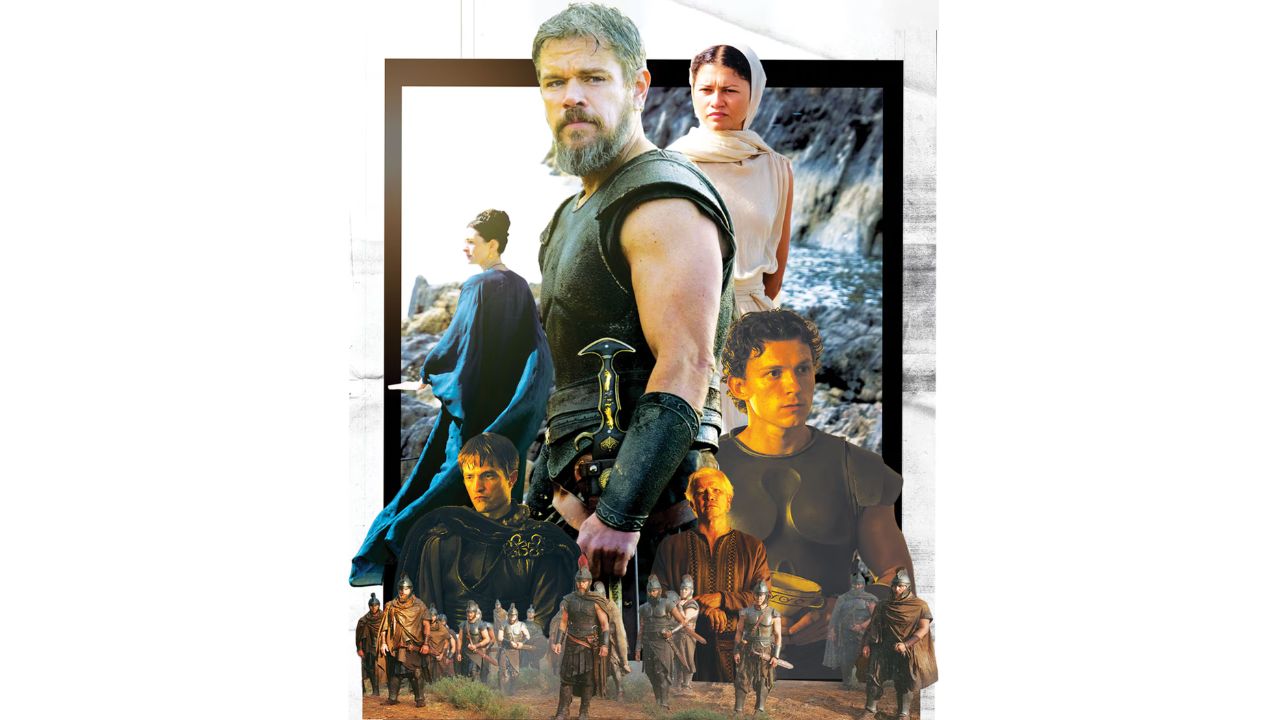
To begin with, I was disappointed by Christopher Nolan’s previous film, Oppenheimer. Although it generated a remarkable box-office response for what was essentially a biographical drama, it ultimately felt like a defensive attempt to give the Manhattan Project a facelift. As audiences, we have come to expect something groundbreaking and transformative whenever Nolan steps behind the camera.
His latest film, The Odyssey, delivers exactly that—and more.

Adapted from Homer’s ancient Greek epic, a work that has inspired countless retellings across literature and cinema for centuries, the film carries enormous expectations. It meets them with remarkable confidence. Nolan’s interpretation of this timeless tale of adventure and tragedy never loses sight of the source material, while confidently making it his own. At times, it is simply breathtaking.

Nolan remains faithful to the spirit of Homer’s epic while imprinting it with his unmistakable cinematic style. Shot entirely on IMAX, the film transforms an already larger-than-life story into an experience of extraordinary scale. Although audiences in Bangladesh could only watch it in standard formats, the visual ambition remains impossible to ignore.
Above all, The Odyssey is a visual spectacle. Every frame feels carefully composed, resembling a moving painting. Nolan reunites with Academy Award-winning cinematographer Hoyte van Hoytema, whose work once again elevates the film through rich, painterly imagery and remarkable texture.
Odysseus’ suffering, loneliness and psychological torment unfold largely through visual storytelling rather than dialogue. One sequence stands out in particular. As Odysseus makes his way back to Ithaca on a raft built from pieces of driftwood, the audience almost feels the sea spray against their faces. The imagery is both intimate and immense.
Equally unforgettable is the famous Trojan horse sequence. Nolan places the audience inside the cramped wooden structure alongside Odysseus and his fellow soldiers. The suffocating tension becomes almost physical, making viewers experience the claustrophobia and uncertainty from within.
The score adds another powerful layer to the experience. Academy Award-winning composer Ludwig Göransson, another of Nolan’s longtime collaborators, blends ancient and folk-inspired musical elements into a soundtrack that enriches the atmosphere without overwhelming the drama.
Matt Damon anchors the film with one of the finest performances of his career. His portrayal of Odysseus captures intelligence, courage and vulnerability in equal measure. Damon earns sympathy for the character without ever inviting pity, presenting a hero who is resourceful, resilient and, at times, reluctant to confront his own destiny.
His strongest scene comes when Odysseus is tied to the mast of his ship to resist the Sirens’ call. As he struggles against the ropes, Damon conveys the character’s inner conflict with remarkable restraint.
Anne Hathaway delivers a graceful performance as Penelope, making the most of a role with relatively limited dramatic scope. Tom Holland is equally convincing as Telemachus, whose quiet emotional journey gradually gains importance as the story unfolds.
Two supporting performances prove especially memorable. Robert Pattinson is perfectly cast as the manipulative and opportunistic Antinous, bringing effortless menace to every appearance. Himesh Patel, meanwhile, excels as Odysseus’ loyal second-in-command, Eurylochus. He frequently matches—and occasionally steals—the screen from Damon, serving as an effective counterbalance to Odysseus’ uncertainty and hesitation.
John Leguizamo, Zendaya, Lupita Nyong’o and Charlize Theron complete an outstanding supporting ensemble. Despite limited screen time, each delivers a convincing and well-judged performance.
Perhaps the film’s greatest achievement is its sense of believability. Although The Odyssey is a fictional epic written nearly 3,000 years ago, Nolan presents its world with such conviction that its characters feel entirely real.
Unlike Homer’s original epic, where Odysseus fulfils a destiny shaped by the gods, Nolan reimagines him as a deeply human figure. His characters grapple with genuine emotional conflicts and personal choices rather than simply following divine will. It is this human-centred approach, combined with extraordinary visual craftsmanship, that lingers long after the credits roll.
My rating for The Odyssey is a strong 8.5 out of 10.

