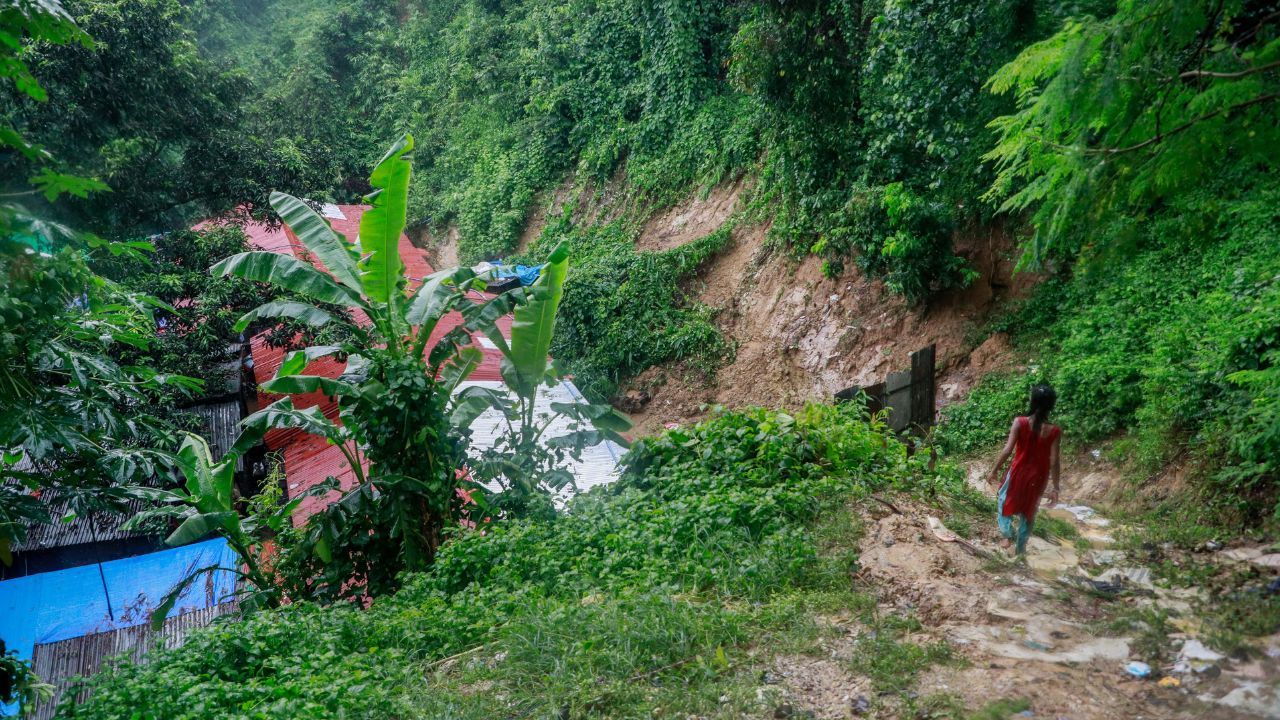

From collapsing hills to raging rivers, the entire Chattogram region is facing a devastating monsoon disaster that has claimed several dozen lives, leaving thousands stranded amid floods, landslides and mounting fear.
Over the past five days, the Ministry of Disaster Management and Relief has recorded a heartbreaking 30 deaths across the division, while local people say the death toll could be much higher as many incidents are yet to be reported.
In Bandarban, five souls were claimed in a single day by crashing hillsides, while Rangamati and Chattogram city mourn those swept away by furious torrents.
Cox’s Bazar has borne the heaviest grief with 22 casualties, leaving families in the crowded Rohingya camps clinging to muddy slopes in absolute terror.
Behind the numbers are hundreds of thousands of people trapped in waterlogged homes. For the region’s poorest, life has ground to a miserable halt, forcing displaced families to seek sanctuary in hundreds of makeshift shelters.
The sheer scale of the deluge is unprecedented. Chattogram endured over 1,000 millimetres of rain in just one week, with another 214.4 millimetres falling ahead of Thursday afternoon.
Tragically, officials admit the existing flood defences are utterly overwhelmed.
KM Zulfikar Tarek of the Water Development Board revealed that the current water flow is nearly double what the drainage network was ever designed to handle.
Infrastructure built to clear typical monsoon waters within twelve hours now leaves communities submerged for over a day.

With heavy rains forecast to persist, a sense of helplessness hangs over the region, as an old friend, the rain, has turned into a relentless enemy.
Five more deaths in Bandarban
In Bandarban, a devastating landslide in Aziznagar Union’s Chambi Pagli area tragically claimed five lives at around 4 am Thursday.
Fire Service and Civil Defence teams, alongside police and locals, recovered the bodies of Mohammad Yunus, his wife Ranu Akhtar, their young child Mohammad Soleiman, and neighbours Mohammad Jewel and Kulisuma Akhtar from the debris.
The region remains in peril, with the Sangu and Matamuhuri rivers breaching danger levels by up to one and a half metres.
Despite urgent, repeated megaphone warnings from local authorities advising residents to evacuate precarious hill slopes and riverbanks, response has been alarmingly poor.
Md Mahbubul Islam, in-charge of the local Soil Conservation and Water Management Centre, warned that the area’s fragile soil, a treacherous mixture of sand and mud, becomes highly unstable during continuous heavy downpours, leaving vulnerable communities at imminent risk of further landslides.




Landslide takes two more lives in Cox’s Bazar
Tragedy has struck Cox’s Bazar again, after a landslide in Chakaria claimed the lives of two 13-year-old children, Obaidul Islam and Rumi Akhter. The victims were sleeping when a hillside collapsed onto their home at around 1:30 am. While a third person was rescued alive, this disaster brings the district’s four-day death toll to 22, including 15 within the Rohingya refugee camps.
The situation remains critical as over 5,00,000 people are stranded across flooded, waterlogged stretches of Chakaria, Pekua, and Matamuhuri.
Khalequzzaman, Barbakia Range Officer of the Chattogram South Forest Division, said that residents living adjacent to the hillside were currently safe.
Pekua Upazila Nirbahi Officer Rafiqul Islam called on residents of low-lying and hilly areas to remain on high alert until the situation normalises. Nurul Islam, executive engineer at the Cox’s Bazar Water Development Board, said Bankkhali and Matamuhuri rivers have both crossed the danger threshold, though all embankments currently remain intact.
Relief is not yet in sight.
Cox’s Bazar Assistant Meteorologist Abdul Hannan warned that heavy rainfall will persist until 11 July. Meanwhile, rough seas have forced a consecutive seven-day suspension of all vessels, including passenger trawlers, along the vital Teknaf-Saint Martin’s island waterway, completely cutting off the island.
Deaths in Rangamati
The tragedy has deepened in Rangamati, where locals recovered the body of Dalmoni Chakma floating in a river in Duluchhari of Mogban Union in the district headquarters. He was swept away by a furious current while crossing a drain on his way home from a relative’s house.
In Belaichari Upazila, a businessman remains missing, and around 25,000 residents are now marooned. Upazila Nirbahi Officer Md Zakir Hossain admitted that surging waters have left the area completely inaccessible to rescue teams from the upazila administration.
A massive landslide at the Arunodaya View Point has also severed local roads and triggered a severe food crisis as shops shuttered.
For the vulnerable border communities, the monsoon brings only dread. As resident Sudatta Tanchangya poignantly shared, “For the people of Farua, rain means terror. When others enjoy the rain, we think to ourselves, when will the houses be submerged.” With infrastructure damaged and isolation growing, the rain offers no respite.
Roads impassable in Khagrachari
Although the rain has eased slightly, causing Khagrachari’s Chengi river to recede, the Maini river continues to swell.
Severe flooding has brought traffic to a complete standstill on the Dighinala-Langadu, Dighinala-Baghaichari, and Dighinala-Sajek routes. Flooding has cut off all access to Sajek, leaving over 400 tourists stranded at the resort.
Furthermore, the Khagrachari-Rangamati road has been entirely closed since Wednesday night. In response to the escalating crisis, Khagrachari Deputy Commissioner Anwar Sadat said that 135 emergency shelters have been opened, with authorities urgently appealing to vulnerable residents to evacuate to safety.
Chattogram in peril
The devastating monsoon has plunged Chattogram into absolute turmoil. In Boalkhali, an 18-year-old youth, Didarul Alam Hridoy, remains missing after being swept away by the furious currents of the Jayishthapura Bhandaljuri canal.
A resident of the Purba Jayishthapura Guchchagram Shelter Project, his disappearance highlights the escalating human cost of the disaster.
Across Chattogram city and its surrounding areas, nearly five lakh people are stranded as rising waters cut off communication with hundreds of villages, submerging homes, schools, marketplaces, and vital agricultural land.
Acknowledging the gravity of the crisis, Chattogram Deputy Commissioner Zahidul Islam Mia admitted that conventional rescue operations are no longer sufficient, prompting an urgent request for Bangladesh Army speedboats.
The Sangu and Matamuhuri rivers are flowing more than a metre above the danger level, inundating vast swathes of Banshkhali, Satkania.
For locals, the disaster is measured not just by water levels, but by the collapse of daily life. Trapped families face acute shortages of safe drinking water, food, and medicine, with children and the elderly at extreme risk.
An assessment of disaster management departmental reveals that over one lakh people are affected, with 7,000 crammed into government shelters.
Yet, amidst the immediate relief efforts, serious questions are being raised over the region’s flood infrastructure.
While the Water Development Board claims all 300 of its regulators and sluice gates are fully functional, bitter residents argue that poor maintenance has rendered many ineffective.
With the Meteorological Department warning of further heavy downpours, the threat of fresh flooding, landslides, and river erosion looms large.
Miskatul Islam Pappa, a resident of Banshkhali at the estuary of the Sangu River, narrated the prevailing dread, “New areas are flooding every hour. People are simply being forced to abandon their homes.”