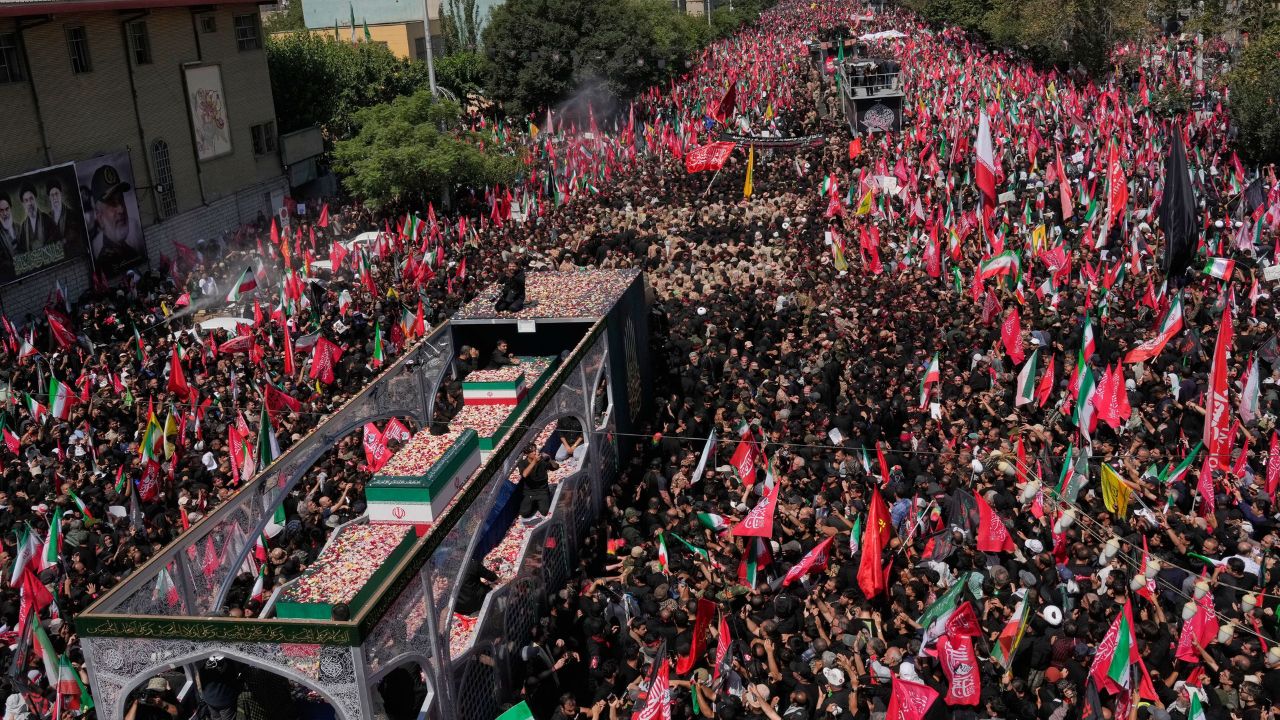



Hundreds of thousands of Iranians gathered on Tehran’s Azadi Street on Monday to bid farewell to the country’s late Supreme Leader, Ayatollah Ali Khamenei, in a funeral that analysts say doubled as a powerful political message to the United States and Israel.
A truck carrying Khamenei’s coffin, along with those of his daughter, three-year-old granddaughter, son-in-law and daughter-in-law, slowly made its way through the crowd before heading to Azadi Square, the final stop of the funeral procession in the capital.
His body will later be taken to the Iraqi holy cities of Karbala and Najaf before being buried in Mashhad, Iran.
Beyond mourning the country’s most influential leader, the funeral showcased Iran’s resilience following the war that began with US and Israeli strikes on 28 February. Regional officials, diplomats and analysts say Tehran used the event to project national unity and signal that the conflict had failed to weaken the Islamic Republic.

They argue that Iran is now seeking to convert its wartime resilience into diplomatic leverage, particularly over the Strait of Hormuz, through which about one-fifth of the world’s oil and liquefied natural gas supplies pass.
Although Washington hoped the 60-day ceasefire would revive negotiations over Iran’s nuclear programme, analysts say Tehran is instead focusing on consolidating its strategic position around Hormuz before engaging in substantive nuclear talks.



Alex Vatanka of the US-based Middle East Institute said Iran views Hormuz less as an economic asset than as a symbol of political legitimacy.
“The symbolic part is more important for the Iranians than revenues,” Vatanka said. “They want some kind of symbolic acceptance that the Strait is Iran’s.”
Citing a Persian proverb, he added: “Why give away a diamond for a lollipop?” According to Tehran’s calculation, Hormuz is the “diamond”, while sanctions relief and access to frozen assets are the “lollipop”.
Iranian leaders have reinforced that message. Parliament Speaker Mohammad Bagher Qalibaf described the Strait of Hormuz as Iran’s “greatest power tool” and a “divine blessing”, saying the country would “under no circumstances relinquish its rights” there.
Alan Eyre, a former US diplomat specialising in Iran, said Tehran is deliberately slowing negotiations to secure what it sees as the strategic gains of the war.
“Iran is perfectly happy to play for time and just drag negotiations out,” Eyre said. “It wants control of Hormuz and is holding talks to institutionalise that control.”
Aaron David Miller, a former US Middle East negotiator, said Iran has little incentive to return to serious nuclear negotiations until it believes the post-war balance around Hormuz has been accepted and progress has been made in releasing billions of dollars in frozen Iranian assets.
“The 60-day clock was always a fantasy,” Miller said. “The Iranians are not going to move to the nuclear file until they’re relatively confident they’ve achieved this new status quo.”