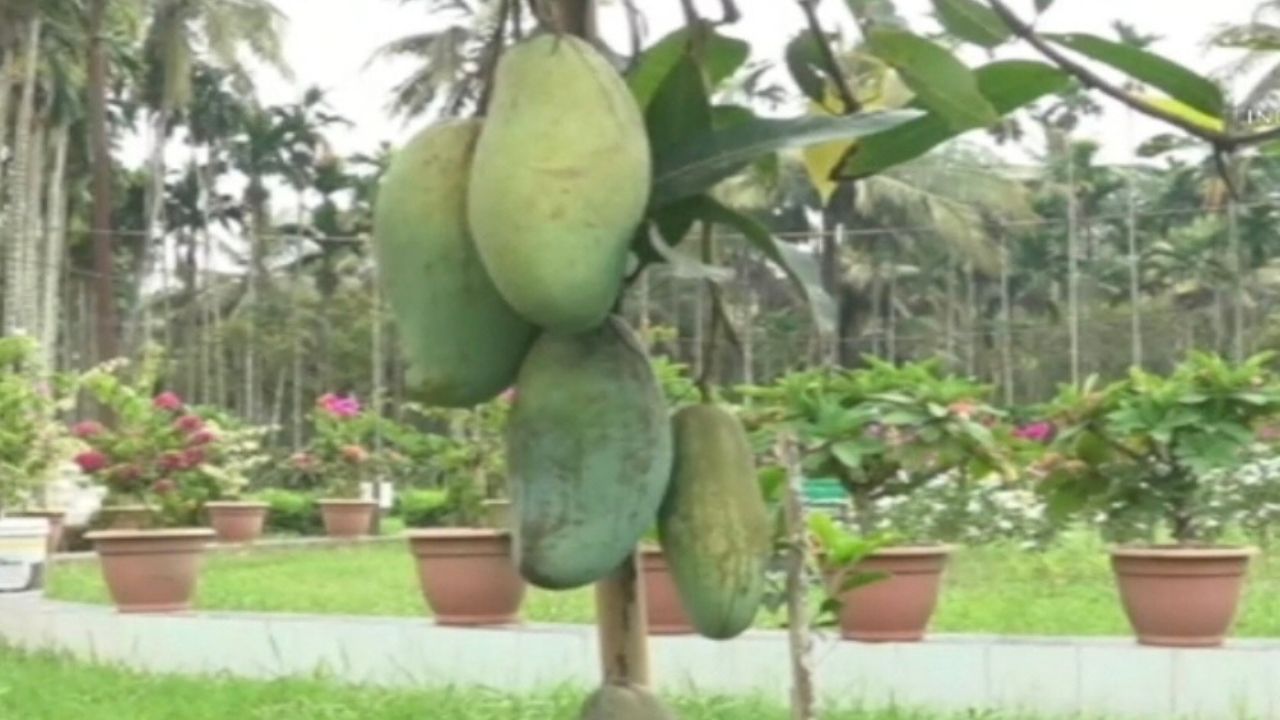



A grafting initiative at the Rahmatpur Horticulture Centre in Barishal is drawing growing attention from fruit lovers and farmers, with saplings now producing up to 10 varieties of mango on a single tree.
Officials say work is also under way to increase the number to 15 to 20 varieties on one tree, raising hopes of wider commercial and household-level cultivation in the region.
The centre has developed the multi-variety saplings by grafting different mango varieties onto a local mango tree. The varieties include Japan’s famed Miyazaki mango, Nam Dok Mai, Red Ivory, Tokmai, Three Taste, Amrapali, Baribhog, BARI-11 and other local and foreign varieties.
Buyers of the saplings are also being given practical training on maintenance and care so that the grafted trees can survive and produce fruit properly.
Md Abu Bakkar, assistant horticulture officer at the centre, said saplings bearing 10 varieties of mango on one tree were now available.

“We are also working to increase this to 15 to 20 varieties through grafting,” he said. “Among the 10 varieties are Baribhog, Amrapali, Miyazaki, Katimon and Banana mango. Any desired variety can be added to a tree through grafting. We have already introduced this, and interested people are coming, buying saplings and receiving training.”
Officials said such trees could help meet a family’s fruit demand while offering nutritional variety from a small space. They said the old practice of depending on large trees with limited fruiting was gradually being replaced by grafted saplings that produce more fruit on smaller trees.
Horticulturist Ferdous Ara Mita said mango had long been one of the country’s most loved fruits, though many people were unaware of its nutritional value.



“Mango contains plenty of vitamin A, while raw mango provides vitamin C,” she said. “Instead of relying on large trees that produce fewer mangoes, we are now moving towards grafted trees with higher yields. We have also taken mango cultivation to rooftop gardens. A single tree can meet the mango demand of a family.”
The Barishal Horticulture Centre sells about 250,000 fruit saplings a year. Officials said that, according to this year’s figures, around 150,000 of those are multi-variety mango saplings.
People from distant areas are first visiting the centre to see the trees and later buying the saplings, reflecting rising public interest in the technique. Officials believe the growing demand is a positive sign for the expansion of mango cultivation in Barishal.
Rashid Sikder, who came to buy mango saplings, said he was surprised to see so many varieties at the centre.
“I came here and saw 74 types of mango saplings in one place,” he said. “What surprised me even more was that one tree has 10 varieties of mango. We should take this idea to our homesteads. It needs more publicity.”
Another buyer, Mahbuk Hossain, said he had seen mango trees, saplings and grafting methods at the centre and bought saplings.
“But a guidebook should be provided with each sapling,” he said. “That would benefit everyone.”
According to officials, successful cultivation of 74 varieties of mango has already been confirmed in Barishal’s soil. The authorities have taken broader programmes to expand the initiative.
Md Oliul Alam, deputy director of Horticulture Barishal, said 74 mango varieties had been successfully cultivated at the centre.
“Among them, Miyazaki, known as one of the world’s most expensive mangoes, and Nam Dok Mai, known for its sweetness, have been giving good yields in Barishal for the past two years,” he said. “Any farmer can buy high-yielding mango saplings from here at government-fixed prices.”
At present, mango is cultivated on 3,233 hectares of land across the six districts of Barishal division, producing an average of 52,730 tonnes a year.