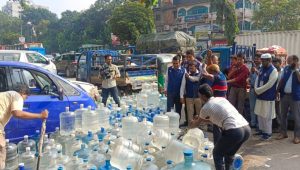
Despite government assurances, citizens may have to endure loadshedding throughout this year’s hot season.
Although the electricity generation capacity exceeds one and a half times peak demand, the country cannot meet requirements due to insufficient fuel supply.
During May, storms and rainfall reduced demand, providing temporary respite, but as temperatures rise, power cuts have become routine.
In April, rural areas outside Dhaka experienced 10 to 12 hours of daily loadshedding.
According to the Bangladesh Power Development Board (BPDB) and the Power Grid Company of Bangladesh (PGCB), the country’s generation capacity is roughly 29,000MW. Yet maximum output recently exceeded 17,000MW on a single day.
District towns still face two to six hours of cuts daily, and in villages, electricity supply fluctuates hour by hour.

BPDB Member (Generation) Zahurul Islam told TIMES of Bangladesh, “Production cannot rise if fuel supply is limited.
Generation had fallen due to LNG (liquefied natural gas) supply disruptions and complications with coal imports.
The situation has improved, with most plants operational over the past week.”
He added that expensive furnace-oil-based generation is being limited to conserve resources, though production could quickly rise if fuel supply increases.



Petrobangla manages gas and liquid fuel imports, and delays directly affect electricity generation, creating instability in supply.
Senior journalist Arun Karmakar, with long experience in the energy sector, said, “This is not a technical crisis — it is a fuel supply problem. Gas-based capacity exists, but gas is scarce; coal relies entirely on imports, and furnace oil is costly.”
He added that private-sector electricity generation relies heavily on furnace oil, while major coal-based plants depend on imports and limited domestic coal, leaving the power sector structurally stressed across gas, coal, and oil.
Currently, gas shortages are the sector’s biggest pressure point. Though gas-based plants have over 12,000MW of capacity, production is limited to 5,000–5,500MW — less than half the potential.
Domestic gas production has declined, while global LNG prices have risen, restricting supply.
The government estimates that full-capacity gas-based generation requires 2,000 million cubic feet per day, but supply fluctuates between 850 and 900 million cubic feet.
At the end of April, Power Division Joint Secretary Umme Rehana said, “With 1,200 mmcfd of gas, 7,200MW of electricity could have been produced at cost-effective rates.” In April 2024, gas-based plants received 1.35 billion cubic feet.
Among 49 gas-based plants nationwide, nine are offline due to fuel shortages and six for mechanical faults or maintenance.
Among 54 furnace-oil-based plants, seven are offline due to fuel shortages and one for maintenance. Diesel-run plants are reserved for emergencies due to high costs. BPDB minimises furnace-oil generation wherever possible.
Coal-based plants, once secondary, are now the country’s main source. Total installed coal capacity is 7,629MW (27% of total generation), but by April end, maximum output reached only 5,185MW.
Eight coal plants exist nationwide; one is offline for maintenance, while Payra, Rampal, and Chattogram’s S Alam plants reduce output when coal shipments are delayed or stocks run low.
Domestic coal sources, such as Barapukuria, are also underutilised, generating only 100–150MW of 525MW capacity.
Rooppur Nuclear Power Plant will not reach full capacity this summer.
Fuel loading for the 1,200MW first unit is complete, but full output will not be achieved until August, initially providing only 300MW.
Full capacity of 1,200MW is expected by the end of 2026 or early 2027, by which time winter will lower demand, leaving the country in surplus.