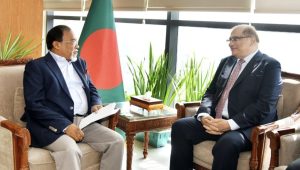
Foreign Minister Khalilur Rahman is set to visit Beijing in the first week of May at the invitation of his Chinese counterpart Wang Yi, in a move aimed at strengthening bilateral ties and reinforcing Bangladesh’s strategic engagement with China.
The visit carries added significance as it follows Rahman’s recent trip to New Delhi, where he held talks with India’s External Affairs Minister S Jaishankar and National Security Adviser Ajit Doval. Together, the two visits underscore Dhaka’s effort to maintain a careful diplomatic balance between the region’s major powers.
Officials at the Ministry of Foreign Affairs said such outreach is routine following the formation of a new government. “It is natural for policymakers to engage key global capitals to explain their priorities and explore ways to deepen cooperation,” a senior official said. He added that Beijing, as one of Dhaka’s most important development partners, remains central to Bangladesh’s foreign policy calculus.
The timing of the visit is also notable, as the five-year development planning cycles of both countries are currently aligned, creating opportunities for enhanced collaboration across multiple sectors.

Comprehensive partnership
Bangladesh and China share a “comprehensive strategic cooperative partnership”, anchored in strong economic, infrastructure and defence cooperation. China remains Bangladesh’s largest trading partner and a leading source of development financing.
In 2024, China accounted for more than a quarter of Bangladesh’s total imports, reflecting the depth of economic interdependence. Major infrastructure projects under China’s Belt and Road Initiative, including power plants, highways and the Padma Bridge Rail Link, highlight Beijing’s central role in Bangladesh’s development trajectory.



Defence ties are also significant, with China being the largest supplier of military hardware to Bangladesh, ranging from fighter aircraft to naval assets.
However, one of the key challenges remains the persistent trade imbalance, as Bangladesh’s exports to China lag far behind its imports. Both sides are exploring ways to address the gap, including discussions on a potential free trade agreement and expanding cooperation in sectors such as the digital economy, agriculture and industrial relocation.
Visit of BNP team
Diplomatic engagement with China has also extended beyond the government. A high-level delegation from BNP, led by Secretary General Mirza Fakhrul Islam Alamgir, recently visited China and held meetings with senior officials of the Communist Party of China.
The two sides reportedly agreed in principle to sign a memorandum of understanding to strengthen party-to-party ties. Sources said a draft MoU is expected to be finalised following further consultations.
Political alignment
Dhaka and Beijing continue to enjoy warm political relations, reinforced by regular high-level exchanges. A senior foreign ministry official said previous visits by key Bangladeshi leaders have helped build trust and mutual understanding.
He referred to the visit of former chief adviser Muhammad Yunus to Beijing, where he held talks with Chinese President Xi Jinping, as well as earlier engagements by former foreign policy officials.
The upcoming Rahman–Wang meeting is expected to further consolidate ties and may pave the way for future high-level visits between the two countries.
As Bangladesh navigates a complex geopolitical landscape, the visit reflects a broader strategy of engagement, dialogue and balance, seeking to align national development priorities with evolving regional and global dynamics.