

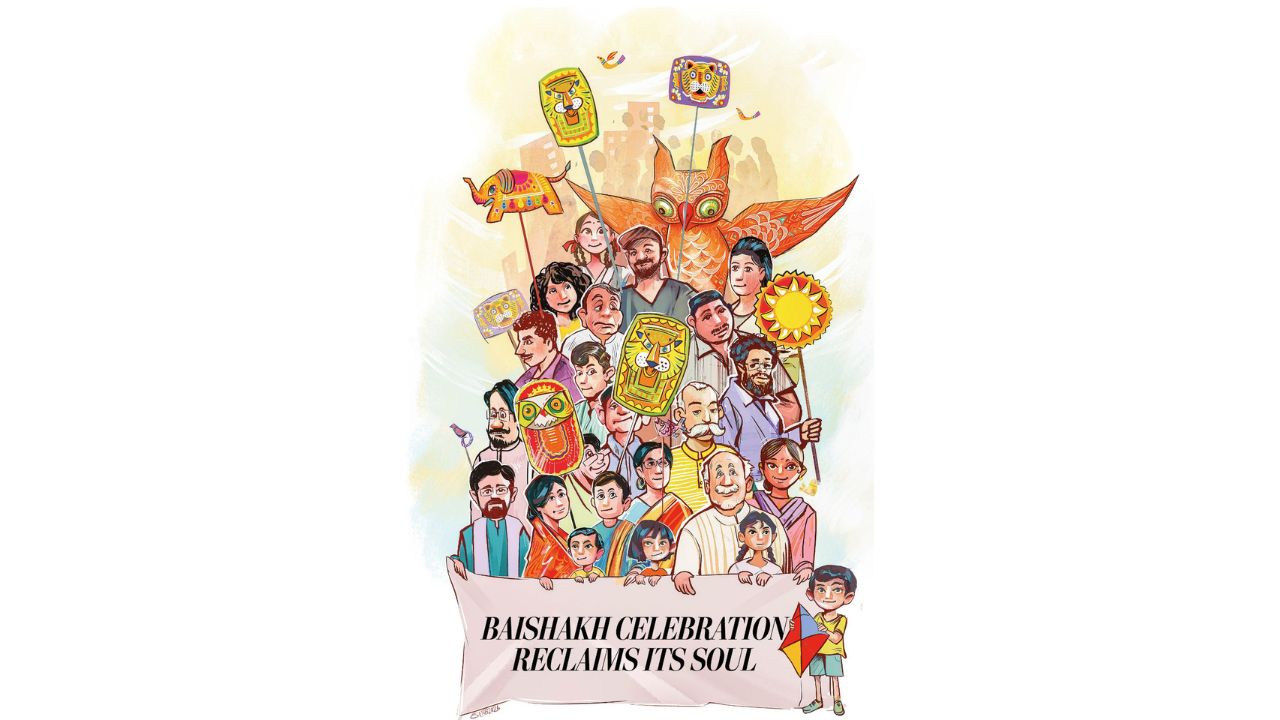



After going through many ups and downs, the Bengali New Year festival, Pahela Baishakh, is once again trying to regain its lost colours.
The celebration had faded due to opposition from hardline religious groups and what some critics described as silent support from the interim government. Now, the newly elected BNP government is making efforts to restore the festival.
Before the fall of the Awami League government, up until 2024, the first sunrise of Baishakh would bring a unique wave of celebration across the capital. From Chhayanaut’s programme at Ramna Batamul to the Baishakhi fair at Justice Shahabuddin Ahmed Park in Gulshan, cultural activities filled every corner.
People immersed themselves in songs of nature, patriotism and renewal. At that time, the Mangal Shobhajatra was organised with the theme “We Are the Destroyers of Darkness”, inspired by a poem by Jibanananda Das.
People walked together in unity, carrying colourful masks and symbolic figures that reflected harmony and a shared identity.
In addition, the Combined Cultural Alliance held programmes at the Central Shaheed Minar in the afternoon. Cultural groups like Udichi in Shahbagh and Rishij in Ramna arranged various events.
In Sher-e-Bangla Nagar, the “Hajar Konth-e Borshoboron” programme by Surer Dhara brought together a thousand voices under the direction of renowned Rabindra Sangeet artist Rezwana Choudhury Bannya. It was a grand cultural gathering.

However, things changed after the political shift in 2024. With the fall of the Awami League government, objections from religious and political groups disrupted the continuity of these celebrations. As a result, the familiar energy of the festival faded.
Although the interim government promised security, people still felt uncertain and afraid. This fear became evident when reports emerged of a fire breaking out during preparations for the procession at the Faculty of Fine Arts, Dhaka University.
Eventually, the procession took place under the theme “Harmony of the New Year, End of Fascism”, but controversy arose over its name. The presence of an effigy of Abu Sayeed, which drew criticism among teachers and students, made the event more contentious.
The procession was led by Dhaka University Vice-Chancellor Professor Dr Niaz Ahmed Khan. However, some students claimed that the event had been organised by a specific group without wider consultation.
At the same time, opposition from religious groups and comments from Cultural Affairs Adviser Mostofa Sarwar Farooki over the renaming of the procession further complicated the situation. As a result, Pahela Baishakh became more of a political issue than a cultural celebration.




Students also shared their experiences. A student from 2020-2021 session of the Faculty of Fine Arts at the University of Dhaka, Chinmoy Ghosh, said that many students did not participate willingly due to political instability. “There was a general sense of fear and uncertainty,” he said.
Another student, Muntaha Rahman Manami from the 2022- 2023 session of the same institution added that the environment last year felt dull. “Threats from extremist groups and internal tensions significantly reduced student participation,” she added.
Later that year, reports of organised mob attacks in December targeting cultural groups like Chhayanaut and Udichi brought back memories of the 2001 bomb attack at Ramna Batamul, showing that cultural organisations were once again under threat.
Despite all this, the spirit of the festival did not fade. In 2026, under an elected government, the situation began to change.
The theme for Bengali New Year 1433 has been set as “Harmony of the New Year, Restoration of Democracy”. The government has announced plans to ensure a safe and inclusive celebration.
This year, the traditional procession from the Faculty of Fine Arts is being organised with renewed energy. Security has been strengthened.
Chhayanaut has also prepared its programme with the theme “Where the mind is without fear”, overcoming the impact of past attacks. The event at Ramna Batamul will be broadcast on BTV and other television channels.
Moreover, the government has instructed that Bangla New Year celebrations be held in every district, upazila and educational institution, with locally organised festive programmes across the country.
Museums and archaeological sites across the country will remain open to the public, with free entry for children, students and people with disabilities.
Cultural bodies under the Ministry of Cultural Affairs, including institutions dedicated to ethnic minority heritage, are also arranging their own programmes.
Alongside these central arrangements, the Bangladesh Shilpakala Academy has undertaken a five-day series of events from April 13 to 17, marking both Chaitra Sankranti 1432 and the New Year.
Meanwhile, the Bangladesh Folk Art and Craft Foundation will host a traditional Baishakhi fair for 14 days starting April 20. Students see this year’s celebration as a turning point. Chinmoy Ghosh believes that with an elected government in place, people no longer feel afraid.
Muntaha Rahman Manami said, “Pahela Baishakh has returned to its earlier spirit this year. The environment is more stable, and teachers and students are working together again.”
However, the debate over the name of the procession, which began in 1989, continues. It was first called “Ananda Shobhajatra”, later renamed “Mangal Shobhajatra”.
During the interim government, the name was changed back to “Ananda Shobhajatra”. This year, the current government has named it “Baishakhi Shobhajatra”.
Political analyst Mohiuddin Ahmed believes that these changes in name are purely political.
On the other hand, Fine Arts Dean Professor Azharul Islam Sheikh argues that changing the name does not alter its core spirit. What matters most, he says, is ensuring participation from all.
Even so, concerns remain about the influence of politics on culture. Purnota Sondhi a student of the Faculty of Fine Arts expressed disappointment over this issue. However, she remains hopeful and adds, ‘This year’s celebration proves that Bengalis have not forgotten that Pahela Baishakh is their own culture’.
In the end, the struggle between cultural expression, religious opposition and political interests continues. Some view this festival through religion, some through unity, and others through the lens of Bengali art and identity.