Long queues at filling stations across the capital show little sign of easing, as pump owners report irregular and insufficient fuel supplies – contradicting official claims by the Bangladesh Petroleum Corporation (BPC) that distribution remains normal.
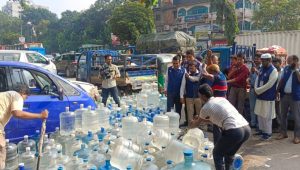
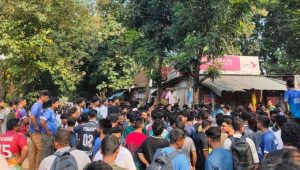
On Wednesday, long lines of vehicles were observed outside filling stations in several parts of the capital, including Banglabazar, Ramna, Poribagh, Moghbazar, and Mohakhali. In some locations, queues extended from one pump to another, highlighting the widespread nature of the shortage.
Many motorists began lining up early in the day, often well before fuel deliveries arrived. Vehicles occupied entire lanes, causing significant traffic congestion in the affected areas.
Pump owners have expressed frustration, saying that motorists from across the city rush to their stations as soon as word spreads that fuel has arrived from the depots. This surge in demand further exacerbates the already strained situation.
With the fuel supply irregular and BPC’s assurances of normal distribution not being reflected on the ground, both motorists and filling station owners are grappling with the ongoing disruption.

Md Yousuf Hossain Bhuiyan, senior general manager (Distribution and Marketing Division) of BPC, told TIMES of Bangladesh that diesel, octane and other fuels are being supplied as usual.
He declined to disclose reserve figures, saying higher authorities are in a position to share such details, while maintaining that the supply chain remains normal.
According to BPC data, the country’s daily demand for fuel – including diesel, petrol, octane and furnace oil – stands at around 20,000 tonnes.



Of this, about 14,000 tonnes is diesel, while petrol and octane account for roughly 1,300 tonnes each. Diesel supply currently stands at around 12,500 to 13,000 tonnes per day, while petrol and octane supply remains close to 1,300 tonnes.
While official data suggests supply remains near expected levels, the situation on the ground – marked by long waits, limited sales and rising pressure – indicates a disconnect between distribution figures and retail availability.
Md Aslam, owner of Pather Bandhu Filling Station in Nilkhet, said fuel supply is highly irregular and does not meet demand.
“We receive fuel inconsistently – sometimes after two days, three days, or even five days,” he said. “Our daily requirement is over 13,000 litres, but often the fuel runs out within half a day.”
He added that parts of the station had to be shut due to supply shortages, disrupting operations and leading to frequent tensions with customers.
“People often assume we are deliberately not supplying fuel, which leads to arguments,” he said.
Quazi Samdani Feroz, owner of Samdani Petrol Pump in Banglabazar, echoed similar concerns. He said that while daily demand previously stood at around 12,000 litres, current supply has dropped to between 5,000 and 7,000 litres.
“Sometimes we receive 7,000 to 9,000 litres, but most days it is limited to 5,000 to 6,000 litres,” he said. “Demand is so high that it is not possible to keep stock even for a single day.”
Due to the supply constraints, many stations have introduced limits on fuel sales, allowing up to Tk500–Tk600 for motorcycles and Tk1,500-Tk2,000 for cars, according to those involved.
Attempts to contact BPC Chairman Md Rezanur Rahman for comment were unsuccessful.