


National Economic Council (NEC) has given its approval to a Revised Annual Development Programme (RADP) amounting to Tk2,00,000 crore for the ongoing fiscal year 2025-26. The transport and communication sector has secured the highest allocation in the revised blueprint.
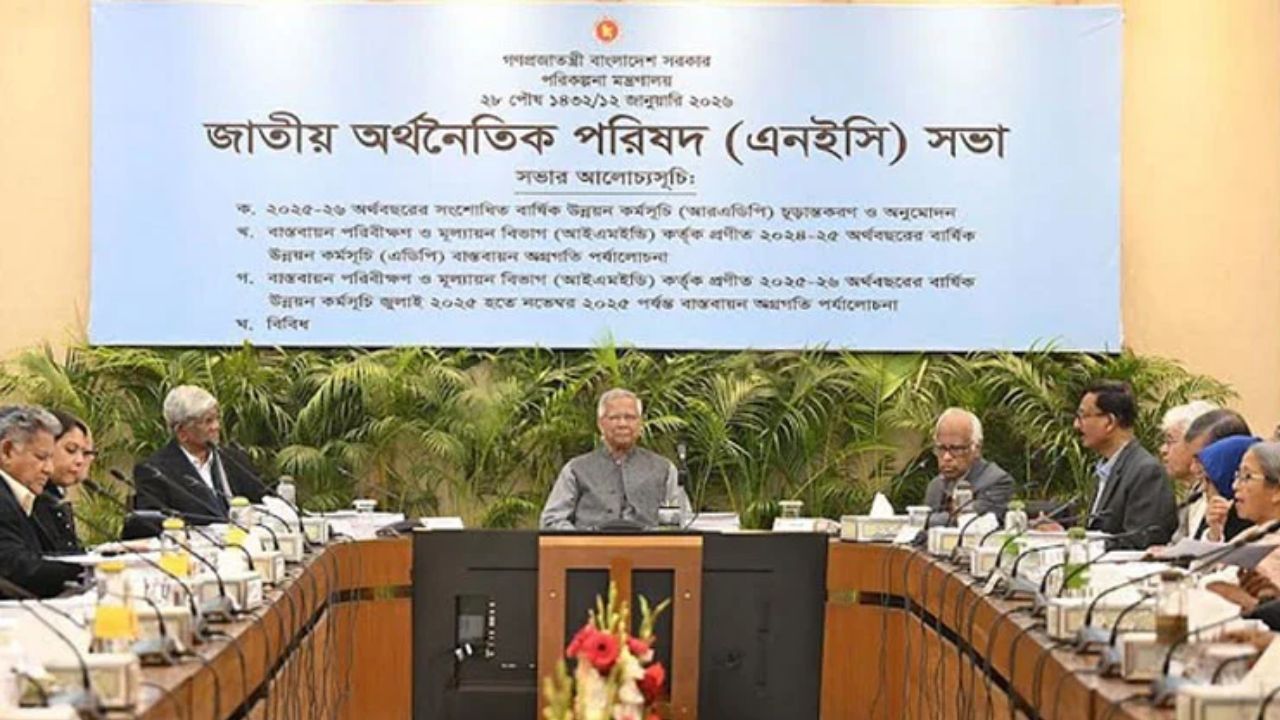
The decision was confirmed at a NEC meeting convened at its Sher-e-Bangla Nagar conference room in Dhaka. The session was presided over by the Chief Adviser and NEC Chairperson Muhammad Yunus.
Planning Adviser Professor Dr Wahiduddin Mahmud briefed the media following the meeting.
When the funding of autonomous bodies and corporations is accounted for, the total size of the RADP expands to Tk2,08,935.53 crore, officials confirmed.
According to authorities, the revision follows the established practice of preceding years, taking into consideration the nation’s resource capacity, the availability of external financing, and the broader macroeconomic landscape.
Of the Tk2,00,000 crore RADP for FY2025-26, domestic sources will provide Tk1,28,000 crore, while foreign financing will cover Tk72,000 crore.

Relative to the original ADP, the revised plan reflects a reduction of Tk16,000 crore in domestic financing and Tk14,000 crore in foreign aid, culminating in an aggregate cut of Tk30,000 crore.
Furthermore, the allocation for projects under autonomous bodies and corporations has been fixed at Tk8,935.53 crore. From this, Tk8,930.53 crore will be sourced domestically, with a marginal Tk five crore coming from foreign sources.
Consequently, the comprehensive size of the RADP, inclusive of autonomous and corporate projects, has been set at Tk2,08,935.53 crore.



The revised ADP encompasses a total of 1,330 projects. This portfolio includes 1,108 investment projects, 35 feasibility study initiatives, 121 technical assistance projects, and 66 projects being executed by autonomous bodies and corporations using their own finances.
A target has been set to complete 286 of these projects by 30 June, 2026.
Highlighting the government’s focus on environmental challenges, the programme also incorporates 170 projects financed through the Climate Change Trust Fund.
Sector-wise, five key areas have been accorded top priority in the revised allocation. These are: transport and communication; power and energy; housing and community facilities; education; and local government and rural development.
Collectively, these five sectors have been allotted Tk1,21,118 crore, which constitutes 60.54 percent of the total RADP outlay.
Ministry and division-specific analysis reveals the Local Government Division received the highest allocation, trailed by the Road Transport and Highways Division and the Power Division.
Other ministries and divisions securing substantial allocations include the Ministry of Science and Technology, Ministry of Water Resources, Ministry of Primary and Mass Education, Secondary and Higher Education Division, Ministry of Shipping, Bridges Division, and the Ministry of Railways.
The revised ADP has incorporated around 856 new, unapproved projects without initial allocation.
An additional 157 unapproved projects without allocation have been included to streamline access to foreign aid. Moreover, 35 new unapproved projects without allocation have been added under the own-financing arrangements of implementing agencies.
The programme also features a total of 81 Public-Private Partnership (PPP) projects.
Officials emphasised that effective execution of the revised ADP will be instrumental in stimulating economic activities, hastening GDP growth, creating employment, and enhancing the standard of education and healthcare services.
They further noted that the programme is anticipated to support human resource development, propel the nation towards food self-sufficiency, aid in poverty reduction, and foster overall socio-economic advancement, thereby steering Bangladesh nearer to its envisaged growth milestones.
The NEC gathering was attended by the Planning Adviser and other members of the Advisers Council, the Cabinet Secretary, the Principal Secretary to the Chief Adviser, the Governor of Bangladesh Bank, members of the Planning Commission, along with senior secretaries and secretaries from various ministries and divisions.