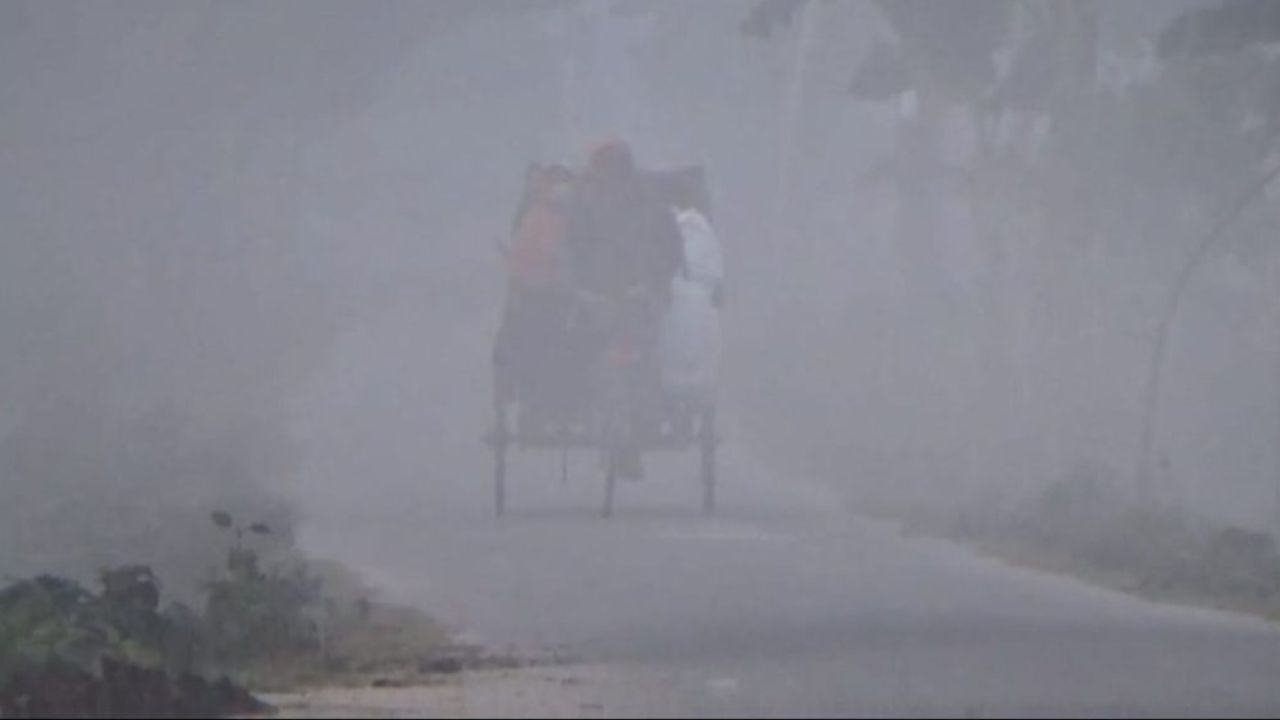

A relentless, bone-chilling blinding fog and persistent cold waves have seeped into the northern region, numbing daily life and slowing its pulse.
Meanwhile, the central region, including the megacity of Dhaka, see little prospect of relief.
The meteorological department indicates no immediate respite until 11 January, forecasting that the prevailing cold conditions are likely to continue, with nighttime temperatures dipping slightly and daytime figures holding steady.
Fortunately, experts predict no rainfall, only temporarily overcast skies across the country.
For Abdul Hamid, a rickshaw puller in Ishwardi, the world has condensed to a few feet of gray obscurity. His hands, gripped tightly on the frigid metal handles, felt distant and rigid, “frozen,” in his words, despite the feeble heat from a small fire of waste paper.

“The sun is merely a tale today,” he murmured. His earnings reflected the reality, a scant Tk 170 against an expected Tk 500. Around him, the vulnerable, daily labourers and the homeless, clustered near roadside flames.
The cold has become more than a seasonal pattern; it is a stealer of income and comfort.




Along the wards of Dhaka Shishu Hospital, the fog’s consequence manifests as a steady, worrisome cadence. Medical staff move through pediatric units with growing concern, as over 27 per cent of outpatients now suffer from cold-related ailments.
Cases of acute respiratory infections rise each day, a sharp chart of distress where the most delicate endure the heaviest toll.
Climate experts note that this localized hardship forms part of a wider, global pattern. The cold gripping Bangladesh carries a whisper from the Pacific, linked to a La Niña phase.
Forecasts from the Bangladesh Meteorological Department provide small comfort, anticipating further cold spells, including one possibly classified as “severe.”
Senior meteorologist Momenul Islam highlighted the harsh irony: the very fog that deepens the chill is sustained by a stagnant atmosphere, absent of purifying winds or rain.
It is a silent, vicious cycle, the fog obstructs the sun, the sun cannot warm the ground, and the ground cannot disperse the fog. In Dhaka, where the sky might typically present a 20°C backdrop, thermometers steadfastly read 19°C.
For intercity and long-distance drivers, the fog turns known routes into hazardous corridors of doubt, where severely limited visibility makes each trip a risk.
Authorities consistently issue warnings, as fatalities tied to the impenetrable fog have become commonplace.
This dense fog is more than a weather event; it acts as a great equalizer of hardship, exposing vulnerabilities, within health systems and across local economies.
Until westerly winds stir or rain arrive, people remain waiting, bundled in whatever warmth they can gather, watching for the faintest gleam of sunlight.