A ban on battery-powered three-wheelers is neither realistic nor sustainable, policy experts, urban planners, and government officials agree. Instead, they are calling for a comprehensive regulatory framework to integrate these vehicles, popularly known as “Bangla Tesla” into the country’s transport system while addressing key safety and environmental risks.
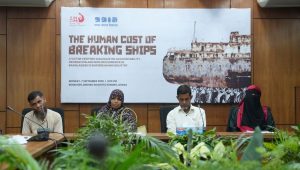
Speaking at a dialogue titled “Integrating Electric Three-Wheelers into the Urban Transport Network: Challenges and the Way Forward,” organised by the Centre for Policy Dialogue (CPD), stakeholders said the ongoing “cat-and-mouse game” between law enforcement agencies and drivers must come to an end.
They argued that the unchecked proliferation of an estimated 4 to 6 million electric three-wheelers (E3Ws) reflects deeper structural failures, including a deteriorating public transport system and long-standing weaknesses in urban planning.
Khondaker Golam Moazzem, research director at CPD, noted that while E3Ws (Electric three wheelers) meet a massive demand for low-cost mobility, their unregulated growth has led to significant revenue losses, illegal charging, and severe health risks from lead-acid batteries.

“We are not here to demonise three-wheelers,” Moazzem clarified. “Sudden bans lead to harassment and social unrest. What we need is to immediately stop further unregulated production and bring the existing fleet under a proper registration and licensing system.”
Echoing this sentiment, Kabir Ahamed, chief of the Physical Infrastructure Division at the Planning Commission, revealed that the situation has already pushed past effective control. He warned that the ease of converting manual rickshaws into motorised ones has created a “systemic crisis” that local governments lack the technical capacity to manage.




Urban planners suggested that E3Ws could actually improve urban mobility if restricted to “first-mile and last-mile” connectivity. “First-mile and last-mile connectivity” refers to the segments of a journey that link commuters to and from major public transport hubs. The first mile covers travel from the starting point, like home or office, to a transport hub such as a bus stop or metro station. The last mile is the final stretch, taking commuters from the hub to their destination, like a workplace, school, or shopping centre.
Asif-Uz-Zaman Khan, a professor at BUET, proposed that these vehicles be banned from arterial highways but encouraged on local and connecting roads to serve as feeders for mass transit like the Metro Rail or bus systems.
“Integrating them into the catchment areas of public transport would make our bus stops more accessible,” Khan said. He also emphasised the need for a 25 km/h speed cap and standardised vehicle designs to reduce the high rate of fatalities as E3Ws were linked to 21% of the road accidents recorded in 2024.
A major focal point of the discussion was the devastating impact of used lead-acid batteries. CPD research highlighted that informal recycling of these batteries has contributed to lead poisoning in 35 million children in Bangladesh. Experts advocated for a mandatory transition to lithium-ion batteries, which offer longer lifespans and lower environmental risks despite higher initial costs.
Neelima Akhter, executive director of the Dhaka Transport Coordination Authority (DTCA), pointed out that while guidelines for battery management and charging exist, implementation remains weak. “The problem lies in poor coordination. Our road sector has focused on infrastructure, but we have failed in transport management,” she stated.
Representing the drivers, Khalequzzaman Lipon, convener of the Rickshaw-Van and Easy Bike Sangram Parishad, alleged that the “illegal” tag on these vehicles is often maintained to facilitate extortion.
“We have never demanded access to highways,” Lipon asserted. “We want regulation, licensing, and designated routes. This sector contributes 6% to the GDP; it should be treated as a domestic industry, not a villain.”