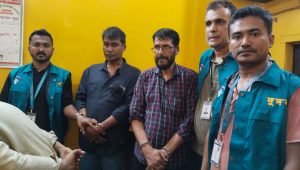
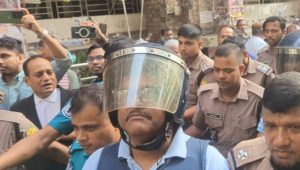
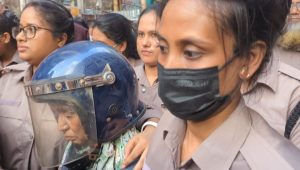
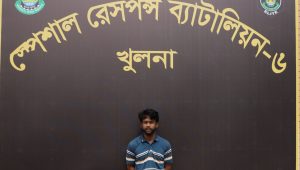
Arms trafficking has re-emerged in the port city of Chattogram, a region hemmed in by hills and flanked by the borders of India and Myanmar. Over the past several months, law enforcement agencies have uncovered a disturbing pattern: firearms once presumed lost or destroyed are resurfacing in the hands of criminal syndicates and politically linked groups.
The resurgence of illicit weapons has coincided with a sharp rise in violent crime. Security officials say a combination of political uncertainty, criminal opportunism, and unguarded border routes may be reigniting dormant arms networks reminiscent of the early 2000s, when the port city last made global headlines for major arms hauls.
Investigators report that serial numbers on many seized weapons match those of firearms looted during the July 2024 political unrest — including some that once belonged to Awami League leaders.
Confirming the pattern, Rapid Action Battalion (RAB) Commanding Officer Lt Col Hafizur Rahman said: “The weapons we have recovered are not newly smuggled. These are old firearms — some dating back more than a decade. It shows that many illegal arms have circulated among criminals for years, and the system failed to trace or recover them.”
Old but deadly

According to RAB sources, the recovered arms include American, Indian, Chinese, Turkish, and locally modified models. Officials believe many once belonged to political stockpiles or entered through porous borders connected to armed groups active in the Chittagong Hill Tracts (CHT) and nearby conflict zones in India and Myanmar.
In a major operation over the past two days, police in Raozan recovered nine firearms — the largest single seizure in recent months. The cache included four pistols, one rifle, one shotgun, two locally made guns, and hundreds of rounds of ammunition.
Among them were four US-made pistols, two identified as police-issued weapons previously reported stolen. Investigators suspect these were used in several recent crimes, including last week’s murder of BNP leader Abdul Hakim.




In the past year alone, security forces have recovered 444 illegal firearms across Chattogram and dismantled two makeshift arms factories in Sitakundo and Anowara.
DIG of Police (Chittagong Range) Ahsan Habib Palash said: “The general belief is that these weapons originate from armed groups in the CHT. Local criminals buy them as needed and later hide them deep in the hills.”
Weapons with a history
Security analysts say the firearms resurfacing in Chattogram have dual origins — some smuggled across the India–Myanmar border, others drawn from domestic caches built up during earlier political regimes.
Intelligence sources confirm that ballistic tests have linked several seized weapons to old criminal cases, exposing a pattern of recycling within the underworld. When new supplies dry up, old arms are refurbished and reintroduced into the black market — sustaining a long-standing ecosystem of violence.
Rising violence, persistent networks
Bordering districts – Rangamati, Khagrachhari, Bandarban, and Cox’s Bazar – remain particularly vulnerable. Intelligence reports suggest local intermediaries continue trading small arms for narcotics or cash, fuelling a cross-border shadow economy that security forces have struggled to dismantle.
A senior official of the Counter-Insurgency Unit told TIMES of Bangladesh that the United People’s Democratic Front (UPDF) — an armed group active in the Hill Tracts — has attempted to procure new arms from India. Some of the recently seized weapons, he said, were intercepted before reaching UPDF strongholds.
Acknowledging the gravity of the situation, Lt Col Rahman said: “The situation in Chattogram is critical. We’ve submitted reports to higher authorities recommending special operations to recover illegal arms. The problem is deeper — and older — than many realise.”
Experts argue that the renewed flow of arms is not merely a law enforcement issue but a symptom of deeper political and socio-economic fault lines.
Dr Sazzad Siddiqui, head of Peace and Conflict Studies at the University of Dhaka, told Times: “The proliferation of illegal weapons in Chattogram and adjacent areas is a spillover from the long-standing conflict in the Hill Tracts. Unemployment and inequality have pushed many into the arms economy. Over time, these networks of weaponisation and political control have become interdependent — making the problem as much social as it is security-related.”
Every shift in political power, he added, merely redistributes the weapons rather than removing them. “The hills, borders, and ports together form a perfect triangle for clandestine trade — one that transcends governments, ideologies, and crackdowns,” he said.