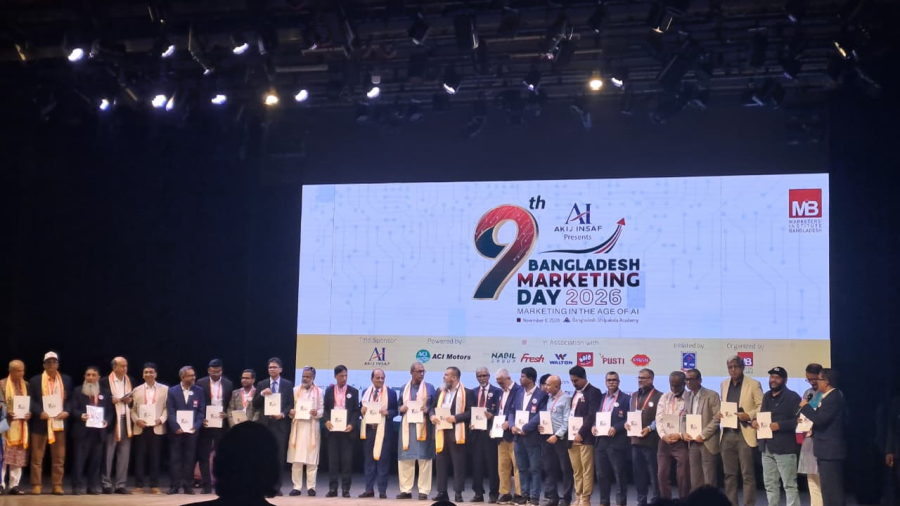



Artificial intelligence is reshaping how businesses advertise, reach customers and manage sales, but its growing role is also raising questions about employment, consumer trust and the limits of automation, industry leaders said at the 9th Bangladesh Marketing Day in Dhaka on Friday.
Held at Bangladesh Shilpakala Academy under the theme “Marketing in the Age of AI”, the event brought together business leaders, marketing professionals and academics to discuss how the industry is adapting to technological change.
The scale of that transformation was illustrated by chief guest Sk Jamil Uddin, managing director of Akij Insaf Group, who traced the evolution of advertising production through his experience with brands such as Mojo, Frutika and Speed between 2006 and 2012.
Producing a 35mm film advertisement then cost Tk 50 lakh to Tk 1 crore and shooting could take 10 to 15 days. The shift to digital reduced the cost to Tk 10 lakh to Tk 50 lakh, while fully AI-generated advertisements can now be produced for Tk 5,000 to Tk 10,000, he said.
Akij has also incorporated AI into its Chocolate Fondale advertisement. But Jamil warned that maintaining quality and consistency remained a challenge. He also raised concerns about employment, noting that work previously involving 40 to 50 people could now be completed by one person at home within a day.

Earlier, in his welcome address, Shariful Islam Dulu, managing director and CEO of Marktale Bangladesh Ltd, said more than 50 lakh people were employed in the marketing profession in Bangladesh. He also announced that the government had given clearance the previous week for the registration of Marketers Institute Bangladesh.
The implications for businesses and marketing professionals were explored further in a panel titled “From Boardroom to Algorithm: How C-Suite Foresees Future Transformation”.
Grameenphone chief product officer Solaiman Alam described how AI models were helping the operator personalise offers, pricing and communications for its 8.5 crore customers. Yet, he stressed, technology still required human supervision, particularly when it came to maintaining customer trust and brand relationships.




For Banglalink’s chief corporate and regulatory officer Taimur Rahman, the challenge is also about understanding local consumers. He argued that Bangladesh’s cultural context makes human judgment indispensable, even as AI becomes more widely used. He urged young marketers to build AI literacy and focus on interpreting insights rather than relying only on data analysis, which can increasingly be automated.
Rahman also pointed to the potential of satellite connectivity, saying fishermen operating 200 to 300 kilometres off Cox’s Bazar could use Starlink to send messages confirming their safety.
Beyond technological change, the event turned to a persistent challenge facing the market: consumer trust. At the panel discussion titled “Market Governance: Building Trust, Ethics and Accountability in Modern Business”, speakers raised concerns about misleading promotions, counterfeit goods and the risks of unverified advertising claims.
Ahm Shafiquzzaman, president of the Consumers Association of Bangladesh, illustrated deceptive pricing with the example of a product actually worth Tk 700 being labelled at Tk 2,000 before a 50 per cent discount was offered. He claimed that 30 to 40 per cent of products in the market were counterfeit or adulterated.
The growing use of AI in advertising adds another dimension to the problem, said Muneer Ahmed Khan, managing director and creative chief of Unitrend. AI-generated advertisements can mislead consumers through unsupported claims, particularly about medicines and other products, making scientific evidence and stronger safeguards essential.
Quamrul Hassan, executive director and COO of ACI Consumer Brands, highlighted the difference in safeguards across businesses, saying established companies maintained internal checks on product claims while smaller businesses could face greater risks.

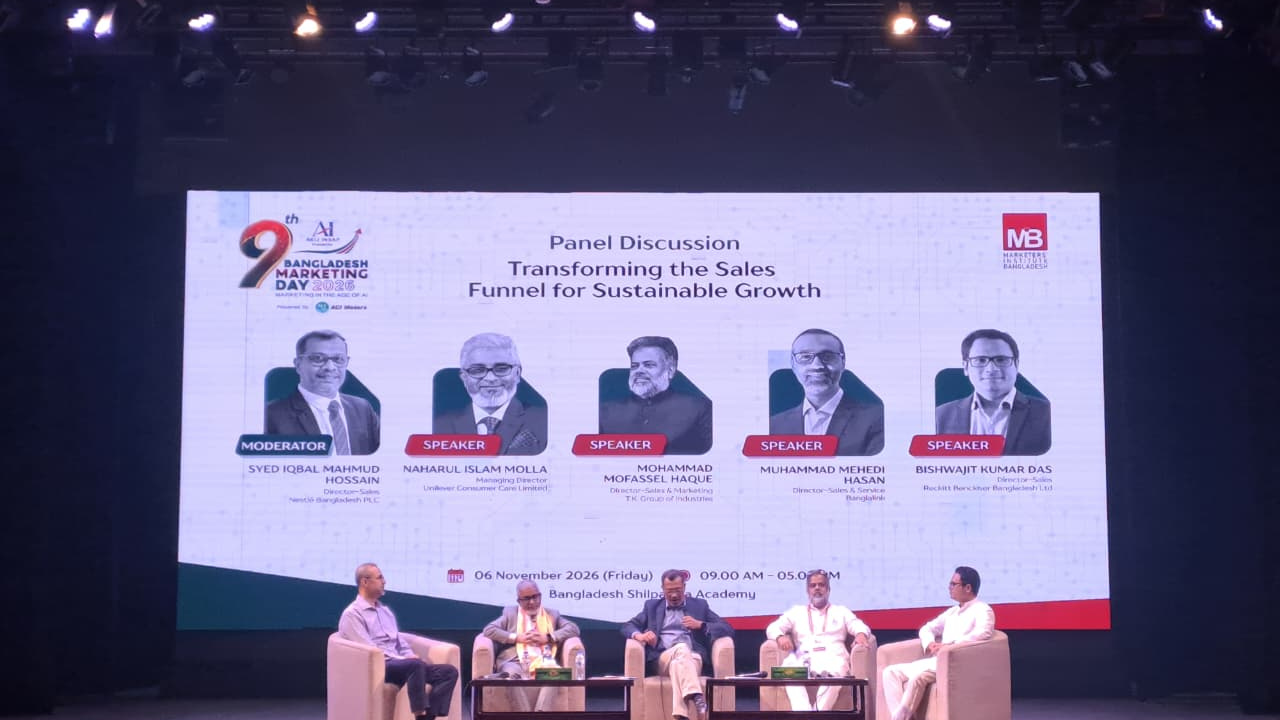
The discussion then shifted from market governance to the changing mechanics of selling. At a panel titled “Transforming the Sales Funnel for Sustainable Growth”, industry representatives discussed how technology could improve sales operations without replacing relationships with retailers and customers.
Mohammad Mofassel Haque, sales and marketing director of TK Group, warned that technology did not necessarily lower costs and could even increase expenses. He said its value rested on improving sales quality, tracking and traceability, with retailer relationships remaining at the core.
Naharul Islam Molla, managing director of Unilever Consumer Care, similarly stressed that technology adoption depended on whether distributors and sales representatives could see practical benefits and receive adequate training.
Presiding over the event, Prof Dr Syed Ferhat Anwar, vice-chancellor of BRAC University and president of the Global Marketing Forum, described AI as “augmented intelligence”, arguing that it should amplify human capabilities rather than simply be viewed as a replacement for people.
He also called for a shift from “profit for good” to “Marketing for Good”, saying ethical and responsible practices should be embedded throughout the marketing process. Anwar announced plans for academia and industry to work together on a sales and marketing guideline that would be distributed free of charge.