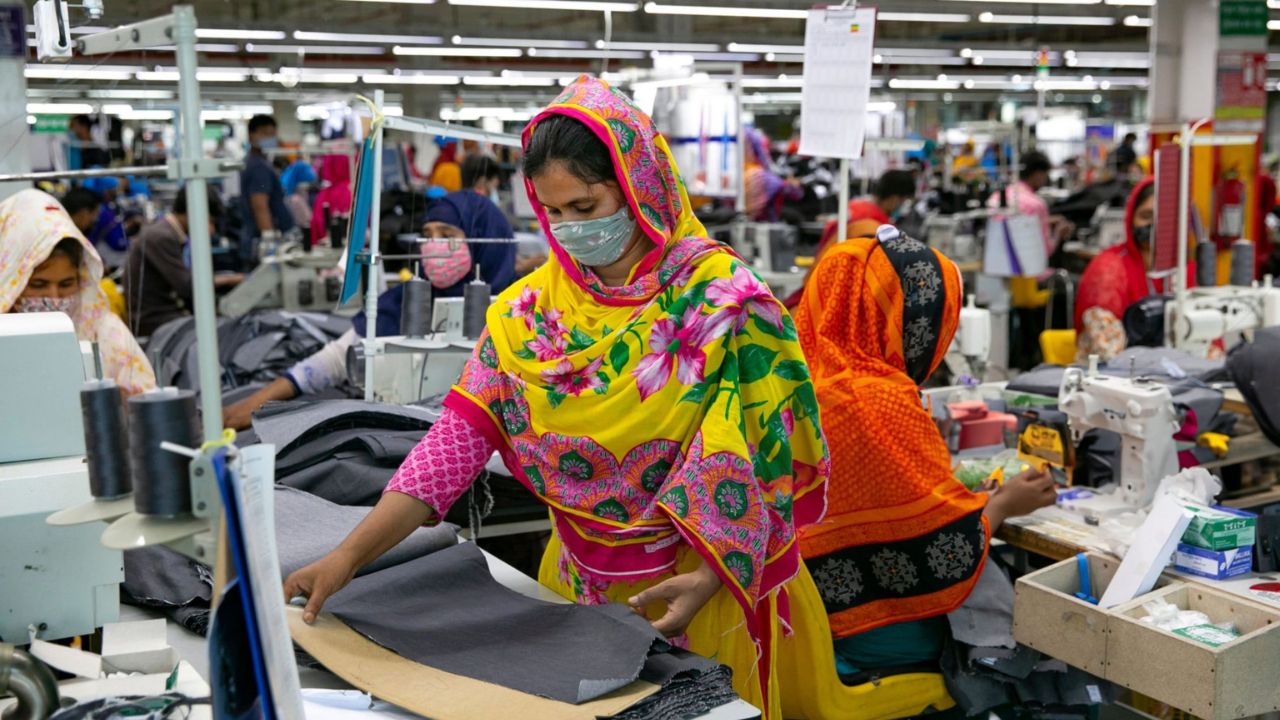
Bangladesh’s garment exports remain heavily concentrated in a small group of destinations, with just 11 countries accounting for nearly 80 per cent of total shipments in 2025, highlighting both the sector’s strength and its exposure to market-specific risks.
Export data for the calendar year show Bangladesh crossed the $1 billion threshold in apparel shipments to 11 individual countries, which together imported garments worth $31.03 billion.
Total garment export earnings stood at $38.82 billion during the period, meaning 79.92 per cent of shipments were concentrated in these markets.
Mohiuddin Rubel, a former director of the Bangladesh Garment Manufacturers and Exporters Association (BGMEA), said crossing the $1 billion mark in 11 destinations reflects the competitiveness and scale of the country’s apparel industry.
However, the high level of concentration also leaves the sector vulnerable to economic and policy shocks in a limited number of markets, he told TIMES of Bangladesh.

Any recession, demand slowdown or policy shift in these economies can significantly affect overall export performance, making market diversification increasingly urgent, he said.
The United States remained the single largest destination, importing garments worth $7.54 billion during the year.




Germany followed with $4.67 billion, while the United Kingdom imported $4.40 billion worth of Bangladeshi apparel.
Exports to Spain reached $3.50 billion, followed by the Netherlands at $2.11 billion and France at $2.04 billion.
Italy imported $1.50 billion worth of garments, while shipments stood at $1.77 billion to Poland, $1.33 billion to Canada and $1.18 billion to Japan.
Denmark imported garments worth $985.91 million, narrowly missing the $1 billion mark.
Industry insiders said the figures underline Bangladesh’s continued dominance in traditional Western markets, while also revealing a heavy dependence on a narrow set of destinations.
Of the 11 countries, 10 are considered traditional markets in North America and Europe, with Japan the only non-traditional destination in the group.
Such concentration increases exposure to global economic uncertainty, shifting trade policies and geopolitical tensions, industry participants said.
They stressed the need to expand into new and emerging markets to ensure long-term resilience and sustainable export growth.
Calls included stronger trade diplomacy, deeper product diversification and targeted exploration of East Asia, the Middle East, Latin America and Africa to reduce reliance on conventional buyers.
The apparel sector accounts for more than 80 per cent of Bangladesh’s export earnings and remains the backbone of external trade, though expanding beyond core markets is increasingly seen as critical for future stability.