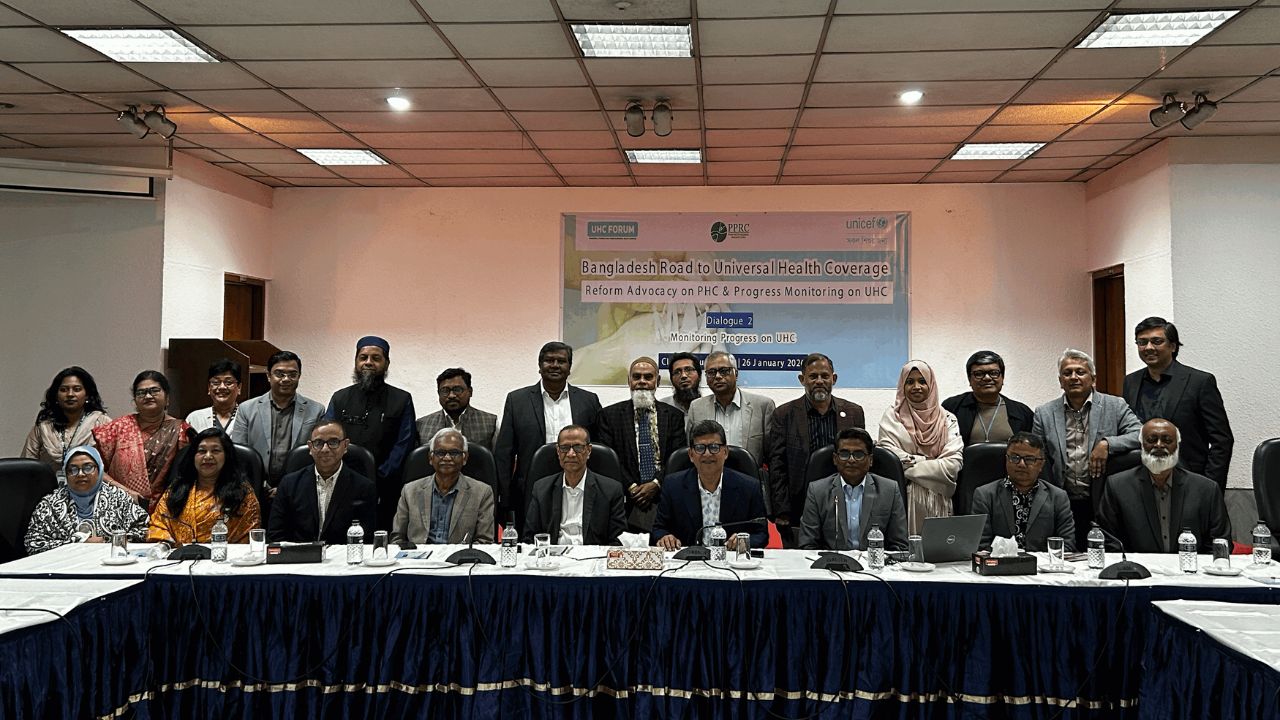

With nearly three-quarters of health spending paid directly by households and more than 70 million people facing financial hardship each year due to medical costs, Bangladesh’s goal of achieving universal health coverage (UHC) by 2030 is at serious risk, speakers said at a policy dialogue in Dhaka on Tuesday.
The dialogue, Monitoring progress towards UHC, was organised by the policy research organisation Power and Participation Research Centre (PPRC) and the UHC Forum, with support from the United Nations Children’s Fund (UNICEF), under the Bangladesh Road to UHC – New Dialogue Series 2026.
Presenting the keynote, Mohammad Aminul Hasan, chief executive officer of the health policy organisation Quality Care Concern and member secretary of the UHC Forum, said Bangladesh has made notable gains in maternal and child health, immunisation and infectious disease control, but warned that access to quality care remains unequal and financial protection weak.
Bangladesh’s UHC Service Coverage Index (SCI) stands at 54 out of 100—far below the Sustainable Development Goal (SDG) 3.8 target of 80 by 2030—while essential service coverage has stagnated for years, particularly in noncommunicable diseases (NCDs), mental health and palliative care.

Financial protection emerged as the most serious constraint, with out-of-pocket (OOP) spending rising to about 73 per cent of total health expenditure, pushing an estimated 6.1 million people below the poverty line each year. Medicines and diagnostics account for more than 80 per cent of household health spending.
Hasan said rising service coverage alone does not amount to UHC if care remains unaffordable, arguing that national averages mask the inability of many poor and extreme poor households to seek care at all.




While Bangladesh performs strongly in programmatic areas such as childhood immunisation and tuberculosis control, hypertension and diabetes control rates remain below 40 per cent, and mental health and palliative care services reach fewer than five per cent of those in need.
Inequities persist across income groups, regions and gender, with the richest 20 per cent accessing specialised hospital care nearly three times more than the poorest 20 per cent, and service coverage in coastal and haor areas significantly below the national average.
Severe workforce shortages also undermine service delivery, with only 6.7 doctors and 6.13 nurses and midwives per 10,000 people—far below the global benchmark required for UHC—while hospital overcrowding and substandard primary healthcare facilities remain widespread.
Participants highlighted weak health information systems, low public health spending, governance gaps and unstable medicine prices as major structural barriers, calling for stronger financial protection, real-time data use and accountable implementation.
In closing remarks, economist and policy analyst Hossain Zillur Rahman said the discussion marked a shift from diagnosis to action, stressing that sustained political commitment and a clear reform roadmap are essential.
Without decisive steps to reduce out-of-pocket spending and address systemic inequities, speakers warned, Bangladesh’s UHC target will remain out of reach.