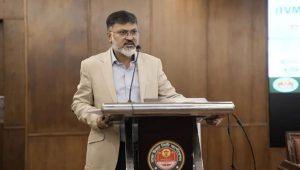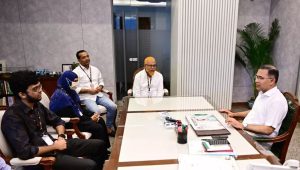



Bangladesh faces a $421 billion financing gap to achieve the Sustainable Development Goals (SDGs), making mobilisation of funds one of the biggest challenges in meeting the targets by 2030, State Minister for Planning Zonayed Abdur Rahim Saki said on Wednesday.
The estimate is in line with a recent government assessment that Bangladesh will need an additional $421 billion in financing between fiscal years 2026 and 2030 to meet the SDGs.
“Implementing the SDGs is not simply about fulfilling international obligations or preparing reports. Our main objective is to bring real improvements to people’s lives,” Saki said.
He was speaking as a special guest at the closing session of the three-day National conference on five-year strategy and SDG at the Bangabandhu International Conference Centre in Dhaka.
Saki said Bangladesh had entered a new phase of possibilities following the 2024 mass uprising, and the current government was preparing a five-year development strategy based on its election manifesto and the aspirations of the people.
Although the 17 SDGs were set internationally, Bangladesh should not view their implementation merely as an international obligation, he said.
“Improving the lives of the people is the government’s commitment. The SDGs are part of our broader development plan,” he said.

No data manipulation
The state minister said the government’s objective was not simply to prepare SDG reports but to ensure that they accurately reflected the country’s actual situation.
“In the past, there was a significant gap between reality and various data and statistics. The current government will not accept any manipulation of data,” he said.
The government wants to establish Bangladesh’s actual position first and then measure progress against that baseline, Saki added.
Development projects to be restructured
Saki said the government was also changing the way development projects are designed and implemented to support SDG targets more effectively.
The Planning Ministry is working to reorganise projects undertaken by different ministries, moving away from isolated projects towards programme-based clusters, he said.



Complementary projects needed to achieve the objectives of a particular programme will be implemented in a coordinated manner. The government is also following a policy of piloting projects first and expanding successful ones nationwide.
Social protection programmes to be streamlined
Saki said the government plans to expand social protection while reducing the number of existing programmes.
“There are currently more than 90 social protection programmes. We are trying to bring the number down to below 10,” he said.
The aim, however, is to ensure that people receive support according to their needs, he added.
Initiatives such as the Family Card and Farmer Card are also being made widely accessible, Saki said.
He said social protection should not be seen merely as a temporary relief measure.
“When money reaches ordinary people, they spend it, creating opportunities for reinvestment in the economy. This brings more people into economic activity,” he said.
Social protection can also help bring people who remain outside the mainstream economy into productive activities, he added.
Five priority areas
Saki described investment in education, healthcare and housing as long-term social investment.
Although such investments may not generate immediate returns, they help create a stronger economic foundation over time, he said.
The government plans to increase investment in education and healthcare to develop human capital while focusing on five areas to generate investment-driven, productive employment: energy, financial-sector reform, easing business regulations, information technology and technological development, and environmental protection.
He said the government was working to reduce the energy sector’s dependence on imports and corruption and move it towards greater self-reliance.
Reforms are also being pursued in banks, financial institutions and the capital market to free the financial sector from political influence, he said.
The government is also seeking to ease business regulations and encourage young entrepreneurs to participate more actively in the economy.
Technology, environment in focus
The government plans to involve young people in technological development from the grassroots level and introduce students to technology from the primary stages of education, Saki said.
He also stressed the need to protect rivers, canals, wetlands and other natural resources from encroachment and destruction while ensuring that development remains compatible with environmental protection.
Bangladesh’s economy remains overly dependent on a few sectors, Saki said, stressing the need to develop new and profitable investment opportunities.
The government is working to reform tax policy and the broader economic structure to support this goal, he said.
Achieving the SDGs while fulfilling people’s democratic and economic aspirations remains a key objective, Saki said, describing the five-year development strategy, restructuring of development projects and broader economic reforms as part of a national reconstruction process.