The Centre for Policy Dialogue (CPD) has remarked that the allocation for renewable energy in the proposed national budget for the 2026-27 fiscal year is insufficient to meet national goals.
The research organisation claimed that approximately 98 per cent of the total allocation for the power and energy sector is being directed towards fossil fuel-based activities, while the share for renewable energy is only 2 per cent.
Under these conditions, the target of producing 20 per cent of electricity from renewable sources by 2030 will not be achievable.
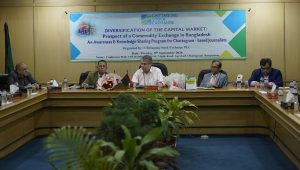
These observations were shared during a media briefing titled “Proposed National Budget for FY2026-27: What did the Power and Energy Sector Get?” organised by the CPD power and energy team in the capital on Wednesday.

Presenting the evaluation, CPD Research Associate Helen Mashiyat Preeti said, “There is not enough allocation for renewable energy in this budget. While 98 per cent of the allocation is still being given to fossil fuels, only 2 per cent is coming to the share of renewable energy.
We do not believe it is possible to achieve the targets of 20 per cent renewable energy by 2030 and 50 per cent by 2050 with this 2 per cent allocation.”
She further questioned the policy of simultaneously encouraging both fossil fuels and renewable energy, describing the direction as “deadly.” According to her, this approach will create excess power generation capacity on one hand and increase the government’s financial pressure on the other.



Following the presentation, CPD Research Director Khondaker Golam Moazzem noted that despite the government’s political commitment, it is not yet reflected in the revenue structure.
“The government’s political commitment is firm, but its reflection is still largely absent in the revenue structure… revenue inequality continues to persist,” he said. He called for a more favourable revenue framework for renewable energy compared to fossil fuels.
In response to questions regarding the expansion of renewable energy amidst overcapacity and existing capacity payment agreements, the CPD proposed a “no electricity, no pay” framework for new power plants.
Dr Moazzem explained that new plants should be established under a system where “they will only receive payment if they can sell electricity – the government will have no separate liability.” He argued that this would make it easier to prioritise renewable energy and reduce unnecessary future financial liabilities.
He warned that any delay in the energy transition would be expensive. “Delay is costly… we are already paying for it today,” he remarked, adding that failure to transition on time would increase financial pressure on the power sector.
The CPD urged the government to reduce benefits provided to fossil fuels, including LNG, coal, and oil.
However, the organisation welcomed several positive aspects of the budget, such as the proposal to reduce duties on various solar power components, zero tax on EV charging stations, and reduced registration fees for electric vehicles.
These steps are seen as conducive to the energy transition.
Mostafa Al Mahmud, president of the Bangladesh Sustainable and Renewable Energy Association (BSREA), and Monowar Mostofa, general secretary of the Democratic Budget Movement, also spoke at the briefing.