




The United States, the United Kingdom and 12 other Western and Asian nations on Sunday reaffirmed that China’s sweeping claims in the South China Sea have no legal basis under a 2016 arbitration ruling, while the European Union separately described the decision as a landmark settlement of disputes, according to AP.
The statements marked the ninth anniversary of the 12 July 2016, ruling by a tribunal established in The Hague under the United Nations Convention on the Law of the Sea (UNCLOS).
The countries said the decision was final and legally binding, rejecting what they called destabilising actions in the disputed waters that threaten regional stability.
China, however, again dismissed the ruling, saying it was “null and void and has no binding force” and that Beijing “neither accepts nor recognizes it”.
The arbitration case was brought by the Philippines in 2013 after a tense standoff in the disputed waters a year earlier ended with China effectively taking control of a contested shoal. Beijing refused to participate in the proceedings and rejected the tribunal’s 2016 decision.

The ruling largely favoured the Philippines, finding that there was no legal basis under UNCLOS for China to claim historic rights to resources in the South China Sea beyond recognised territorial areas under the convention.
The U.N. treaty, widely regarded as the framework governing the world’s oceans and seas, entered into force in 1994 and has been ratified by more than 170 countries and parties, including China and the Philippines.
The joint statement was signed by the United States, Britain, the Philippines, Japan, Australia, New Zealand, Canada, Germany, Italy, Estonia, Latvia, Lithuania, Romania and Slovenia.




“We reaffirm the Arbitral Tribunal’s decision that there is no legal basis for China’s expansive maritime claims in the South China Sea, including those based on `historic rights,’” the statement said.
The countries also expressed opposition to “destabilizing or unilateral actions including by force or coercion” that threaten peace and stability in the region.
They criticised the use of coast guard, military and maritime militia forces to “harass, obstruct, intimidate” lawful activities by other states at sea or in the air, warning that such actions endanger personnel and fishermen while damaging regional security.
The nations stressed that freedom of navigation, overflight and other internationally lawful uses of the sea under UNCLOS must be protected, adding that territorial disputes should be settled peacefully under the 1982 convention.
In a separate statement, the 27-member European Union reaffirmed the arbitration ruling as a “landmark decision in the peaceful settlement of disputes”.
China’s Foreign Ministry said the tribunal’s ruling “seriously contravene[s] the general practice of international arbitration” and “gravely infringe[s] upon China’s legitimate rights as a sovereign state and state party to UNCLOS”.
“China opposes and will never accept any claim or action based on those awards,” the ministry said, adding that Beijing does not accept third-party dispute settlement or solutions imposed on China.
China continues to claim almost the entire South China Sea, one of the world’s busiest trade routes and a major geopolitical flashpoint. The disputed waters involve competing claims from China, the Philippines, Vietnam, Malaysia, Brunei and Taiwan.
Territorial tensions have intensified in recent years, particularly between Chinese and Philippine forces and fishing fleets, as well as with Vietnam.
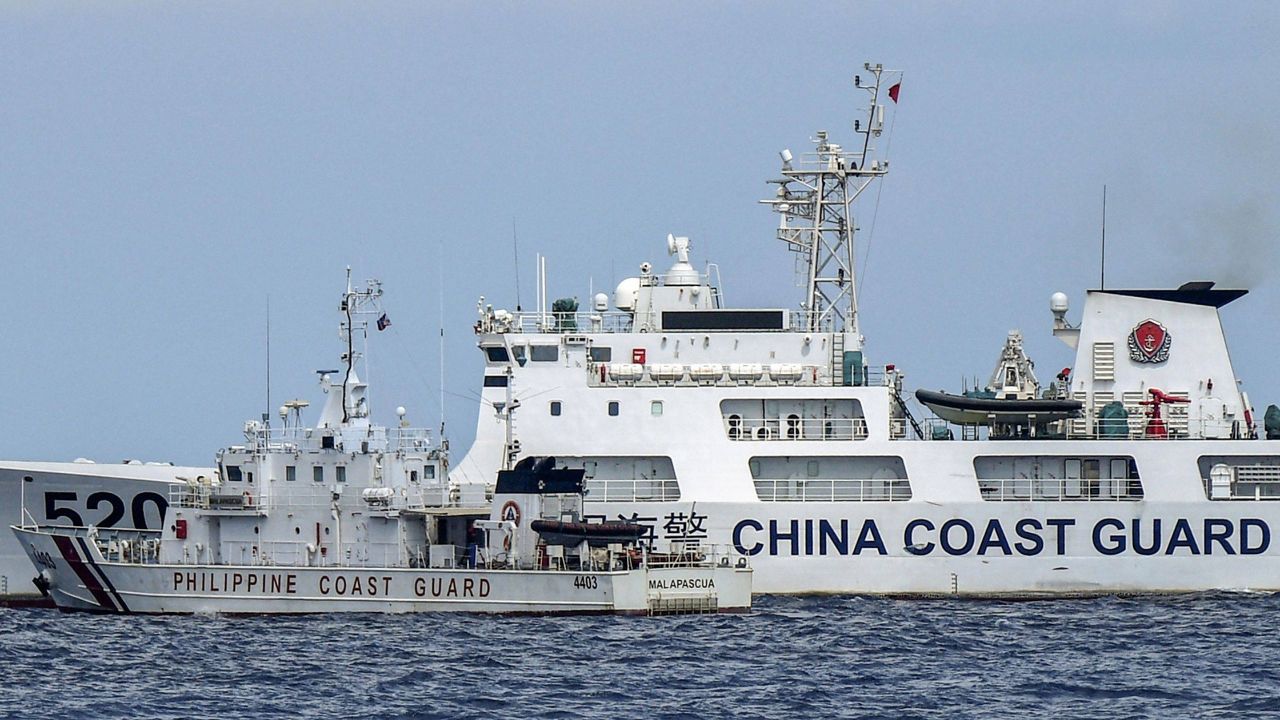
Chinese coast guard vessels and support ships have used water cannons, military-grade lasers and dangerous blocking manoeuvres against Philippine forces and fishermen from rival claimants, resulting in collisions and high-risk encounters at sea and in the air.
Washington has repeatedly urged Beijing to comply with the arbitration ruling.
Both the former Biden administration and the current Trump administration have said the United States is obligated to defend the Philippines, its oldest treaty ally in Asia, if Filipino forces, vessels or aircraft come under armed attack in the disputed waters.








