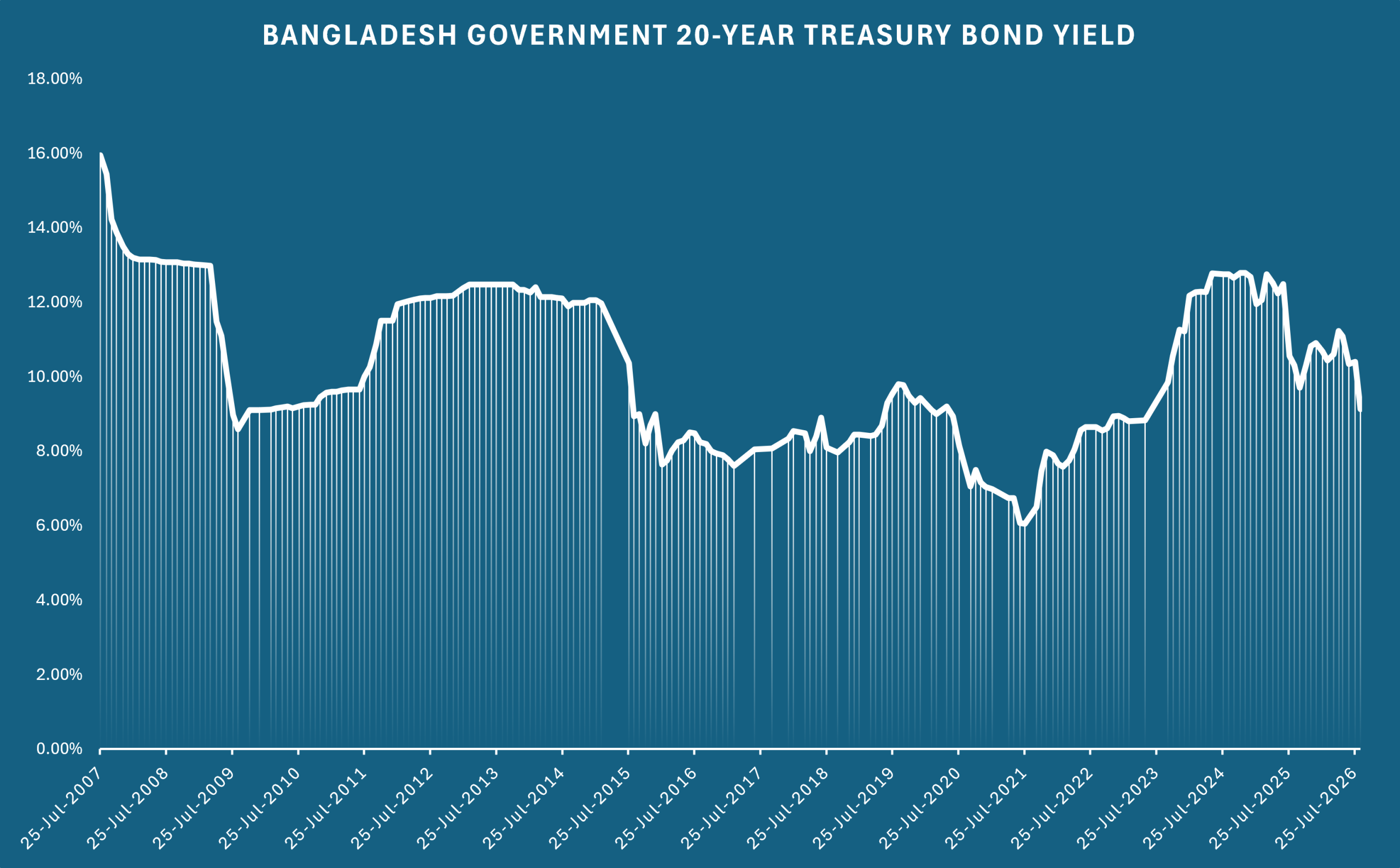



Bangladesh’s interest-rate cycle is turning lower as excess liquidity, easing inflation expectations and prospects of further monetary easing push treasury yields down, said S M Rashedul Hasan, managing director and CEO of UCB Asset Management.
The 91-day treasury-bill yield has fallen below 9 per cent from 10.42 per cent in early June, after exceeding 12 per cent last year. Hasan said the earlier 11-12 per cent yield environment was unsustainable and the market is now adjusting to a lower-rate cycle.
“The yield curve is shifting downward,” he said, adding that the adjustment could continue across short- and long-term government securities.
A yield curve is a graph showing the interest rates (yields) investors demand on government securities with different maturities. A declining yield curve means yields across different maturities are falling
The main driver is weak private-sector credit demand, which has left banks with excess liquidity to invest in government securities.
“The money market has a lot of liquidity, but there are limited investment opportunities. So the market is reacting naturally,” Hasan said.
He said the official inflation has become more manageable and investors are pricing in further monetary easing after Bangladesh Bank shifted from six-monthly to quarterly monetary policy reviews.

“If inflation continues on a declining trend, the market is expecting that another rate cut could come in a few months,” he said.
A 50-basis-point policy-rate cut last month had a broader impact on market rates as yields respond not only to the current policy rate but also to expectations, liquidity and the future direction of monetary policy.
The latest decline follows a sharp rise in yields during the period of high inflation and tight monetary conditions.
As rates climbed, investors preferred shorter-duration securities because of uncertainty over how high yields could go. Banks later locked significant funds into longer-duration government securities when yields became attractive.




“Strong banks allocated a significant amount of money to longer-duration treasury securities. Those rates also remained high until recently, but from there the correction has already started,” Hasan said.
Strong demand across maturities at recent treasury auctions indicates that investors are adjusting to the lower-rate environment.
“When rates are rising, investors avoid longer durations because of uncertainty. But when the cycle changes, the yield curve starts shifting downward,” he said.
Why stocks are stressed after a rally
The decline in treasury yields has coincided with a stock-market correction, but Hasan sees no contradiction between the two in the present context.
“The market has a natural connection with interest rates. When interest rates decline, it generally supports equities,” he said.
The DSEX had gained about 20 per cent in the first six months of the year, with much of the rise coming in May and June.
By then, several catalysts investors had been waiting for had already materialised, including changes at the market regulator, easing political uncertainty, a rate cut and more trading-friendly margin rules.
“Many of the positive developments that could have supported the market have already happened. After such a rise, some correction is natural,” Hasan said.
He attributed part of the decline to profit-taking, describing the move as a pause before the market’s next phase rather than a liquidity-driven sell-off.
Falling treasury yields could meanwhile improve banks’ earnings through valuation gains on their securities portfolios.
Banks that bought treasury bills and later increased their holdings of longer-duration securities at high yields could benefit as bond prices rise when yields fall.
But lower rates alone will not guarantee a sustained equity recovery.
“The market has liquidity. The issue is confidence and investment opportunities,” Hasan said.
The next phase will depend on inflation, monetary policy, business confidence and companies’ ability to deliver stronger earnings.