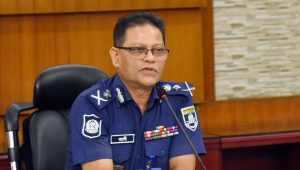
The government has been arresting key military figures associated with the political turmoil of January 2007, famously known as One-Eleven. The BNP government’s hardline stance against armed forces individuals linked to that period has sparked new debates in political circles.
A central question arises: after regaining power nearly 18 years later, will the BNP government now scrutinise the role of civil society leaders, including Muhammad Yunus, in the infamous “Minus Two” formula?
The political fallout from the military-backed caretaker government that took power in 2007 severely impacted the Zia family and its political arm, the BNP. In this turbulent period, a significant focus has remained on Muhammad Yunus, a figure at the centre of debates about the 1/11 event.
Former military and Directorate General of Forces Intelligence (DGFI) officials have confirmed to TIMES of Bangladesh that, on 11 January 2007, the military leadership invited Yunus to lead a caretaker government.
However, Yunus refused the short-term offer and instead proposed establishing a long-term government under his leadership. He suggested that Fakhruddin Ahmed be appointed as the head of the caretaker government, a move that the military leadership eventually accepted.

During this time, key military figures—army chief General Moeen U Ahmed, PSO Masud Uddin Chowdhury, DGFI chief Major General Syed Fatemi Ahmed Rumi, Brigadier General Chowdhury Fazlul Bari, and ATM Amin—along with Yunus and prominent civil society leaders, began plotting to remove both the Zia and Sheikh families from Bangladesh’s political scene. Their plan was to ensure that their newly formed “King’s Party” would stay in power for an extended period. This process came to be known as the “Minus Two” formula.
To implement the “Minus Two” formula, two DGFI units—Counter Intelligence Bureau (CIB) and Counter Terrorism and Intelligence Bureau (CTIB)—were responsible for carrying out the operation. Brigadier General Bari headed the CIB, and Brigadier General Amin led CTIB.




Under Brigadier Amin’s leadership, CTIB engaged in the abduction and torture of political leaders and businessmen, with numerous reports of human rights violations. Senior BNP leader Tarique Rahman and other political figures were among those reportedly subjected to this brutal treatment.
Multiple former officials, currently residing abroad, have told TIMES of Bangladesh that Yunus, with Western backing, moved towards forming a political party with the support of General Moeen. However, when he realised that Moeen harboured ambitions to become the head of the government, Yunus stepped back.
Moeen, in turn, facilitated the formation of another political party through Ferdous Ahmed Qureshi. The plan was for Moeen to join this party once the “Minus Two” plan was successfully implemented.
However, resistance from the grassroots level within both the Awami League and BNP led to the failure of the “Minus Two” project, forcing the military and civil society figures to negotiate a “safe exit” with the Awami League.
While Yunus lost the opportunity to assume power in 2007, the political landscape shifted again in 2024 after the July movement, which led to the collapse of the Awami League. Yunus found himself once more with the opportunity to lead the country.
However, his position remained consistent—initially reluctant to take the role of head of government for a short term. Sources confirm that he ultimately agreed to take on the role only on the condition of serving a longer tenure.
Following the flight of Sheikh Hasina, some claims emerged suggesting that Yunus was initially hesitant to assume the responsibility of an interim government. However, political and military sources have confirmed that by 8 August, even before taking the oath of office, Yunus was already certain that he would be the next head of government.
While in Paris, he had prepared a list of advisers. He also maintained frequent contact with military leadership in late July and early August, further cementing his political ambitions.
Muhammad Yunus is regarded with respect by many for his entrepreneurial accomplishments, but his political journey has been fraught with controversy. His repeated attempts to consolidate power have failed twice.
Despite receiving Western support, his political setbacks are attributed to several factors: a lack of long-term vision, an inclination to prioritise personal interests over national welfare, and an immature approach to setting political objectives. Analysts argue that these weaknesses have played a pivotal role in Yunus’s inability to sustain political power.