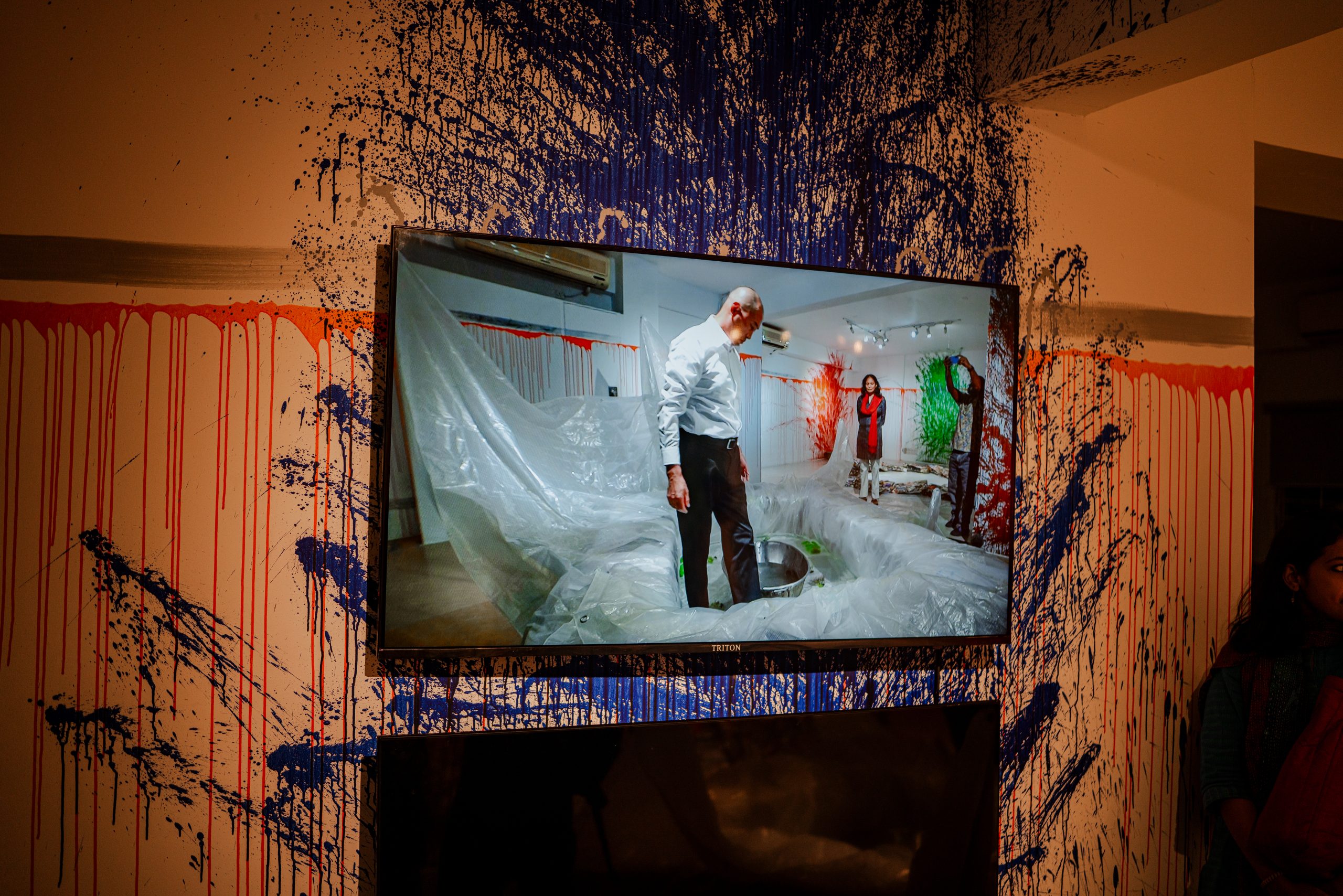



At Britto Arts Trust, where rooms often feel like thresholds rather than conventional spaces, Japanese artist Tadashi Watanabe unfolded ‘Empty No.28’ (titled ‘Ashonno Morichikar Majhe’ in Bangla), an intimate performance presented as part of Britto’s ‘Artist in Residency Programme – XXIX’.
Running from November 21 to December 5, the residency marks Watanabe’s first solo showcase in Bangladesh and the 28th instalment of his long-running ‘EMPTY’ series.

In Bangladesh, performance art occupies a fragile yet quietly persistent niche, sustained by a small number of practitioners and collectives such as Britto, who safeguard its experimental spirit. Audiences often approach the form cautiously, yet works like Watanabe’s demonstrate how performance can offer a rare, immediate intimacy unmatched by other media.
On November 23, visitors stepped into such an atmosphere: part ritual, part recollection, as Watanabe eased himself into a white shirt stained with black. On the wall hung a fresh, unstained shirt, waiting like an untouched possibility or a version of the self not yet altered.
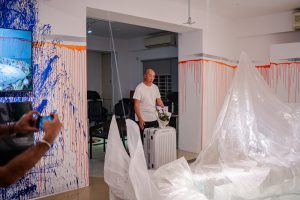

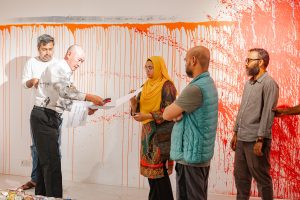
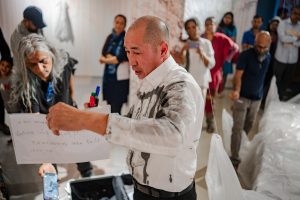
He handed viewers sheets of paper and marker pens, inviting them to write the name of someone who mattered to them. Water followed: drunk, poured and transferred; turning the small basin inside the bathtub into a vessel of shared significance.
The written pages were placed inside a suitcase, as though each name carried a weight that required movement or migration. Water shifted again, flowing from tub to container to paper, softening ink and intention into something vulnerable and half dissolved.
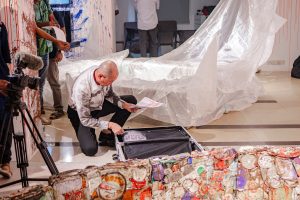
He then offered a second sheet of paper to each participant, this time asking for a single meaningful word. These too were submerged, and once more the water blurred the fragments into muted confessions.
A moment of gentle surprise followed: two live koi fish were lifted from the bathtub and placed on the drenched notes, while flower petals drifted down over them, a gesture suspended between blessing and surrender.
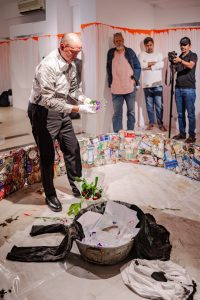
Watanabe moved across the room tracing magenta circles with discarded containers, marking the floor with loops that resembled both boundaries and portals. These rings linked tub to body, water to pigment, performer to the silent audience watching from around him.
He stepped through the painted circles, removing his shirt as if shedding a narrative layer, before donning the clean one. But the brief purity did not last: he wrung water from the name-soaked papers onto his head, baptising himself with the memories entrusted to him.
The clean shirt was then submerged, first in the tub, then in the coloured basin, absorbing everything it had momentarily escaped. When hung on the wall, magenta dripped from it like time working its way downward.
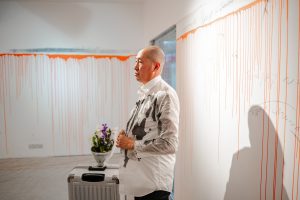
Below the shirt, the wall held the trails of water, Watanabe’s signature and the title of the piece, markings that felt less inscribed than left behind by the performance itself. A nearby monitor showed footage of earlier works, suffused with blood-like tones that deepened the context of EMPTY.
Speaking to The TIMES of Bangladesh, Watanabe described performing in Bangladesh as a rare freedom, an expansion of breath and perception, and expressed gratitude to Britto. He recalled that EMPTY began in Sharjah in 2003, when an unfilled bathtub unexpectedly reflected his own sense of being.
He later encountered Buddhist ideas of emptiness and realised the meaning was not fixed but unfolding. “The diversity of empty is what liberates expression,” he said, noting that the 28th iteration feels like a rediscovery in an unfamiliar land.
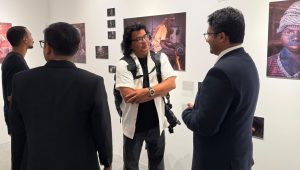
Artist Arif Bacchu, who attended the performance, remarked that he often struggles to connect with performance art, but Watanabe’s use of names, words and self-soaking resonated with the quiet emptiness people navigate in private.
Britto founder Mahbubur Rahman noted that the residency forms part of their long-running international programme. He added that Watanabe created every element of the performance on-site, embodying Britto’s commitment to allowing artists to build worlds within its walls.