The country goes to the polls today in its most consequential election, with up to 128 million citizens eligible to vote in what is widely regarded as the country’s first genuinely competitive national election since 2008.
For millions of voters, it marks their first real chance to participate in a meaningful democratic contest after nearly two decades of authoritarian rule under ousted prime minister Sheikh Hasina.
A total of 1,981 candidates are contesting 299 parliamentary seats, making this arguably the largest democratic exercise anywhere in the world in 2026.
Hasina presided over three deeply flawed elections—two boycotted by major opposition parties in 2014 and 2024, and a third in 2018 that was widely criticised as rigged.

Her removal in a student-led uprising about 18 months ago reset the political order and raised expectations that today’s vote could restore constitutional legitimacy and produce a government with a genuine popular mandate for the first time in a generation.
The election is a big step forward for democracy, but it probably won’t bring political stability. Instead, it could start a much more complicated and unstable time in Bangladesh’s long and troubled political history.
With Awami League currently suspended and absent from the contest, the election has reshaped the political landscape into a starkly bipolar race between the BNP-led 10-party alliance and the Bangladesh Jamaat-e-Islami–led 11-party alliance. This realignment has dramatically raised the stakes.



The vote is being held under the interim administration of Chief Adviser Muhammad Yunus amid economic stress, inflationary pressure, rising unemployment and an unprecedented security deployment. International observers see the election as Bangladesh’s best opportunity in nearly two decades to reclaim democratic legitimacy. But legitimacy alone will not guarantee governability.
BNP chairman Tarique Rahman and Jamaat Ameer Shafiqur Rahman concluded intense campaigns by outlining divergent visions for the country. On most political and arithmetic calculations, BNP is widely viewed as the front-runner. However, emboldened by the collapse of the Hasina regime, Jamaat has expanded its organisational reach and seeks to convert post-uprising momentum into parliamentary strength.
Both camps carry liabilities that could complicate post-election governance. BNP continues to face reputational damage from allegations of extortion and criminal activity involving sections of its grassroots. Jamaat, meanwhile, remains burdened by its historical opposition to Bangladesh’s independence in 1971 and its hardline positions on women’s rights and social freedoms—issues that continue to polarise voters.
If today’s election proceeds peacefully, with broad participation and results accepted by major stakeholders, Bangladesh will cross a crucial legitimacy threshold after nearly two decades of democratic erosion. But this moment should not be mistaken for an endpoint. It is a strategic inflection point.
The real test lies in what follows. Translating electoral legitimacy into political stability, credible governance, rule of law and economic recovery will be extraordinarily difficult. The fall of Hasina has already created space for hardline Islamist forces to assert themselves and containing their influence will test any incoming government. At the same time, Awami League leaders who are hiding or facing prosecution will not remain quiet for long. There will be a strong push for political revival.
A vengeful Awami League, an emboldened Jamaat, resurgence of hardline Islamists and a fragile state apparatus form a combustible mix.
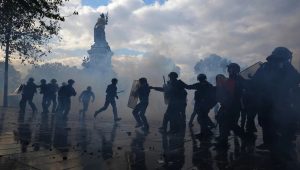
History doesn’t provide much comfort. Bangladesh’s post-election periods have often been marked by violence, street mobilisation and institutional paralysis. The country’s return to electoral politics in 1991 after military rule did not usher in stability but instead opened an era of relentless street confrontation, parliamentary boycotts and zero-sum politics that paralysed governance.
The 2001 election, though competitive, was followed by widespread political violence, minority persecution and a rapid erosion of institutional trust. Even the landslide victory of the Awami League in 2008—initially hailed as a democratic reset—ultimately paved the way for the steady concentration of power, weakening of checks and balances, and the eventual collapse of electoral credibility itself. In Bangladesh, credible elections have repeatedly failed to resolve political conflict; they have often merely rearranged it.
So, no matter how fair and peaceful today’s vote turns out to be, the real trouble may start when the votes are tabulated.