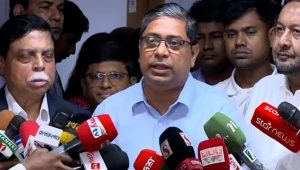
Voters expressed mixed views on a constitutional reform referendum held alongside the national parliamentary election on Thursday, with many supporting the idea of change but questioning the clarity of the proposals.
The referendum, the first to be conducted simultaneously with a general election in the country’s history, asked voters to approve a package of constitutional and political reforms. While some said the changes were necessary, others complained that key aspects of the proposals were not clearly explained.
The Election Commission said the referendum included measures related to setting term limits for the prime minister, establishing a neutral oversight mechanism during elections, strengthening parliamentary accountability and introducing changes to the local government structure.
However, several voters told reporters they were uncertain about the details.

Saiful Amin, who cast his vote at a polling centre in Dhaka-17 after a 17-year gap, said he supported reform in principle but did not fully understand all the points. “I felt change is needed, so I voted ‘yes’,” he said.
Parveen Alam, a private sector employee at the same centre, said she supported limiting the prime minister’s tenure but was unclear about other proposals. “Some parts were not very clear to me,” she said.



Election analysts say presenting multiple reforms as a single package may have contributed to voter hesitation. Some voters appeared to support specific measures but questioned the overall proposal.
At another polling station in Dhaka Cantonment, 77-year-old Abdul Halim, who arrived in a wheelchair, said his son had explained parts of the referendum to him beforehand. “Not everything was clear, but I want elections to be held under a neutral caretaker system every five years,” he said.
Others took a different view. University student Sadaf Abrar said he voted “no” because of what he described as insufficient detail. “Reform is necessary, but it is difficult to support unclear proposals,” he said.
In Chattogram-9, homemaker Saleha Naznin said she favoured increasing parliamentary accountability but was uncertain about approving all proposals together. Businessman Nurul Kabir also questioned the package approach, suggesting that reforms could have been debated separately.
Observers noted strong public interest in the referendum but pointed to limited public awareness about the details. Some voters said they learned more about the proposals only after arriving at polling stations.
At a polling centre in Banani, rickshaw driver Amin Mohammad said he voted in favour after hearing about the promise of change, though he admitted he did not fully understand all aspects. First-time voter Afia Khan said younger voters would have benefited from simpler explanations.
Overall, while many voters appeared to agree on the need for reform, there were clear differences over the structure, clarity and implementation of the proposals. Analysts say the mixed response may send an important signal to policymakers, regardless of the final outcome.