
Even as vast areas of southern Chattogram remain underwater after days of record rainfall, government agencies have begun estimating the cost of the destruction.
Preliminary estimates submitted to the Chattogram Divisional Commissioner’s Office show hundreds of kilometres of damaged roads and hundreds of millions of taka needed for emergency repairs. But the figures have raised questions among local officials and community leaders, who say much of the affected infrastructure remains submerged, making a comprehensive assessment impossible.
The discrepancy highlights a recurring challenge in the country’s disaster response: balancing the need for rapid funding decisions with the difficulty of accurately measuring damage before floodwaters recede.
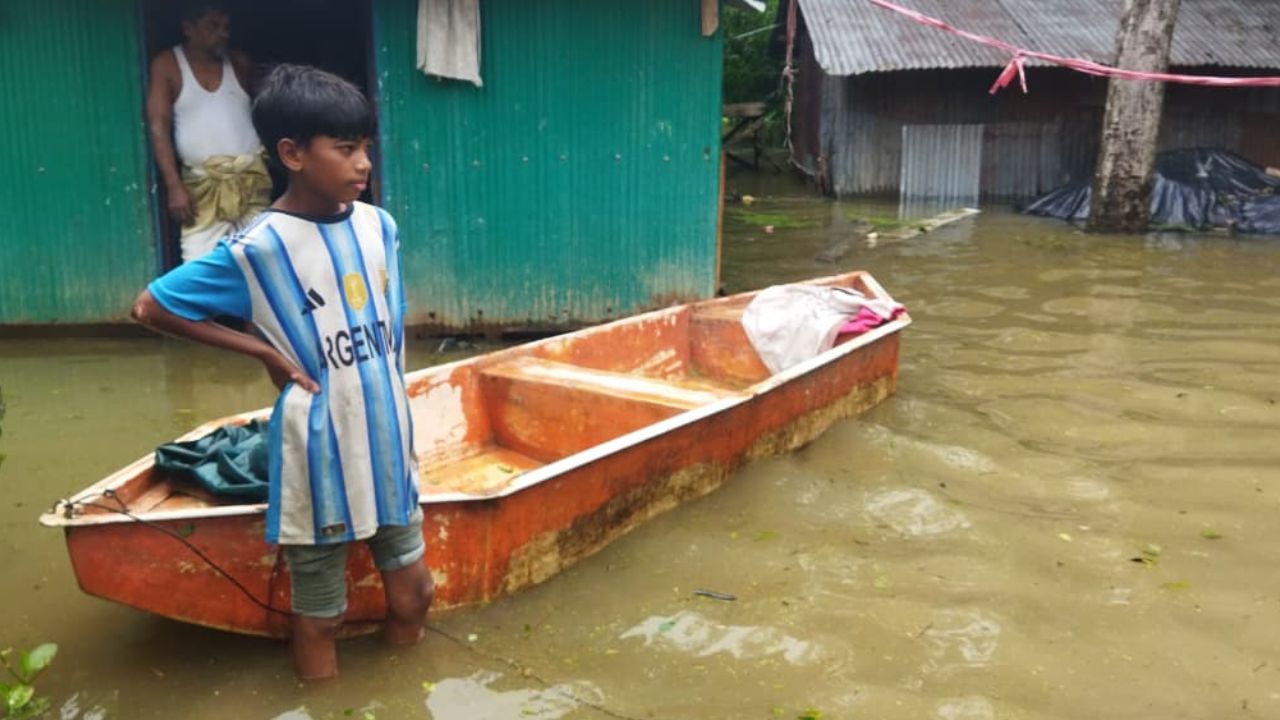
Since 4 July, relentless rainfall has inundated large parts of Chattogram district, leaving Satkania, Banshkhali, Lohagara and Chandanaish under water. Entire communities remain cut off, while sections of the Chattogram-Cox’s Bazar, Chattogram-Kaptai and Chattogram-Rangamati highways have been submerged, disrupting transportation across the region.
A damage assessment released Friday by the Chattogram Divisional Commissioner’s Office estimates that approximately 241 kilometres of roads across Chattogram, Cox’s Bazar, Rangamati and Khagrachori have been affected, including 32 kilometres of national highways, 33 kilometres of regional highways and 176 kilometres of district roads.

Yet another government agency has reported a significantly different picture.
The Local Government Engineering Department (LGED) of Chattogram district, which oversees much of the rural road network, says 247 kilometres of its roads in Chattogram district alone have been damaged. The department says the destruction covers 514 individual roads and will require an estimated Tk120-130 million (12-13 crore) for repairs.
The Divisional Commissioner’s Office estimates that repairing damaged road infrastructure across the region will require about Tk340 million (34 crore) in immediate funding, while long-term reconstruction could cost as much as Tk2.1 billion (210 crore).



Officials acknowledge that the figures remain provisional.
“We requested all relevant agencies to submit their initial assessments,” Chattogram Divisional Commissioner Zia Uddin said. “These are preliminary estimates based on the information currently available. Once the water recedes completely, they will be able to provide a more accurate account of the damage.”
LGED Executive Engineer of Chattogram District Mohammad Jamal Uddin said field officials collected information directly from affected areas despite the continuing floods.
Emergency repairs, he said, will initially be financed from the department’s existing annual allocation before additional funding is sought under future flood rehabilitation programmes. Separate allocations will also be requested to repair damaged bridges and culverts.
However, local representatives in several worst-hit communities say they were not consulted during the assessment process.
In Banshkhali’s Chhanua Union, where large areas remain inundated, Acting Union Parishad Chairman Nurul Amin Chanubi said the extent of destruction is only beginning to emerge as floodwaters recede.
“Many roads have been washed away to the point where people cannot even walk across them,” he said. “No one from LGED or any other government agency contacted us while preparing these estimates.”
Similar concerns were raised in neighbouring Khanakhanabad Union.
“How can anyone determine the extent of road damage while most of the roads are still underwater?” Acting Chairman Shahidul Islam Sikder said. “Only after the water has completely receded will we know which roads are damaged, how severe the damage is and how much money will actually be needed.”
The differing assessments underscore the uncertainty surrounding disaster-loss estimates during an unfolding emergency.
Early estimates are often essential for mobilising emergency funds and initiating repairs. However, flood damage frequently becomes apparent only after water levels decline, when erosion beneath road surfaces, weakened embankments and structural failures in bridges and culverts can be properly inspected.
For now, with significant portions of Chattogram still submerged and recovery operations continuing, official damage figures remain subject to revision, leaving questions over whether the true cost of the flood has been fully counted.