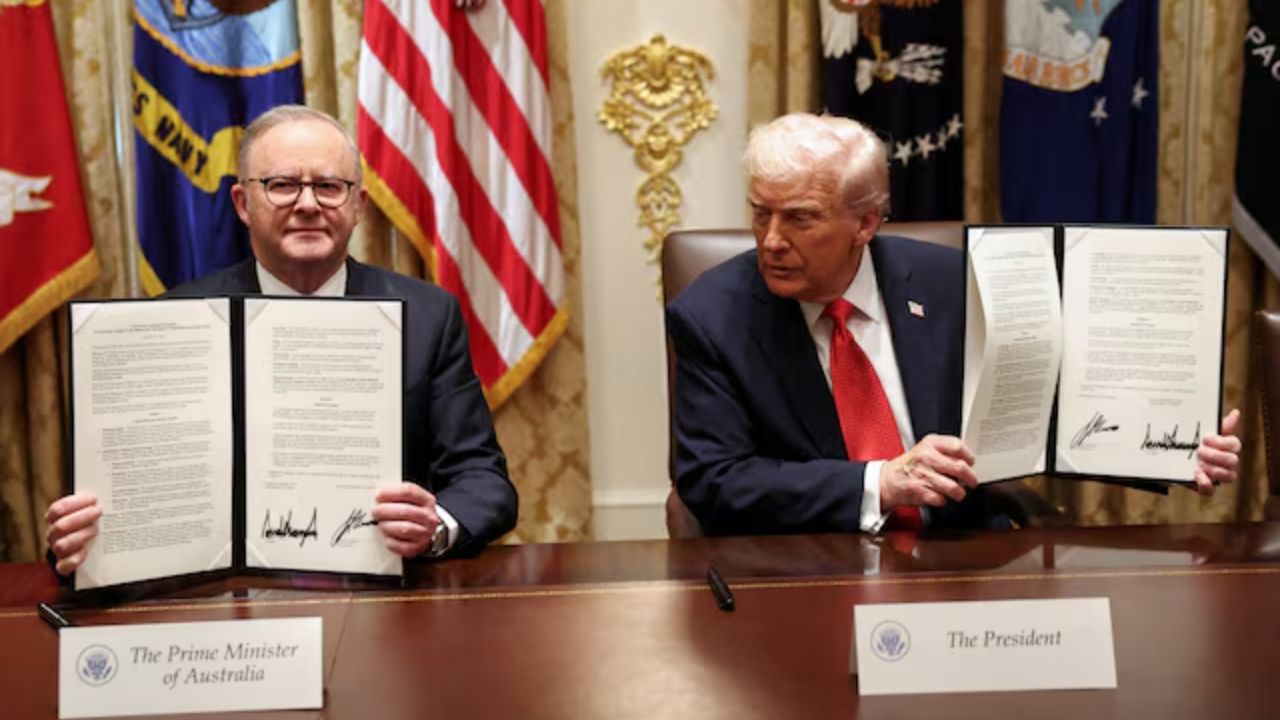

In a significant step to counter China’s tightening grip on global critical mineral supplies, the United States and Australia have signed a landmark agreement to boost cooperation on rare earth and critical minerals essential to modern industries.
The accord was signed Monday at the White House by US President Donald Trump and Australian Prime Minister Anthony Albanese. The deal aims to strengthen both nations’ capabilities in sourcing and processing rare earths, vital for technologies ranging from electric vehicles to defense systems, reports Reuters.
The agreement, months in the making, includes a commitment by both countries to invest $1 billion each over the next six months into joint mining and processing initiatives. A key feature of the deal is the establishment of a price floor for critical minerals, a long-standing demand from Western producers to stabilize the volatile market.
Prime Minister Albanese called the deal part of an $8.5 billion development pipeline, stating that Australia is prepared to move forward immediately with projects that reduce dependency on Beijing.
“China holds the largest reserves of rare earths, but Australia is ready to step up,” Albanese said during the signing ceremony.

According to the US Geological Survey, China dominates the global rare earths market, but Australia also possesses sizable reserves. In recent months, Beijing has expanded its export controls on rare earths, prompting Western countries to seek alternative sources and supply chains.
Broader strategic talks on submarines, defense




In addition to the minerals deal, Trump and Albanese discussed broader security cooperation, including progress on the AUKUS, a trilateral defense pact between the US, Australia, and the UK.
Talks included the $239.4 billion submarine programme initially brokered in 2023 under the then-US President Joe Biden, under which Australia will acquire US-made nuclear-powered submarines before transitioning to a joint-build model with the UK Delivery of the US submarines is scheduled for 2032.
US Navy Secretary John Phelan noted that ongoing revisions aim to streamline and clarify the framework of the AUKUS agreement, which has seen some ambiguity in implementation.
President Trump downplayed the concerns, stating, “These are minor adjustments. We’re now full steam ahead on construction.”
Australia’s Defence Minister Richard Marles also expressed confidence in the project’s timeline, saying the review is on track.
Australia ramps up strategic investment
Ahead of the meeting, Australian officials emphasised the country’s financial contributions under AUKUS, including a $2 billion investment this year to accelerate production at U.S. submarine shipyards. Canberra is also preparing to host US Virginia-class submarines at its Indian Ocean naval base starting in 2027.
In a bid to further align with allies, Australia has offered equity stakes in its planned strategic reserve of critical minerals to trusted partners such as the UK , a move that reflects growing Western urgency to diversify away from Chinese-controlled supply chains.
Last week, US officials warned that China’s expanded rare earth export restrictions pose a serious threat to global industrial and defense manufacturing. Rare earths are indispensable for components in electric vehicles, aircraft engines, renewable energy systems, and advanced weaponry.
Australia has been actively negotiating trade provisions with Washington since April, offering preferential access to its rare earth stockpiles as part of broader trade and defense cooperation.