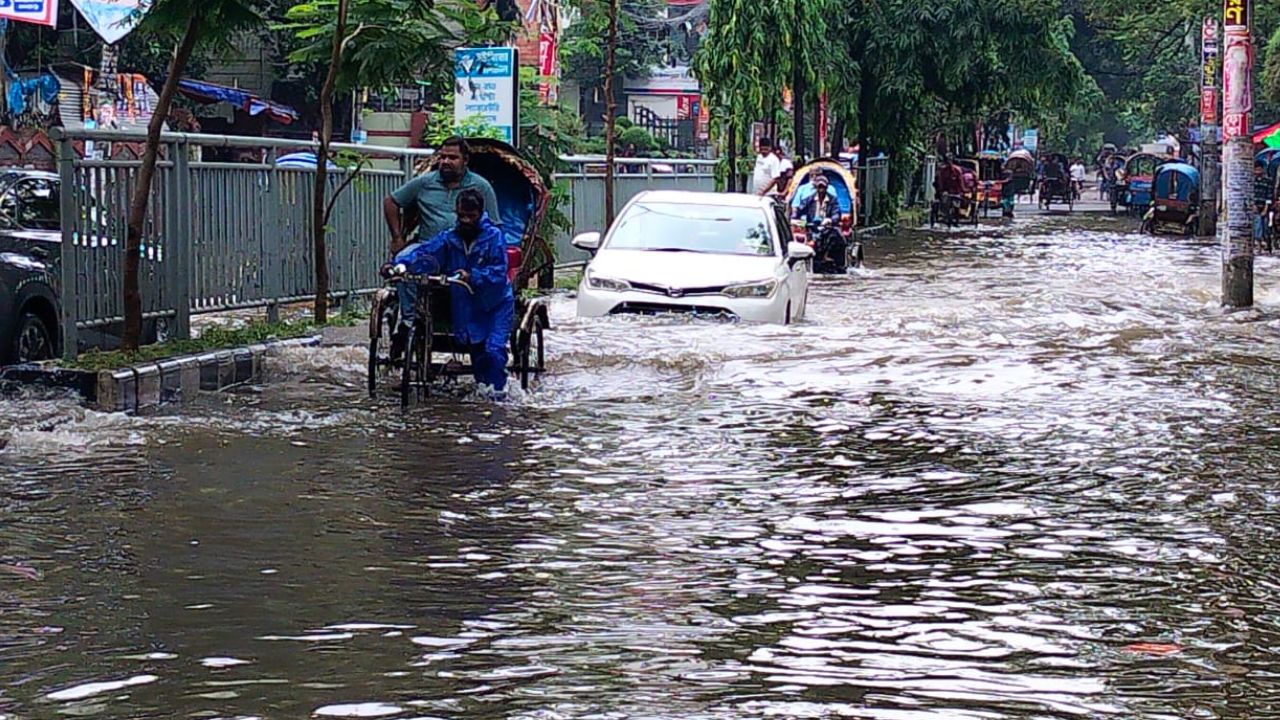

Heavy rainfall has brought life to a standstill in several districts, with cities and towns from Cumilla to Gaibandha submerged as weak drainage systems fail to cope with monsoon downpours.
The perennial problem, once affecting mainly large cities like Dhaka and Chattogram, now spread across urban areas in many parts of the country.
The crisis has exposed a recurring problem across urban areas: inadequate drainage networks, clogged canals and drains filled with waste, along with unplanned construction that blocks natural water flow.
Residents say authorities often promise long-term solutions, but waterlogging returns every year with little visible improvement.
Large parts of Cumilla city have gone underwater, while Faridpur, Rajbari, Pabna and Jhenaidah are also facing severe disruption. Low-lying areas of Khulna city have been submerged. In Gaibandha, frustrated residents blocked a regional road demanding action to restore water flow.
Cumilla submerged after heavy rain
Three hours of rainfall measuring 107 millimetres on Monday morning left the city’s main roads, lanes and residential areas submerged.
Water rose to knee level in some areas and reached waist level in others, entering homes and causing severe hardship for thousands of residents.
Low-income families, day labourers and working people were among the worst affected.
The worst-hit areas included Zila School Road, Police Lines, Racecourse, Chartha, Thakurpara, BSCIC Industrial Estate, Gobindapur, Muradpur and Chhayabitan.
In many places, overflowing drains spread dirty water mixed with waste across roads, worsening public suffering.

A video showing a father struggling to take his son to Zila School went viral on social media. Their vehicle broke down in the water, forcing them to push it through the flooded road.
“This is the third time this monsoon that water has entered my house,” said Amir Hossain, a resident of Thakurpara.
Cumilla weather office acting officer Syed Arifur Rahman said the district recorded 138.2 millimetres of rainfall in 24 hours, including 107 millimetres between early Monday and 9am.
Faridpur Hospital patients wade through dirty water
At Faridpur Medical College Hospital, heavy rain left several areas under knee-deep water, forcing patients and visitors to walk through polluted water to reach the emergency department.
Doctors warned that stagnant water inside the hospital compound could create health risks.
Physician Mizanur Rahman said the problem occurs whenever heavy rain hits because of weaknesses in the external drainage system.
“The situation can be resolved if the municipality improves the drainage system,” he said.



Rajbari market under knee-deep water
In Rajbari market, traders and customers were forced to move through knee-deep dirty water as clogged drains failed to clear rainwater.
Several traders kept their shops closed, while others reported sharp declines in sales.
“Municipal drains are not cleaned regularly. If they were maintained properly, water would not remain stagnant,” said grocery trader Sushanta.
Vegetable seller Md Emon said foul-smelling water had driven away customers, leaving fresh produce at risk of damage.
Rickshaw driver Abdur Rahman said standing water also created safety hazards.
“It becomes impossible to see broken roads or potholes. Rickshaws often fall into holes and accidents happen,” he said.
Rajbari Municipality executive officer Mohammad Rabiul Haque said some drains had problems and authorities would take steps to resolve them.
Pabna residents trapped indoors
Waterlogging in Pabna municipality has disrupted daily life, with rainwater entering homes, roads and alleys.
Residents in several areas have been forced to move furniture and essential belongings to higher places.
Nazma Khatun of Kalachandpara said water had remained under her bed for five days, stopping her family from cooking normally.
She said her children, who were sitting exams, were unable to study properly because of the conditions.
Residents also expressed concern over rising mosquito numbers and possible outbreaks of dengue and other waterborne diseases.
Municipal administrator Khairul Islam said authorities were assessing solutions, including repairing damaged drains and building new drainage facilities.
Pabna Water Development Board superintending engineer Sudhangshu Kumar Sarker said dredging work on the Ichamati River and connecting canals was underway and would help reduce waterlogging.
Jhenaidah struggles with recurring flooding
Around 40 percent of Jhenaidah municipality has been affected by waterlogging, with water entering homes, shops and classrooms.
Residents blamed poor drainage maintenance and weak management for the crisis.
Areas including Paglakhanai Saidatia Road, Upashahar Para, Chaklapara, Adarshapara, Beparipara and Kanchanpur Para were among the worst affected.
Locals said waste removed from drains was often dumped beside roads, only to return to drainage channels during rain and block water movement.
Municipal administrator Rathindranath Roy said old canals around the town had disappeared over time, worsening the problem.
He said initiatives were being taken to renovate drains, build new drainage systems and reconnect waterways with canals and the Nabaganga River.
Three monitoring committees in Khulna
Three monitoring committees have been formed after low-lying areas of Khulna city were submerged. The city corporation is working to remove obstructions from drains and canals to restore the water drainage system.
Bidhan Chandra, owner of Bidhan Store at the city’s main wholesale market, Barabazar, said, “Business has already been slow for quite some time. The rain has made the situation even worse.”
Small traders selling goods from roadside vans and makeshift stalls are facing severe hardship. Rickshaw pullers said they were earning less due to fewer passengers, while motorised rickshaws were frequently breaking down in the rain.
Gaibandha residents protest blocked waterways
Residents in Gaibandha blocked a regional road protesting waterlogging caused by the occupation of government canals and construction that disrupted water flow.
The demonstration was held at the three-mile area of the Gaibandha–Palashbari regional road on Monday morning.
Protesters said villages including Komorpur, Madhupur and Islampur under Ballamjhar Union had been submerged.
The blockade was withdrawn after local representatives and the administration assured residents that steps would be taken to drain the water.