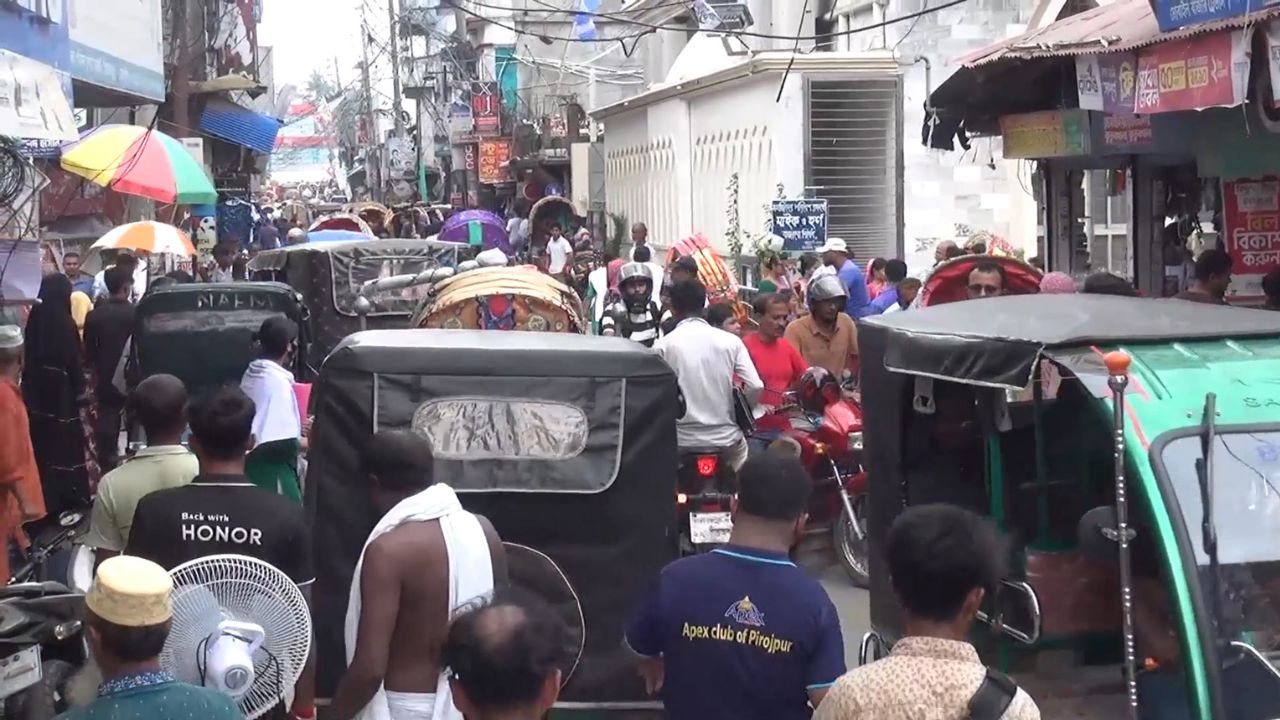



Unskilled drivers, narrow roads and indiscriminate parking of rickshaws and auto-rickshaws are causing growing hardship for students, pedestrians and traders across Pirojpur town.
Vehicles are often parked for hours in front of shops, blocking customer access and causing financial losses to businesses, while persistent traffic congestion and frequent accidents have made daily travel increasingly difficult.
Residents said the problem had worsened rapidly following the sharp increase in the number of battery-powered rickshaws and auto-rickshaws operating on roads that were never designed to handle such heavy traffic.
Litton Sheikh, a resident of the town’s Khamkata area, has been driving a rickshaw for about 20 years.
He said he once earned a reasonable living by operating a pedal rickshaw on relatively quiet roads, but the arrival of large numbers of battery-powered vehicles had transformed the town.
“The roads now look more like makeshift stands, with rickshaws and auto-rickshaws lining up everywhere while drivers wait for passengers,” he said.

Much of Pirojpur town developed without proper planning, leaving many roads too narrow to cope with the growing number of vehicles.
Widening the roads has also become difficult because shops, homes and other structures have already been built close to them.
The situation is further aggravated by roadside stalls and vehicles parked outside business establishments for long periods, severely restricting the movement of pedestrians and students.



Drivers, however, said they had little choice but to pick up and drop off passengers on the roads because the town had no designated stands for rickshaws or auto-rickshaws.
Mitu, a class eight student at Pirojpur Government Girls’ High School, said students faced difficulties every day while travelling to and from school.
“Vehicles are parked along the roads in such a way that we can hardly walk. Roadside shops also occupy the footpaths, forcing us onto the road,” she said.
She said students often collided with other pedestrians in the crowded streets and faced further inconvenience because of the disorderly movement of vehicles.
“The problem could be reduced if traffic rules were properly enforced and the footpaths were cleared of illegal occupation,” she added.
Hasib, owner of Hasib Art on Kalibari Road, said pedestrians had almost no space to walk in the area.
“Auto-rickshaws remain parked in front of shops for hours, preventing customers from entering. Whenever we ask the drivers to move, arguments break out,” he said.
He said disputes between drivers and traders sometimes escalated into physical confrontations.
“The absence of designated rickshaw and auto-rickshaw stands is making the problem worse every day,” he added.
Pirojpur Municipality Administrator Mahamudur Rahman Mamun said hundreds of auto-rickshaws entered the small town every day from neighbouring districts and upazilas, adding to congestion and the risk of accidents.
“As no proper auto-rickshaw stand was developed in the past, drivers park their vehicles wherever they find space. This creates serious problems for pedestrians and traders,” he said.
He said the municipal authorities were working to find a solution to the problem.
According to local estimates, more than 5,000 rickshaws and auto-rickshaws operate in the district, providing employment to over 6,000 drivers.