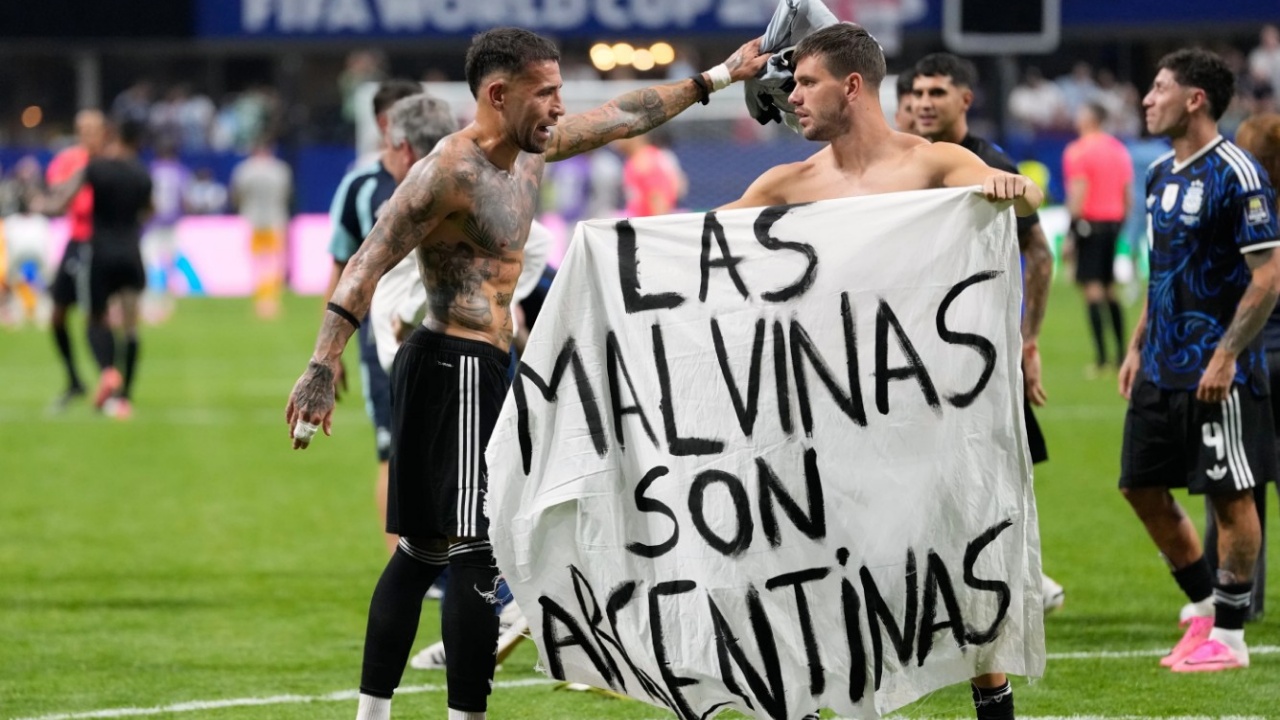

The British government on Thursday urged FIFA to investigate Argentina’s national team after players celebrated their 2-1 World Cup semifinal victory over England with a banner asserting Argentina’s claim over the disputed Falkland Islands.
During post-match celebrations on Wednesday in Atlanta, Argentina’s players posed with a banner handed to them by supporters that read, “Las Malvinas son Argentinas” (“The Malvinas are Argentine”).
Argentina refers to the Falkland Islands as Islas Malvinas. The South Atlantic territory was invaded by Argentina in 1982 under orders from the country’s military dictatorship, triggering a 10-week war that Britain won.
“The World Cup might not be ours, but the Falkland Islands definitely are,” a spokesperson for British Prime Minister Keir Starmer said on Thursday, “Self-determination rests with the islanders and our commitment to the Falklands will never waver.”

The spokesperson said Starmer backed calls for FIFA to investigate the incident after U.K. Business Secretary Peter Kyle described the players’ actions as “entirely inappropriate.”
Argentine President Javier Milei defended the players, describing the celebration as “perfectly valid” and saying the banner “reflects a sentiment shared by all Argentines.”




However, Milei acknowledged the team could face disciplinary action from FIFA.
“What the players do is understandable; they get carried away by their emotions, they act on impulse, and that will likely lead to discussions about a fine,” Milei told a Buenos Aires radio station.
Manchester United defender Lisandro Martínez, who has played in England for the past four years, also defended the display.
“We couldn’t let the Argentine people down,” Martínez said on Wednesday when asked whether the banner could have stirred painful memories for veterans of the 1982 conflict.
Under FIFA’s disciplinary code, players and member associations can face sanctions for displaying messages at stadiums that are deemed inappropriate for a sporting event, including those of a “political, ideological, religious or offensive nature.”
Potential penalties for political messaging range from approximately $5,000 to $20,000