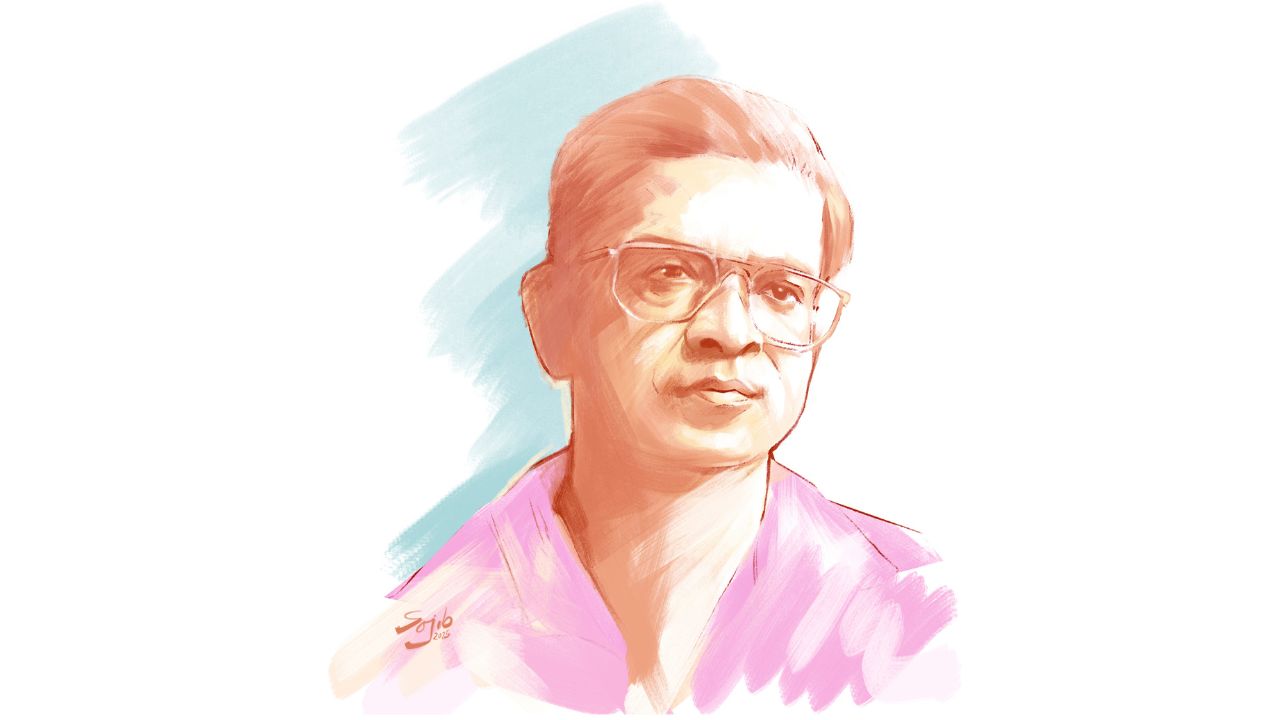



Humayun Ahmed had a rare gift for making audiences feel the joys and sorrows of fictional characters as their own. Whenever he wrote an emotional passage, he often became emotional himself, sometimes sitting alone and crying over his characters’ suffering. He created each one with affection and care. That emotional connection extended from his novels and stories to the television dramas and films he directed.
Alongside his novels, Humayun wrote and directed hundreds of television dramas and eight films. His works won widespread popularity and numerous awards, establishing him as one of Bangladesh’s most influential storytellers.
His journey into television began in the 1980s. His first single-episode drama as a writer, Prothom Prohor, aired in 1983. Serial dramas such as Ei Shob Din Ratri, Bohubrihi, Ayomoy, Kothao Keu Nei and Aaj Robibar soon became hugely popular. He later stepped into direction, with Nokkhotrer Raat marking an important milestone.
Much like his prose, his television stories and characters felt familiar to ordinary people. Through simple, natural dialogue, he explored everyday joys, disappointments and struggles. He also drew remarkably effortless performances from actors, allowing audiences to immerse themselves in his stories.
Beyond Nokkhotrer Raat, dramas such as Ure Jay Bok Pokkhi, Shedin Choitro Mash, Nitu Tomake Bhalobashi, Shomudro Bilash Private Limited, Hablanger Bazar-e, Tara Tin Jon and Montri Mohodoy-er Agomon Shubhechha Shagotom made audiences laugh and cry. In Ure Jay Bok Pokkhi, viewers initially saw Ustad Jalal Khan as a bad man but eventually developed a deep affection for him.

His dramas featured celebrated actors including Asaduzzaman Noor, Abul Hayat, Aly Zaker, Sara Zaker, Zahid Hasan, Bipasha Hayat and Dolly Zahur. He also helped establish performers such as Meher Afroz Shaon, Dr Ejajul, Faruque Ahmed, Monira Mithu and Challenger.
Much of Humayun’s life revolved around Dhaka, and his experiences of growing up in an urban middle-class family shaped his storytelling. After his father, a police officer, was killed during the 1971 Liberation War, he witnessed his mother’s struggle to raise him and his siblings. The tensions of city life, middle-class struggles, laughter, sorrow and wider social realities repeatedly found their way into his writing and dramas.
In an interview with Times, actor Abul Hayat recalled Humayun’s distinctive storytelling style.




“His dialogues easily found their way into the hearts of audiences, while his storytelling style captivated both viewers and actors,” he said.
Humayun’s storytelling magic extended to the big screen, where he enjoyed extraordinary popularity. I remember one particular experience. After his death, his final directed film, Ghetuputra Komola, was released on 7 September 2012.
I joined the queue at Balaka Cinema Hall at 7.30am for the 10am show. The counter opened at 8am, but all tickets were sold out by 8.10am. Balaka could accommodate around 1,200 viewers in one screening, yet more than 1,000 people were still waiting behind me without tickets.
The incident offered a glimpse of his popularity beyond books and television. As a writer, he had faced criticism and the label of a ‘commercial writer’. His filmmaking also attracted criticism, but he rarely allowed such remarks to distract him.
His eight films were Aguner Poroshmoni, Srabon Megher Din, Dui Duari, Chondrokotha, Shyamol Chhaya, Noy Number Bipod Sanket, Amar Ache Jol and Ghetuputra Komola. Among them, Aguner Poroshmoni won eight National Film Award categories.
Humayun made Aguner Poroshmoni in 1994 with a government grant of Tk25 lakh. The money was not enough to complete the film, forcing him to use his personal savings and borrow from his friend Asaduzzaman Noor.
The film portrayed the human cost of the Liberation War through guerrilla freedom fighter Badiul Alam. Its final sequence remains particularly powerful. As dawn breaks, an injured Badiul waits to be taken to hospital.

A new sun rises outside as he gradually slips towards death. Through this contrast, Humayun captured the immense sacrifice behind Bangladesh’s independence and the bloodshed of countless people like Badiul.
He returned to the Liberation War in Shyamol Chhaya, depicting people struggling to find safe shelter after the war began. The film also portrayed people from different social backgrounds, including members of the maulana community, some of whom opposed the war while others took part in the struggle for independence.
With Srabon Megher Din, Dui Duari and Chondrokotha, Humayun gave audiences memorable stories and songs that have endured across generations. His contribution to music was another defining part of his screen career. Just as he introduced Kuddus Boyati through television, he helped bring the songs of celebrated folk musicians Ustad Rashid Khan and Ukil Munshi to wider audiences.
Srabon Megher Din also brought singer Bari Siddiqui into the spotlight. Set in a quiet village, the film explored love in its light and darkness, the tragic realities of the zamindari system and the remorse of a man who had opposed the Liberation War.
Humayun directed only eight films, but his work left a lasting mark on Bangladeshi cinema. His films demonstrated the same storytelling power that had made his novels and television dramas so beloved.