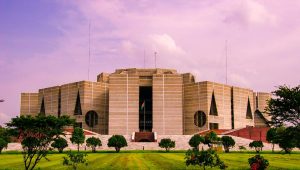



A few days ago, I noticed a discussion in Parliament about journalism. Members of Parliament raised several questions. The State Minister for Information responded to them. Senior parliamentarian Zainul Abedin Farroque questioned the qualifications of journalists. He mentioned that press cards are now being issued even at the union level. Also discussed was that some journalists have not even completed secondary education. These discussions made me think about writing something on journalism.
After some deep thought, I decided to focus on the issue of neutrality in journalism. Among our political leaders, there is a common tendency. If a journalist praises them or writes in their favour, no one will question that journalist’s qualifications. I have raised this issue several times before, but the opinions of people like me rarely attract much attention. Can journalism remain neutral if a journalist follows a political ideology? Can a journalist openly support a particular political party? What qualities should a journalist have to practice neutral journalism? Many more questions could be asked, but I will focus on these few and develop my discussion from there.
Ideally, a journalist should not have a political affiliation in their professional role. In personal life, a journalist may believe in any ideology, but when reporting news, the primary responsibility should be to verify facts and present them fairly. One of the core principles of journalism is that news and opinion are separate. When personal views or political positions enter news reporting, the credibility of information becomes weaker. In reality, however, things are often different. Many journalists become sympathetic to a political party or ideology. Others may develop bias because of their association with certain institutions. Some even work directly as political activists or propagandists. This clearly conflicts with the ethical foundations of journalism. At that point, news ceases to be information and becomes propaganda.

Neutral journalism means verifying facts, presenting different perspectives, and avoiding emotional or politically charged language. A good journalist should show multiple sides of a story so that readers or viewers can form their own conclusions. For international news organisations, accuracy matters more than speed. Their journalistic philosophy can be summarised in a simple way: “It is better to publish correct information late than to publish incorrect information quickly.” In Bangladesh, some newspapers may disagree with their editors or editorial policies. But they continue to walk the right path of journalism.
In a politically divided society, questions about journalistic neutrality arise frequently. The role of different media outlets under different governments is often debated. Some are accused of being too close to the government, while others are criticised for being excessively anti-government. However, there is a practical reality: media ownership, dependence on advertising revenue, and political pressure often influence editorial decisions.



Reshuffling of journalists in newspapers and television stations after changes in government is not a new phenomenon. But when such changes are made based on political loyalty rather than professional merit, the dignity of journalism is undermined. Journalism then becomes a tool of influence rather than a respected profession. The foundation of journalism is public interest, not self-interest. Yet accusations are often made that some individuals use their journalistic identity to gain political, economic, or social advantages. Such behaviour damages the reputation of the entire profession and reduces public trust.
Research around the world shows that trust in journalism is declining in many countries. Reasons include political polarisation, the spread of misinformation through social media, and, in some cases, biased reporting. At the same time, it is also true that many journalists continue to take risks to gather and publish accurate information from the field. Their work remains extremely important for society.
Although complete neutrality may be difficult to achieve, it should remain the goal. Every journalist grows up within a particular social and political environment, so total detachment is unrealistic. However, journalists must strive to maintain balance, verify facts, and present multiple viewpoints. This continuous effort is what makes journalism credible and trustworthy.
The views expressed in this article are solely those of the author
The writer is a Senior Journalist; Former President, Moulvibazar Press Club. E-mail: [email protected]